
How Much Does Heat Pump Replacement Cost?
Direct answer
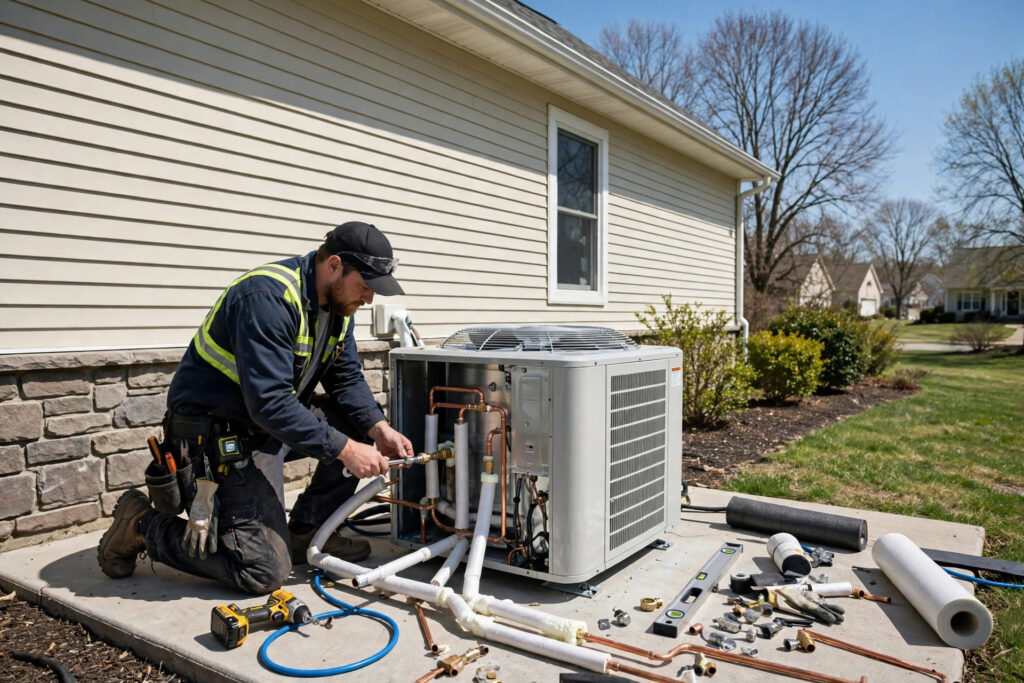
Heat pump replacement cost depends mainly on what you are replacing — the outdoor unit alone, the outdoor unit plus the indoor coil, or a full system — and on the size your home needs and the efficiency level you choose. For a typical 3-ton system in a 2,000 to 2,500 square foot home, replacing the heat pump and indoor coil typically costs about $7,800 at the Standard level, with a Budget-to-Premium range of about $5,200 to $12,400.
A heat pump heats and cools your home by moving heat instead of creating it: in summer it pulls heat out of your home, and in winter it pulls heat from the outside air and moves it indoors. Because one system does both jobs, it runs year-round, and after a decade or more of that workload the equipment eventually wears out. When it does, replacement usually means swapping the equipment while reusing the ductwork, wiring, and pad — which is why replacing an existing heat pump is often a simpler project than installing a heat pump in a home for the first time.
Use the Heat Pump Replacement Cost Calculator early in your planning. It prices the equipment, line set, electrical connection, labor, removal, and permit separately, so you can see how each choice changes the estimate before you invite installers to quote.
What “heat pump replacement” means
A heat pump replacement is the complete job of taking out the old equipment and fitting a working new system in its place: the outdoor unit comes off its pad, the indoor coil or air handler is swapped if it is part of the job, the refrigerant lines are replaced or flushed, the electrical connections are checked, and the new system is charged, tested in both heating and cooling modes, and commissioned. The old unit is removed and disposed of, and its refrigerant is recovered by a certified technician.
Replacement is not the same as a first-time installation. A first-time installation in a home heated by baseboard heaters, a boiler, or window units can mean adding ductwork, running new refrigerant lines through finished walls, and upgrading the electrical panel — work that a replacement usually avoids, because the infrastructure is already there. If you are comparing the two, our guide to heat pump installation cost covers a new-system installation in detail, including system types and cold-climate performance.
What usually carries over from the old system is the ductwork, the concrete pad (if it is sound and the right size), and often the electrical connection. What almost always changes is the equipment itself — and, in most replacements, the indoor coil too. The outdoor unit and the indoor coil are designed to work as a matched pair, and pairing a new outdoor unit with an old coil can cost you efficiency and shorten the life of the new equipment. That matched-pair question is one of the first things to settle, because it is also one of the biggest drivers of heat pump replacement cost.
Replacement types
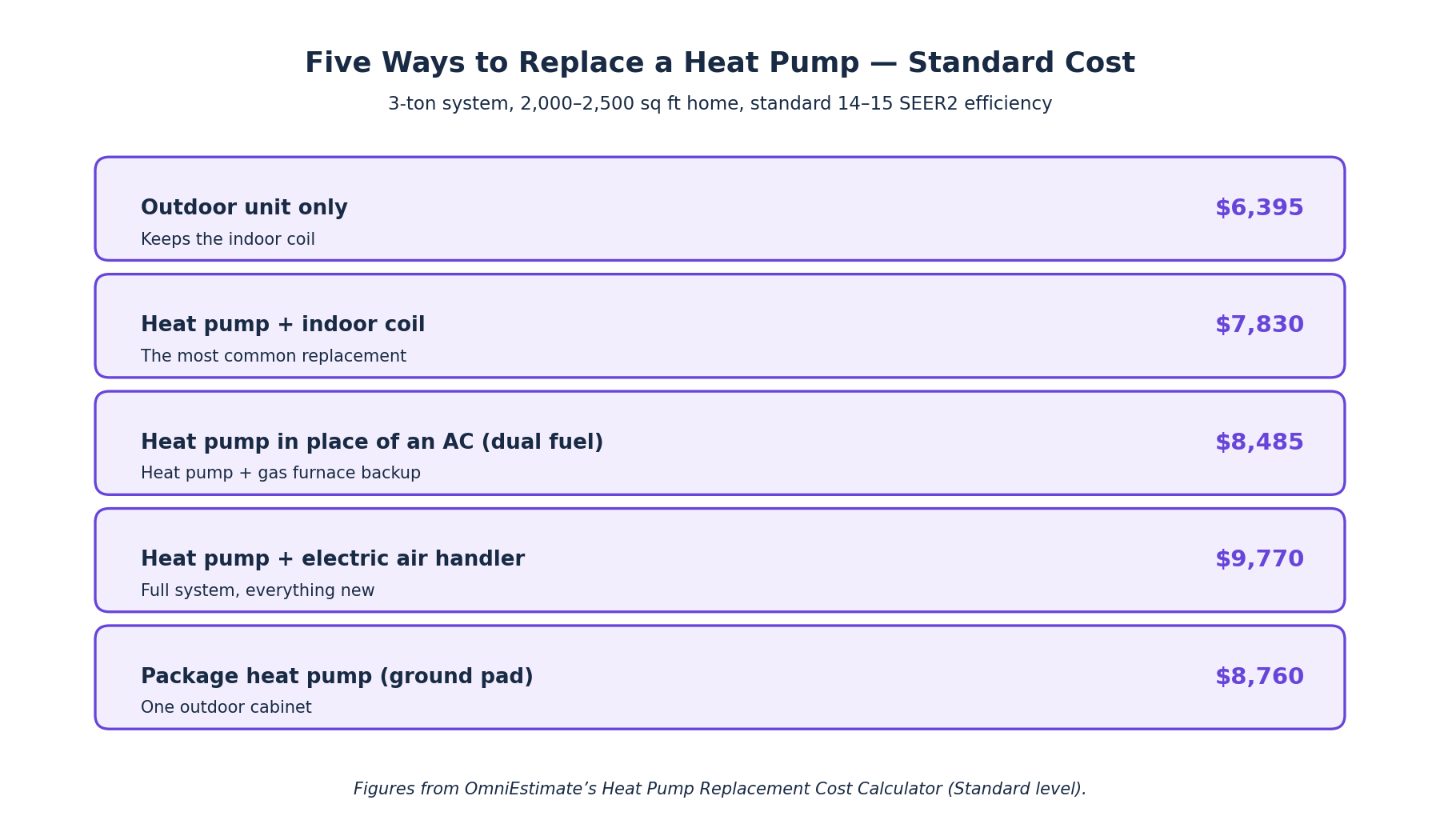
The calculator prices five replacement types, and the spread in heat pump replacement cost between them is wide. The figures below are for a 3-ton system in a 2,000 to 2,500 square foot home at standard 14 to 15 SEER2 efficiency, with a new line set, an existing electrical connection that is still fine, a basement or utility-room indoor unit, easy outdoor access, removal of the old system, a permit allowance, and an average labor market.
| Replacement type | Budget | Standard | Premium |
|---|---|---|---|
| Outdoor heat pump only | $4,235 | $6,395 | $10,325 |
| Heat pump + new indoor coil | $5,195 | $7,830 | $12,390 |
| Heat pump in place of an AC (dual fuel) | $5,610 | $8,485 | $13,435 |
| Heat pump + electric air handler | $6,490 | $9,770 | $15,470 |
| Package heat pump (ground pad) | $5,770 | $8,760 | $13,875 |
Outdoor heat pump only is the lowest-cost option: you keep the indoor coil and replace just the outdoor unit. It only makes sense when the coil is in good condition, the right size, and compatible with the new unit — and your installer should confirm all three before you choose it.
Heat pump + new indoor coil is the most common replacement, because the two parts are designed to work as a matched pair. It is the baseline the rest of this article uses, and the figure most homeowners should plan around when they budget for heat pump replacement cost.
Heat pump in place of an AC (dual fuel) means replacing an air conditioner with a heat pump while keeping a gas furnace. The heat pump handles mild weather and the furnace takes over in deep cold, and the job includes the controls that switch between them. The controls add to heat pump replacement cost, but they are what make the two systems work as one. It suits homes that already have a working furnace and want heating flexibility without giving up gas backup.
Heat pump + electric air handler is a full system replacement: new outdoor unit, new indoor air handler, and electric backup heat. It costs more because there is more equipment and more labor, but everything is new and matched.
Package heat pump replaces everything in one outdoor cabinet — heating and cooling in a single unit that sits on a ground pad. It suits homes built for packaged equipment, and it avoids indoor equipment work entirely, though a roof-mounted package unit needs a crane.
ENERGY STAR’s clean heating and cooling guide explains the main types of heat pump systems — ducted air-source, ductless mini-split, and geothermal — and what to look for when choosing between them. It is a useful second opinion before you settle on a replacement type, since that choice shapes heat pump replacement cost more than any other decision.
Repair or replace?
The hardest question in a heat pump replacement is often whether to replace at all. A repair is the better choice when the unit is relatively new and the problem is small — a failed capacitor, a faulty sensor, a refrigerant leak that can be found and fixed. Replacement starts to make sense when the heat pump is more than about 10 to 15 years old, when it uses the older R-22 refrigerant, when the compressor has failed, or when repairs keep adding up.
Age is the simplest guide. A typical air-source heat pump lasts 10 to 15 years, with well-maintained systems sometimes reaching 20. After about a decade, major repairs become more likely, and the efficiency gap between your old unit and a new one grows. A system that has needed two or three significant repairs in recent years is usually telling you something: the money going into repairs is buying shorter and shorter stretches of reliable service — and at some point that money is better counted toward heat pump replacement cost.
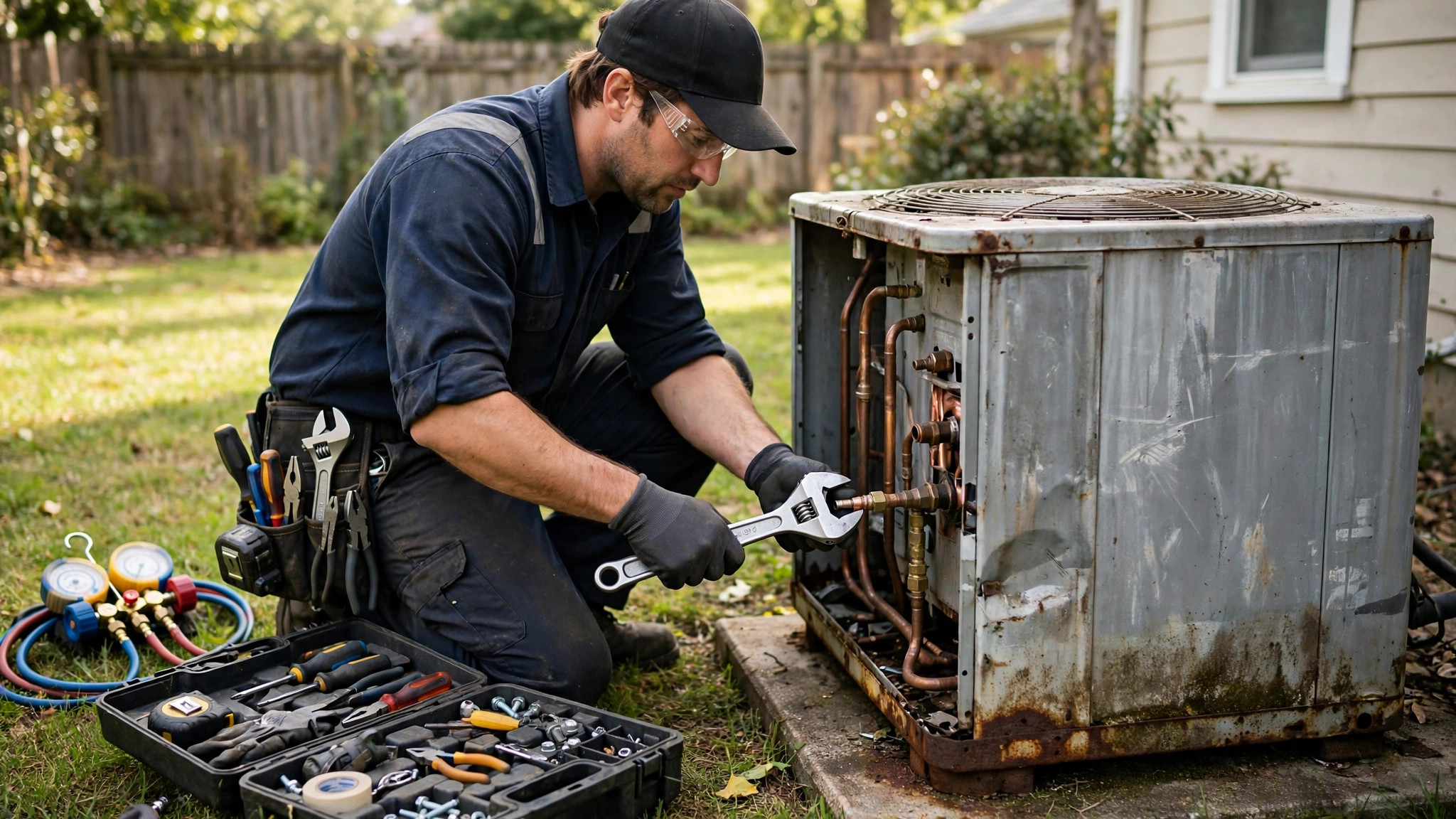
Refrigerant is the second factor. Older heat pumps run on R-22, a refrigerant that is no longer manufactured, so recharging an R-22 system has become expensive and will only get harder. New heat pumps use newer refrigerants, and a replacement is often the practical answer once an R-22 system starts leaking.
The compressor is the third. It is the heart of the system and the most expensive single component to replace. When a compressor fails on an older unit, the repair bill can approach a large share of a replacement — and the rest of the system is still old. In that situation, most homeowners are better off putting the money toward new equipment with a fresh warranty.
Efficiency is the quiet fourth factor. A new heat pump meeting today’s federal minimums — 14.3 SEER2 and 7.5 HSPF2 — is typically far more efficient than a unit installed 15 years ago, so while heat pump replacement cost is a bigger one-time spend than a repair, it can lower your running costs as well as ending the repair bills. If you are weighing a heat pump replacement against replacing an air conditioner instead, our guide to AC replacement cost covers the cooling-only side of the decision, including system size and efficiency.
What Affects Heat Pump Replacement Cost
No two replacements have the same heat pump replacement cost, because the price is built from several moving parts. These are the ones that matter most.
What you are replacing
The replacement type is the starting point, as the table above shows. Swapping only the outdoor unit keeps the indoor coil and costs the least; a full system with a new electric air handler costs the most. The heat pump and coil combination is the most common job and the one the rest of this section uses as its baseline, at about $7,830 at the Standard level, and every factor below moves heat pump replacement cost up or down from that baseline.
Home size and system size
Heat pump size is measured by heating and cooling capacity, usually in tons for cooling and British thermal units per hour (BTU/h) for heating. One ton of cooling equals 12,000 BTU/h. The calculator maps home size to about 1.5 to 5 tons, and the Standard estimate for a heat pump and coil runs from about $5,670 for a home up to 1,000 square feet, to about $6,390 for a home of 1,000 to 1,500 square feet, about $9,265 for a home of 2,500 to 3,500 square feet, and about $10,705 for a home over 3,500 square feet.
The new unit should be sized from a load calculation, not just copied from the old one. Your home may have changed since the original unit was fitted — new insulation, replacement windows, an addition — and the old unit may have been the wrong size in the first place. A system that is too small may struggle on the coldest days; one that is far too large can short-cycle, leaving rooms humid in summer and wearing components. An installer who sizes from square footage alone, or who simply matches the old unit’s tonnage without checking, is cutting a corner — and a wrongly sized unit is one of the few mistakes that raises heat pump replacement cost twice, once at installation and again in running costs.
Efficiency ratings: SEER2 and HSPF2
Heat pumps carry two efficiency ratings. SEER2 (Seasonal Energy Efficiency Ratio 2) measures cooling efficiency over a season; HSPF2 (Heating Seasonal Performance Factor 2) measures heating efficiency. Higher numbers mean more heating or cooling for each unit of electricity used.
Federal minimum standards that took effect in 2023 require new split-system heat pumps to meet at least 14.3 SEER2 and 7.5 HSPF2 nationwide. Above that floor, efficiency is a choice with a price: a high-efficiency, two-stage unit raises the Standard heat pump and coil estimate from about $7,830 to about $9,340, and a premium variable-speed inverter unit raises it to about $11,605. Variable-speed units run longer at lower speeds, which improves comfort and efficiency, and the premium buys better components. Whether the higher efficiency pays back depends on your climate, how much you heat and cool, and local electricity prices — it is worth asking your installer to walk through the trade-off between heat pump replacement cost now and running costs later, rather than assuming the most efficient unit is always the right buy.
Refrigerant line set
The line set is the copper piping that connects the indoor and outdoor units. A new line set is the default for a replacement, and it is recommended for most jobs. Reusing and flushing the existing lines lowers heat pump replacement cost at the Standard level to about $7,365, but only when the lines are the right size and clean. Newer refrigerants may require new or flushed lines, so this is not a corner to cut on the installer’s say-so alone — ask why they are recommending reuse or replacement in your case.
Electrical connection
The default assumption is that the existing disconnect and whip are fine. A new disconnect and whip raises heat pump replacement cost at the Standard level to about $8,045, and a new circuit and breaker raises it to about $8,675. A new circuit is needed when the new unit is larger than the old one or when the old wiring is damaged. Your installer should check the panel and the existing connection early and include any electrical work in the quote, rather than discovering it on installation day.
Install location and access
An indoor coil or air handler in a basement or utility room is the easy case. A closet or crawl space takes more time, and an attic is the hardest: an attic install raises heat pump replacement cost at the Standard level from about $7,830 to about $8,180. Outdoor access matters too — a tight location, such as a narrow gate or stairs, raises the Standard estimate to about $8,005. A package unit on the roof needs a crane, which raises the Standard package estimate from about $8,760 to about $9,885.
Outdoor pad and stand
The old pad may be cracked, sunken, or the wrong size for the new unit. Choosing a new composite pad raises heat pump replacement cost at the Standard level to about $8,100. In snow country, a raised stand or wall bracket keeps the unit above drifts and raises it to about $8,225. It is a small part of heat pump replacement cost, but a level, stable base matters for drainage and for the life of the unit.
Thermostat and optional upgrades
A smart thermostat raises heat pump replacement cost at the Standard level to about $8,205. Other upgrades — a hard-start kit, a surge protector, a condensate pump, a media filter cabinet, a UV light or air purifier, and a line-set cover — each add parts and labor, and they appear in the estimate only when they apply to the replacement type you chose. None of them is essential, but a surge protector and a line-set cover are worth considering on any replacement, and a smart thermostat is a sensible upgrade if your old thermostat is as old as the system it controlled.
Removal and disposal
The old system must be removed, and its refrigerant has to be recovered by a certified technician — refrigerant handling is not work a homeowner can legally do. The calculator includes removal, refrigerant recovery, and disposal by default. If you remove it from the estimate, heat pump replacement cost at the Standard level for a heat pump and coil falls from about $7,830 to about $7,345. In practice, almost every replacement includes removal, so treat the figure with removal as your planning number and check that your quote includes it.
Permits
Many cities require a permit and an inspection for a heat pump replacement. The calculator includes a permit allowance of about $200 at the Standard level by default; if you remove it, heat pump replacement cost at the Standard level falls to about $7,630. The allowance is a planning placeholder, not the municipal fee — actual fees vary by city and county. If a quote does not mention permits, ask whether they are included.
Urgency
Heat pumps often fail at the worst time — the first cold snap or the first heat wave. Urgent and after-hours work carries a premium: the calculator adds 15% to labor for work within about 48 hours and 40% for emergencies. An emergency replacement raises heat pump replacement cost at the Standard level from about $7,830 to about $8,400. If your system is showing signs of trouble, getting quotes before it fails outright is one of the cheapest things you can do.
Labor market
HVAC labor rates and permit practices vary across the country. A low-cost market lowers heat pump replacement cost at the Standard level to about $7,610, and the highest-cost market raises it to about $8,560. Equipment and materials are not adjusted — only labor, removal, and crane rental change with the market. That is why a neighbor’s replacement cost in another state is a poor guide to your own.
What happens on replacement day
A straightforward replacement follows a clear sequence, and knowing it helps you judge whether the heat pump replacement cost you were quoted covers a complete job. The crew arrives, protects floors and work areas, and disconnects the old system. The refrigerant is recovered, the old outdoor unit and indoor coil or air handler are removed, and the pad and connections are inspected. Then the new outdoor unit is set on the pad or stand, the indoor coil or air handler is fitted, and the line set is run or flushed and reconnected. The electrical connections are made, the thermostat is wired, and the condensate drain is checked.
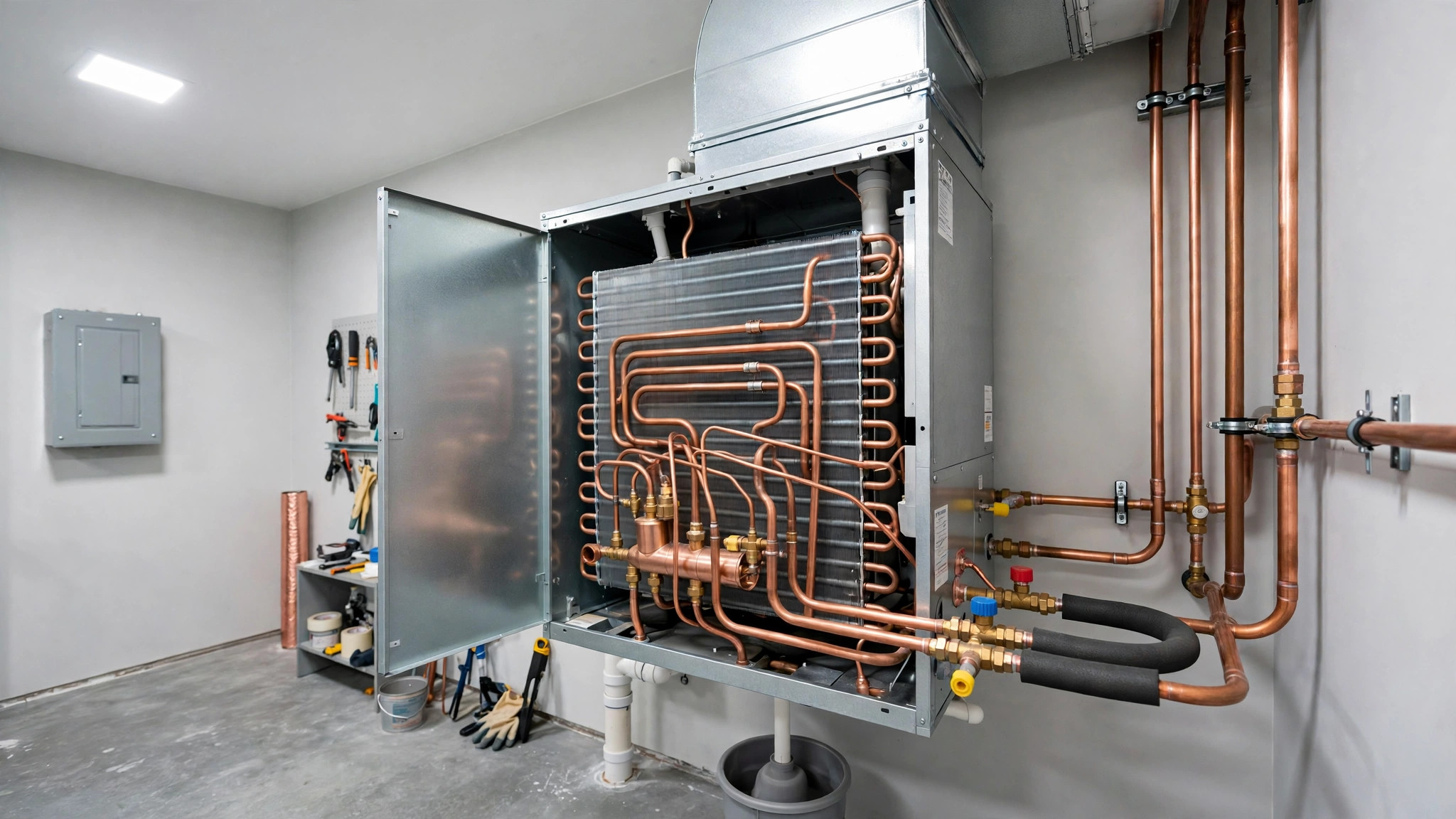
Once everything is connected, the crew evacuates the refrigerant circuit to remove air and moisture, charges it with the correct amount of refrigerant, and starts the system. It is tested in both heating and cooling modes, airflow is checked, and the installer walks through the controls with you. The old equipment is taken away for disposal, and the work area is tidied. A thorough installer will also check that the system is registered for its warranty before leaving.
Sizing: don’t just copy the old unit
The most common sizing mistake in a replacement is assuming the old unit was the right size. It may not have been — the original installer may have guessed, the home may have been changed since, or the old unit may have been sized for a different era of insulation and windows. A proper load calculation — commonly called a Manual J calculation — accounts for your home’s size, insulation, windows, ceiling height, air leakage, and the coldest and hottest temperatures your area is designed for.
Sizing matters more for a heat pump than for many other systems because one unit does both jobs, and the size your home needs is one of the main drivers of heat pump replacement cost. A system sized only for cooling may be too small to heat the home in winter, while one sized for the coldest day may be oversized for summer. Ask how the size was calculated and whether the heating load or the cooling load drove the choice — and be wary of any installer who skips the calculation entirely.
Cold-climate performance
If your old heat pump struggled in cold weather, the replacement is a chance to fix that rather than repeat it. Modern cold-climate air-source heat pumps keep heating at much lower outdoor temperatures than the models of a generation ago, using larger coils, variable-speed compressors, and other design changes. Even so, in very cold weather the heat pump alone may not cover the home’s full heating load, and auxiliary or backup heat — usually electric resistance heat built into the indoor unit — covers the coldest hours.
That is also where a dual-fuel replacement earns its place: a heat pump paired with a gas furnace for the coldest days gives you the efficiency of a heat pump for most of the winter and the certainty of gas backup when temperatures plunge. Ask your installer how the new system handles the coldest days in your area and how often backup heat is expected to run, since that shapes both comfort and running costs — and it is worth settling before you agree the heat pump replacement cost, not after.
Permits, incentives, and making good
Most heat pump replacements need a permit, and the work is usually inspected afterward. Requirements and fees vary by city and county, and some areas require separate permits for the electrical work. Your installer normally handles the application, but the fee is part of heat pump replacement cost. If a quote does not mention permits, ask whether they are included.
Incentive programs change, and what is available depends on where you live and when the system is installed. The federal energy efficient home improvement credit (Section 25C) ended for heat pumps placed in service after December 31, 2025, so do not assume a federal credit applies to a replacement installed now. State programs, utility rebates, and manufacturer promotions may still be available, and some are tied to specific efficiency ratings. Check what is currently offered in your area before you budget for heat pump replacement cost, and confirm the eligibility rules yourself rather than relying on a sales claim.
Making good is the work of putting your home back together after the replacement: patching holes left by removed equipment or old line sets, repairing drywall, repainting, and tidying the area around the outdoor unit. Line-set covers that hide the piping on the outside wall are part of the finished look and should be included. Ask what making good is in the quote, so you are not left arranging a separate repair job.
How to compare replacement quotes
Because heat pump replacement cost varies so much with scope, the only way to compare quotes fairly is to make sure each one covers the same work. A lower quote that excludes the line set, the electrical upgrade, the removal, or the permits is not cheaper — it is incomplete.
Before you invite installers, gather the basics: your home’s size, the age and type of your current heat pump, whether it uses R-22 refrigerant, your ductwork and its condition, your electrical panel’s size and spare capacity, and any rooms that are hard to heat or cool. Then check that each quote names the equipment (brand, model, SEER2 and HSPF2 ratings), the system size and how it was calculated, whether the coil is included and matched, the line set (new or flushed, and why), the electrical work, the controls, removal and refrigerant recovery, permits, the pad, and making good.
Ask each installer the same questions: Will you replace the coil along with the outdoor unit, and is the system a matched pair? Will you perform a load calculation to confirm the size? Which brand and model numbers are in the quote, and what are the SEER2 and HSPF2 ratings? Is the line set new, or flushed and reused, and why? Does the quote include removal, refrigerant recovery, the permit, and the pad? Which rebates does this model qualify for, and who files the paperwork? What warranty covers the equipment, and what covers the installation work? A thorough installer who explains the sizing and the scope is usually a safer choice than a lower quote with no explanation.
For more on choosing the installer themselves, see our guide to how to hire an HVAC contractor.
Use the Heat Pump Replacement Cost Calculator to build an estimate for your own home before you compare quotes. It gives you a realistic starting point for heat pump replacement cost, so you can spot a quote that is missing major scope — or one that includes work your home does not need.
FAQs
How much does heat pump replacement cost?
Heat pump replacement cost depends on what you are replacing, the size your home needs, and the efficiency level you choose. Replacing a 3-ton heat pump and indoor coil in a 2,000 to 2,500 square foot home typically costs about $7,800 at the Standard level, with a Budget-to-Premium range of about $5,200 to $12,400. Replacing only the outdoor unit costs less, and a full system with a new air handler costs more. Use the Heat Pump Replacement Cost Calculator for a tailored estimate, and compare detailed quotes from qualified local installers.
Should I replace just the outdoor unit or the whole system?
It depends on the condition of your indoor equipment. Replacing only the outdoor unit costs less — about $6,395 at the Standard level — but it only makes sense when the indoor coil is in good condition, the right size, and compatible with the new unit. Replacing the heat pump and indoor coil together raises heat pump replacement cost to about $7,830 at the Standard level, but gives you a matched pair designed to work together, which protects efficiency and the life of the new equipment. Your installer should confirm whether your existing coil matches before you choose.
How long does a heat pump last?
A typical air-source heat pump lasts 10 to 15 years, with well-maintained systems sometimes reaching 20 years. Because a heat pump heats and cools, it runs year-round and accumulates more operating hours than a furnace or air conditioner alone. After about a decade, major repairs become more likely, and replacement starts to make more sense than repair — especially if the unit uses the older R-22 refrigerant or the compressor has failed.
Is it worth replacing a heat pump or repairing it?
Repair is usually the better choice when the unit is relatively new and the problem is small, such as a failed capacitor or a faulty sensor. Replacement makes more sense when the heat pump is more than about 10 to 15 years old, uses R-22 refrigerant, has a failed compressor, or needs repairs that keep adding up. A new unit is also usually more efficient than one installed 15 years ago, so while heat pump replacement cost is a bigger one-time spend than a repair, it can lower your running costs as well as ending the repair bills.
Do I need a new line set when replacing a heat pump?
A new line set is the default and is recommended for most replacements. Reusing and flushing the existing lines is possible when they are the right size and clean, and it lowers heat pump replacement cost at the Standard level to about $7,365. Newer refrigerants may require new or flushed lines, so ask your installer why they are recommending reuse or replacement in your case rather than deciding on price alone.
Will a new heat pump work with my existing ductwork?
Usually, yes — if the ductwork is in good condition. A careful installer inspects the ducts before quoting, and the quote may include sealing, insulating, resizing, or replacing sections. Leaky or undersized ducts waste conditioned air and can leave rooms uncomfortable no matter how good the new heat pump is, so ductwork condition is worth checking as part of any replacement.
Do I need a permit to replace a heat pump?
In most areas, yes. A heat pump replacement usually needs a permit and an inspection, and some areas require separate permits for the electrical work. Your installer normally handles the application, and the calculator includes a permit allowance of about $200 at the Standard level. Ask whether permits are included in your quote.
Conclusion
Heat pump replacement cost is shaped by what you replace, the size your home needs, and the efficiency level you choose. Replacing the outdoor unit and indoor coil together is the most common job, at about $7,800 at the Standard level for a typical 3-ton system, while an outdoor-only swap costs less and a full system with a new air handler costs more. The details that move the price — the line set, the electrical connection, the install location, removal, permits, and timing — are all things a good installer will work through with you before quoting.
Start with the Heat Pump Replacement Cost Calculator to build an estimate for your own home, then compare detailed quotes from qualified local installers, checking that each one covers the same scope. A heat pump is a long-term investment in how your home heats and cools — the time spent getting the sizing, the system type, and the scope right is time well spent.
