
How Much Does It Cost to Fix a Sewer Backup?
Direct answer
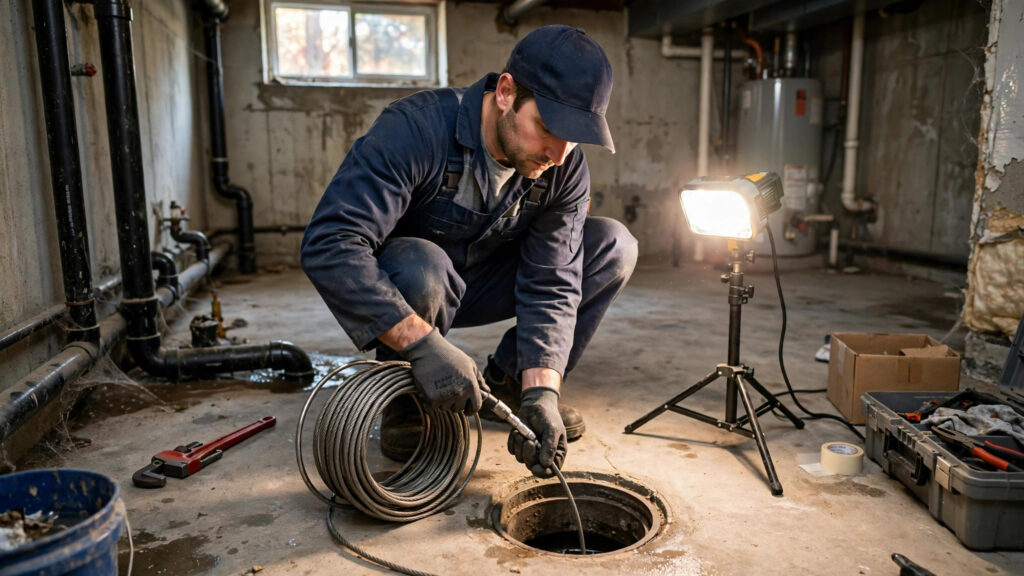
The cost to fix sewer backup depends on what is blocking the line and how far the fix has to go. A main sewer line cleared by snaking typically budgets at about $430 to $525, including a service call. If the line needs hydro-jetting with a camera inspection, the figure is closer to $975 to $1,150. And if the pipe itself is broken or collapsed, the cost to fix sewer backup rises into the thousands, because the fix becomes a repair or a full replacement rather than a clearing.
A sewer backup happens when wastewater cannot flow out of your home to the municipal sewer or septic system, so it comes back up through the lowest drains — usually a basement floor drain, a shower, or a toilet. It is one of the few plumbing problems that is also a health problem: raw sewage carries bacteria, viruses, and parasites, so the cleanup matters as much as the repair, and both shape the cost to fix sewer backup.
The first step is always the same: stop using water in the house, then find out what is blocking the line. A plumber usually starts with a camera inspection, because the cause decides the fix — and the fix decides the cost to fix sewer backup. Use the Drain Cleaning Cost Calculator to see what clearing a main line budgets at for your situation before you call.
What “fixing a sewer backup” means
Fixing a sewer backup means two jobs, not one. The first is restoring the flow: removing whatever is blocking the sewer line so wastewater can drain out of your home again. The second is dealing with what the sewage touched: extracting the wastewater, removing contaminated materials, disinfecting surfaces, and drying the area. The plumbing fix and the cleanup are separate scopes, often done by different trades, and both belong in your budget.
A sewer backup is not the same as a clogged sink or a slow toilet. A single slow fixture usually means a blockage in that fixture’s own drain, close to the fixture. A backup means the problem is in the main sewer line — the large pipe that carries all of your home’s wastewater out — so several fixtures are affected at once, and the lowest drain in the house is where the sewage appears first. That is why the cost to fix sewer backup is driven by the main line, not by any one fixture.
It is also not the same as a leaking pipe. A leak is clean or gray water escaping from a supply or drain pipe; a backup is sewage coming back into the house. The health risk, the cleanup, and the repair are all different, which is why a backup usually needs a plumber the same day — and why the cost to fix sewer backup includes a cleanup scope that a leak does not. If you are dealing with a supply-side leak instead, our guide to leaking pipe repair cost covers that side of the problem.
What causes a sewer backup
The cause decides the fix, so it is worth knowing what a plumber is looking for. Most backups come from one of these causes, and a camera inspection is how the cause is confirmed — and the cause is the first thing that sets the cost to fix sewer backup.
Tree roots
Tree roots are the most common cause of a sewer backup in an older home. Roots find their way into the sewer line through small cracks or loose joints, then grow inside the pipe and catch everything that flows past. The blockage builds slowly — drains get slower over months — until one day the line stops flowing altogether. Root intrusion is a recurring problem: cutting the roots clears the line and keeps the cost to fix sewer backup at the clearing level for now, but they grow back unless the damaged section is repaired or replaced.
Grease, wipes, and flushed debris
Grease poured down a kitchen drain cools and hardens inside the pipe, narrowing it over time. So-called flushable wipes do not break down the way toilet paper does, and they snag on rough spots and joints. Paper towels, hygiene products, and cotton products do the same. These blockages usually sit in the main line rather than in a single fixture drain, which is why several fixtures back up together — and why the cost to fix sewer backup for a grease blockage is usually a clearing price, not a repair price.
A collapsed, cracked, or bellied pipe
Older sewer lines — especially clay, cast iron, and Orangeburg pipe — can crack, collapse, or sag over time. A sagging section, called a belly, holds standing water and collects solids until it blocks. A collapsed section cannot be cleared at all: no amount of snaking restores a pipe that has caved in, so the fix is a repair or a replacement, and the cost to fix sewer backup jumps accordingly.
Heavy rain and municipal overload
In a heavy storm, the municipal sewer system can be overwhelmed, and sewage can be pushed back into homes through the lowest drains. This is not a problem in your own line at all — your pipe may be perfectly clear — which is why a backup that happens only during storms points to the city main rather than your plumbing. A backwater valve, fitted on your sewer line, is designed to stop this kind of backup, but it is prevention for next time, not a fix for the one happening now — and the cost to fix sewer backup in that case is mostly cleanup, not plumbing.
| Cause | How it shows up | Usual fix | Recurrence |
|---|---|---|---|
| Tree roots | Drains slow over months, then stop; worst after dry spells | Snake or hydro-jet, then repair the damaged section | Yes, unless the section is repaired |
| Grease and wipes | Several fixtures slow or backing up together | Snake or hydro-jet the main line | Yes, unless habits change |
| Collapsed or bellied pipe | Repeated backups in the same spot; camera shows damage | Spot repair or full replacement | No, once the section is replaced |
| Municipal overload | Backup only during heavy rain; neighbors affected too | Backwater valve for prevention; cleanup now | Depends on the city system |
What Affects the Cost to Fix Sewer Backup
No two backups have the same cost to fix sewer backup, because the price is built from several moving parts. These are the ones that matter most.
Where the blockage is and what it is
A blockage near an accessible cleanout is a quick job: the plumber opens the cleanout, runs the snake, and the line clears. A blockage deep in the line, under a driveway or a finished basement floor, takes longer to reach and longer to clear. What the blockage is made of matters too. Soft grease and paper clear with a standard snake. Dense root masses may need a cutting head and several passes, and a hydro-jet to wash the line clean afterward. The method that clears the line is a large part of the cost to fix sewer backup.
The condition of the pipe
A camera inspection often reveals that the blockage is only the symptom. If the pipe is cracked, offset at a joint, or bellied, clearing the blockage buys time but does not fix the cause — the backup will come back. That is the point where the conversation changes from clearing to repair — the fork in the road for the cost to fix sewer backup: a spot repair for one damaged section, or a full replacement if the line is failing along its length. The pipe’s material and age matter here. Clay and cast iron lines in older homes are the most likely to need repair, while a newer PVC line that is simply blocked is usually a clearing job.
Line length, depth, and what is on top
For any repair or replacement, the cost to fix sewer backup grows with the length of line involved, how deep it is buried, and what sits above it. A short, shallow line under a lawn is the simplest excavation. A long line under a concrete driveway, a patio, or a mature tree costs more to reach, because the surface has to be broken out and restored afterward. Depth matters because deeper trenches need more excavation, more shoring, and more time. Permits are part of the job too: most areas require a permit for sewer line repair or replacement, and the work is usually inspected before the trench is backfilled.
Access, timing, and labor
A backup rarely waits for business hours, and the timing of the call affects the bill. The planning figures in this article assume a fully blocked drain cleared in normal working hours, and each includes a service call. An emergency call at night or on a weekend usually costs more. Access matters as well: a cleanout that is easy to reach keeps the job simple, while a line with no cleanout may need one installed before the blockage can be reached at all. Labor rates vary widely across the United States, and the same job takes longer in a home where the line runs under finished floors than in one with an open basement and a clear path to the cleanout. All of these sit on top of the base cost to fix sewer backup for the fix level your line needs.
How a backup gets fixed
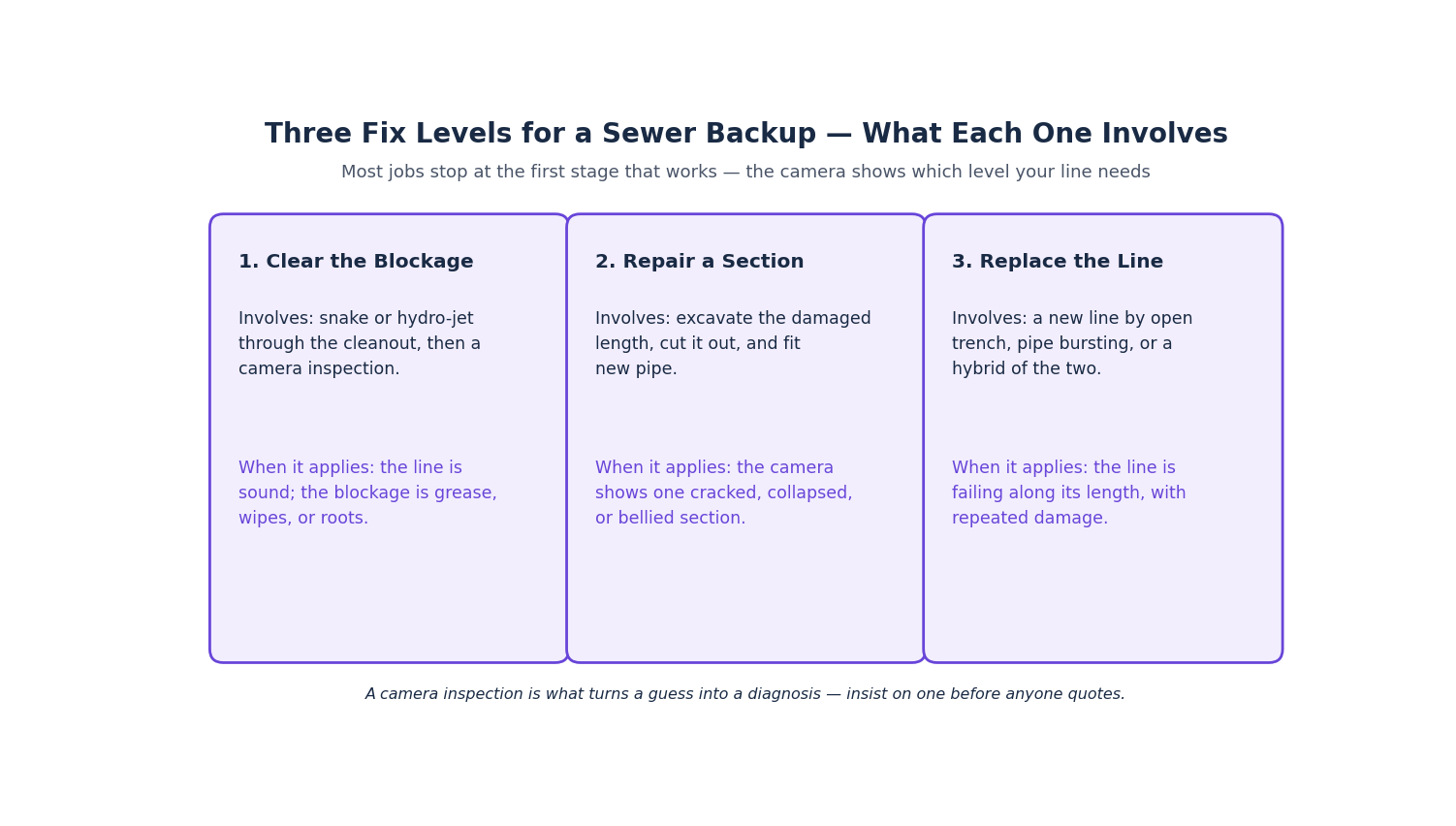
A sewer backup is fixed in stages, and most jobs stop at the first stage that works. Understanding the stages helps you see why one backup is a few hundred dollars and another is several thousand — and why the cost to fix sewer backup is really three different prices depending on how far the fix has to go.
Clearing the blockage
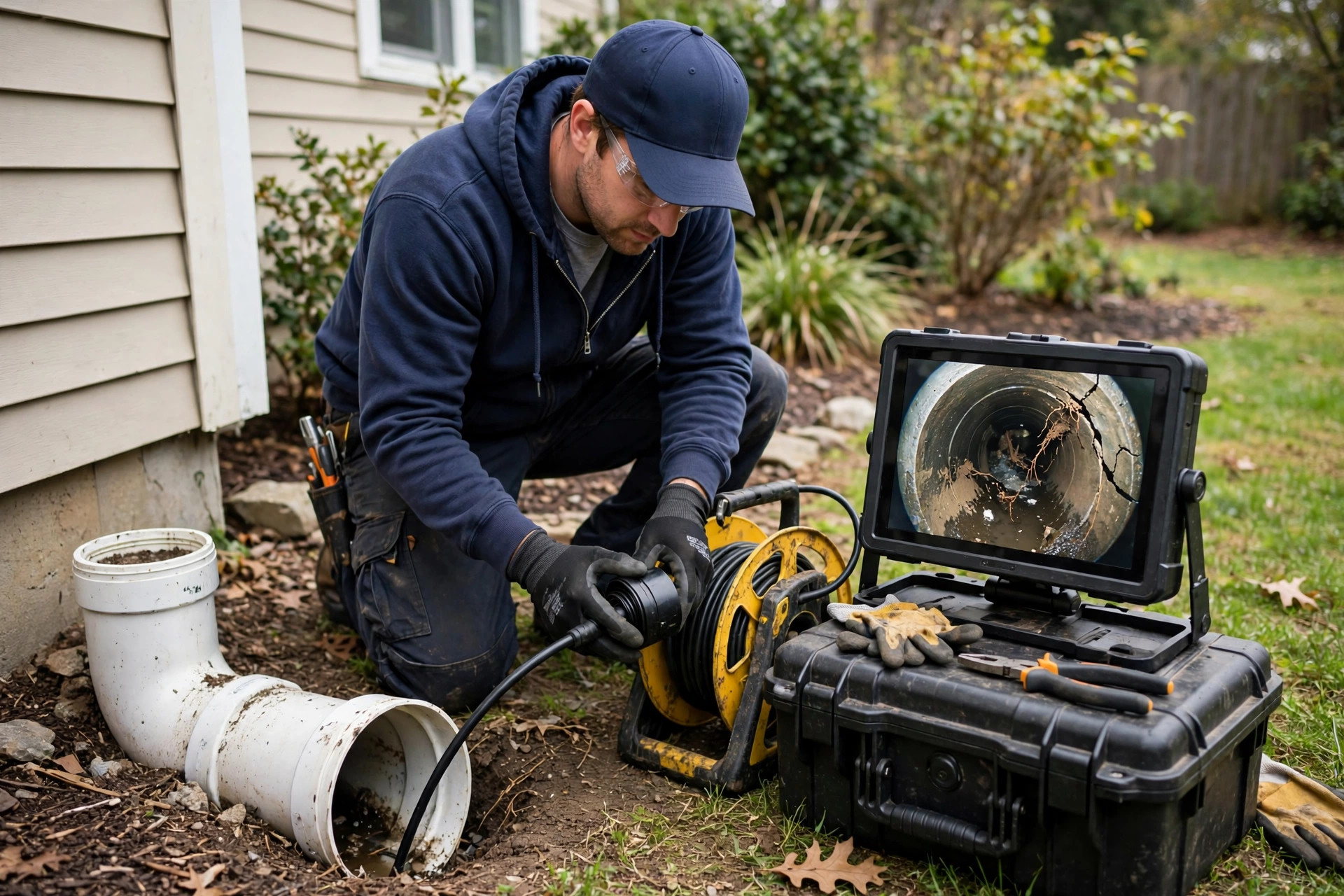
Clearing is the first stage and the most common fix. The plumber opens the cleanout — the capped pipe that gives access to the sewer line — and runs a drain snake (a long flexible cable with a cutting head) through the line to break up the blockage. For a main sewer line, snaking typically budgets at about $430 to $525, including a service call. If the blockage is grease, scale, or fine roots, the plumber may follow with hydro-jetting: high-pressure water that scours the inside of the pipe clean. Hydro-jetting a main line with a camera inspection budgets at about $975 to $1,150. A single blocked fixture drain is a smaller job, typically budgeting at about $230 to $320 including a service call, but a backup that affects several fixtures is a main-line job, not a fixture job.
A camera inspection usually follows the clearing. The plumber feeds a small camera down the line and watches the pipe’s condition on a monitor: cracks, root entry points, bellies, offsets, and collapses all show up clearly. The camera is what turns a guess into a diagnosis, and it is the reason a good plumber recommends one after any backup — clearing without looking leaves the cause unknown. The camera result is also what confirms whether the cost to fix sewer backup stops at clearing or goes further.
Repairing a section
If the camera shows a damaged section — a crack, a collapsed length, or a joint that has separated — the fix is a spot repair: excavate that section, cut out the damaged pipe, and replace it. A spot repair of up to 10 feet of sewer line typically budgets at about $2,300 to $2,750 at standard pricing; a budget repair starts near $1,350 and a premium one can reach about $4,500. A longer section costs more: a 10 to 30 foot section budgets at about $4,550 to $5,450, and a long run of 30 to 60 feet at about $8,600 to $10,300. These are the planning figures from the Sewer Line Repair Cost Calculator, and they assume a cracked pipe at a typical depth with standard access.
Spot repair makes sense when the rest of the line is sound: for a single bad section, the cost to fix sewer backup lands in the low thousands rather than the tens of thousands. It is the middle ground between clearing and replacement: more than a clearing because it involves excavation, but far less than replacing the whole line. If the camera shows damage in several places, though, repairing one section at a time stops making sense, and the conversation moves to replacement.
Full replacement
Full replacement means installing a new sewer line from the house to the street connection, and it is the fix when the line has failed along its length — repeated collapses, widespread root damage, or a pipe material that has reached the end of its life. Sewer line replacement typically costs roughly $50 to $250 per foot all-in, depending on the method, depth, and what is on top of the line. In the calculator’s example for a 60-foot line through a lawn, open trench costs roughly $6,100 to $8,000 ($102 to $133 per foot), pipe bursting roughly $8,600 to $11,250, and a hybrid approach roughly $7,500 to $9,800.
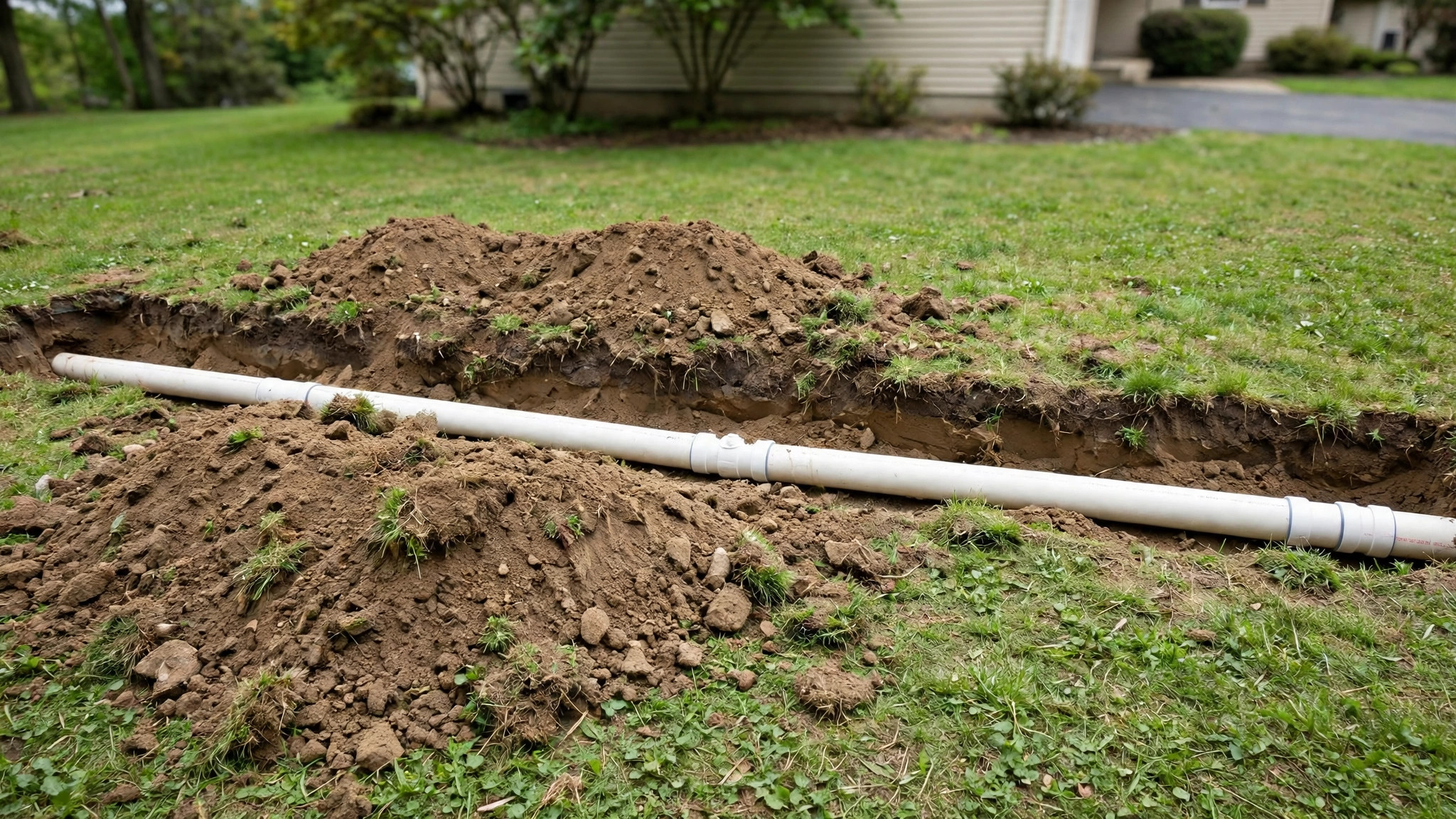
The method is the biggest choice in a replacement — method alone can move the cost to fix sewer backup by thousands on the same line. Open trench is the traditional approach: dig the full length of the line, lay new pipe, and backfill. It is the most flexible method and usually the least expensive per foot — the standard rate for open trench in PVC is about $69 per foot — but it disturbs the most surface, which matters if the line runs under a driveway or landscaping. Pipe bursting pulls a new HDPE pipe through the old line, breaking the old pipe outward as it goes; it costs more per foot (about $86 at standard pricing) but needs only small pits at each end, so the surface above stays mostly intact. A hybrid approach digs only where it has to, and lands between the two on price, at about $76 per foot for PVC. Use the Sewer Line Replacement Cost Calculator to build an estimate for your own line length, depth, and method before you compare quotes.
| Fix level | What it involves | When it applies | Planning figures |
|---|---|---|---|
| Clear the blockage | Snake or hydro-jet through the cleanout, then camera inspection | Line is sound; blockage is grease, wipes, or roots | Main line snaked $430–$525; hydro-jet with camera $975–$1,150 |
| Repair a section | Excavate and replace the damaged length | Camera shows one cracked, collapsed, or bellied section | Spot repair up to 10 ft $2,300–$2,750; 10–30 ft $4,550–$5,450 |
| Replace the line | New line by open trench, pipe bursting, or hybrid | Line failing along its length; repeated damage | ~$50–$250 per foot all-in; 60-ft lawn line $6,100–$11,250 by method |
Health and safety: sewage is a biohazard
A sewer backup is not just a plumbing problem. Raw sewage is classified as Category 3 water — “black water” — under the IICRC S500 standard, the most contaminated category in water damage restoration. It carries bacteria such as E. coli and Salmonella, viruses such as hepatitis A and norovirus, and parasites such as Giardia and Cryptosporidium. Exposure can cause gastrointestinal illness, skin infections, and respiratory problems, and it does not require drinking the water: touching a contaminated surface and then your face, or breathing in droplets while scrubbing, is enough.
That is why the cleanup has rules that ordinary water damage does not, and why cleanup is a real part of the total cost to fix sewer backup, not an afterthought. Porous materials that sewage has soaked — carpet and padding, drywall, upholstered furniture — cannot be reliably disinfected and are usually removed and discarded. Hard, non-porous surfaces such as tile and sealed concrete can be cleaned and disinfected with products registered for the purpose. Children and pregnant people should not take part in cleanup work, and people with breathing problems or weakened immune systems should stay away from the affected area until it is clean and dry — the EPA’s flood-cleanup guidance says the same for floodwater, and sewage is at least as hazardous.
If the backup is more than a small amount in one drain, call a professional cleanup crew as well as a plumber. A shop vacuum and household bleach are not enough for sewage, and disturbing the area without protection spreads contamination further through the house. The EPA’s resources for flood cleanup and indoor air quality explain the cleanup steps and the protective measures in detail, and they are a useful second opinion before you decide what to handle yourself and what to leave to a crew.
Cleanup, insurance, and making good
The cleanup is a separate scope from the plumbing fix, and it is easy to underestimate — it is often the part of the cost to fix sewer backup that surprises homeowners most. After the line is cleared or repaired, the affected area still needs the wastewater extracted, contaminated materials removed, surfaces disinfected, and the space dried and checked before anyone uses it again. Drying matters: moisture left inside a wall or floor assembly invites mold, and mold can begin colonizing damp porous materials within a day or two of exposure. A professional crew measures moisture with meters rather than relying on a visual check, because a surface can look dry while the material behind it is still wet.
Insurance is the question most homeowners ask too late. Standard homeowners policies typically exclude damage caused by water backing up through sewers or drains, so a backup claim is usually denied unless you added a water backup endorsement — sometimes called a sewer and drain backup rider — to your policy. Flood insurance is a separate policy and does not fill this gap: the National Flood Insurance Program covers a sewer backup only when it is a direct result of flooding. If you have the endorsement, check its limit and deductible before you assume the cleanup is covered, because the limit caps how much of the cost to fix sewer backup the insurer will pay, and document the damage with photos before anything is removed. If you do not have it, adding one will not cover the backup that already happened, but it covers the next one.
Making good is the work of putting your home back together after the repair: backfilling and restoring the excavation, replacing removed drywall and flooring, repainting, and reinstating anything that was taken out to reach the line. For a spot repair or a replacement, the surface restoration — lawn, driveway, or patio above the trench — is part of the project cost and should be in the quote, not left as a surprise. Ask what restoration is included, so you are not left arranging a separate job after the plumber leaves — restoration belongs in the cost to fix sewer backup from the start.
How to compare plumber quotes
Because the cost to fix sewer backup varies so much with the cause and the fix level, the only way to compare quotes fairly is to make sure each one covers the same work. A lower quote that excludes the camera inspection, the excavation, or the surface restoration is not cheaper — it is incomplete.
Before you invite plumbers, gather the basics: which fixtures are affected, where the sewage is appearing, whether the backup happens only in heavy rain, the age of your home and the material of your sewer line if you know it, and where your cleanout is. Then check that each quote names the fix level (clearing, spot repair, or replacement), the method, the line length and depth involved, the camera inspection, the permit, and the restoration work.
Ask each plumber the same questions: What did the camera show, and can I see the footage? Is this a clearing job or a repair job, and why? What is included in the price and what is not? What warranty covers the work, and how does each answer change the cost to fix sewer backup for your home? A plumber who shows you the camera footage and explains why the fix is the right one is usually a safer choice than a lower quote with no diagnosis.
For more on choosing the plumber themselves, see our guide to how to hire a plumber, and if the camera shows a line near the end of its life, our guide to repair or replace pipes and fixtures covers how to weigh a repair against a replacement.
Use the Sewer Line Replacement Cost Calculator to build an estimate for your own line before you compare quotes. It gives you a realistic starting point, so you can spot a quote that is missing major scope — or one that includes work your home does not need.
FAQs
How much does it cost to fix a sewer backup?
The cost to fix sewer backup depends on what is blocking the line and how far the fix has to go. Snaking a main sewer line typically budgets at about $430 to $525, including a service call. Hydro-jetting with a camera inspection budgets at about $975 to $1,150. A spot repair of up to 10 feet typically budgets at about $2,300 to $2,750, and a full line replacement runs roughly $50 to $250 per foot all-in. A camera inspection shows which fix your line needs.
How much does a plumber cost to unclog a main line?
Snaking a main sewer line typically budgets at about $430 to $525, including a service call — that snaking price is the most common cost to fix sewer backup for a simple blockage. If the line needs hydro-jetting with a camera inspection, the figure is about $975 to $1,150. These planning figures assume a fully blocked drain cleared in normal working hours. A single blocked fixture drain is a smaller job, typically budgeting at about $230 to $320.
What causes a sewer backup?
The most common causes are tree roots growing into the line, grease and flushed wipes building up inside the pipe, a collapsed or sagging section of pipe, and heavy rain overwhelming the municipal sewer. A camera inspection is how the cause is confirmed, and the cause decides whether the fix is a clearing, a spot repair, or a full replacement.
Is a sewer backup dangerous?
Yes. Raw sewage is classified as Category 3 water — “black water” — under the IICRC S500 standard, the most contaminated category in water damage restoration. It carries bacteria, viruses, and parasites that can cause gastrointestinal illness, skin infections, and respiratory problems. Children, pregnant people, and anyone with a weakened immune system should stay away from the affected area, and porous materials that sewage has soaked usually have to be discarded rather than disinfected.
Does homeowners insurance cover a sewer backup?
Usually not by default. Standard homeowners policies typically exclude damage caused by water backing up through sewers or drains. Coverage is added by an optional water backup endorsement, sometimes called a sewer and drain backup rider. Flood insurance covers a sewer backup only when it is a direct result of flooding. Check your policy and endorsements before you assume a backup is covered.
Can I fix a sewer backup myself?
A single slow fixture drain is sometimes a DIY job, but a backup affecting several fixtures is a main-line problem and is not. Clearing a main line needs professional snaking or hydro-jetting equipment, a camera to find the cause, and protective gear for handling sewage. Chemical drain cleaners will not clear a main-line blockage and can damage pipes. Call a plumber, stop using water in the house, and keep people and pets away from the affected area.
How long does it take to fix a sewer backup?
A straightforward main-line clearing is usually done in a single visit, often within a few hours. A spot repair typically takes a day, including excavation and backfilling. A full line replacement takes several days, depending on the length, depth, and method. Cleanup and drying are separate and take longer: the affected area needs to be disinfected and dried before it is used again. The fix level is what sets the cost to fix sewer backup, and the time follows the fix level.
Conclusion
The cost to fix sewer backup comes down to the cause and the fix level. A blocked main line that only needs clearing is a few hundred dollars. A damaged section that needs a spot repair is a few thousand. A line that has failed along its length needs a full replacement, priced by the foot and by the method. The camera inspection is what tells you which of the three you are facing, and it is the step worth insisting on before anyone quotes.
Start with the Drain Cleaning Cost Calculator to see what clearing your main line budgets at, and the Sewer Line Replacement Cost Calculator if the camera shows a line that needs replacing. Then compare detailed quotes from qualified local plumbers, checking that each one covers the same scope — clearing, repair, or replacement, plus the cleanup and the restoration. Knowing the fix level before you call is how you keep the cost to fix sewer backup predictable. A sewer backup is an unpleasant surprise, but with the cause diagnosed and the fix priced properly, it is a solvable one.
