
Plumbing Materials Compared: PEX, Copper, and PVC
The short answer
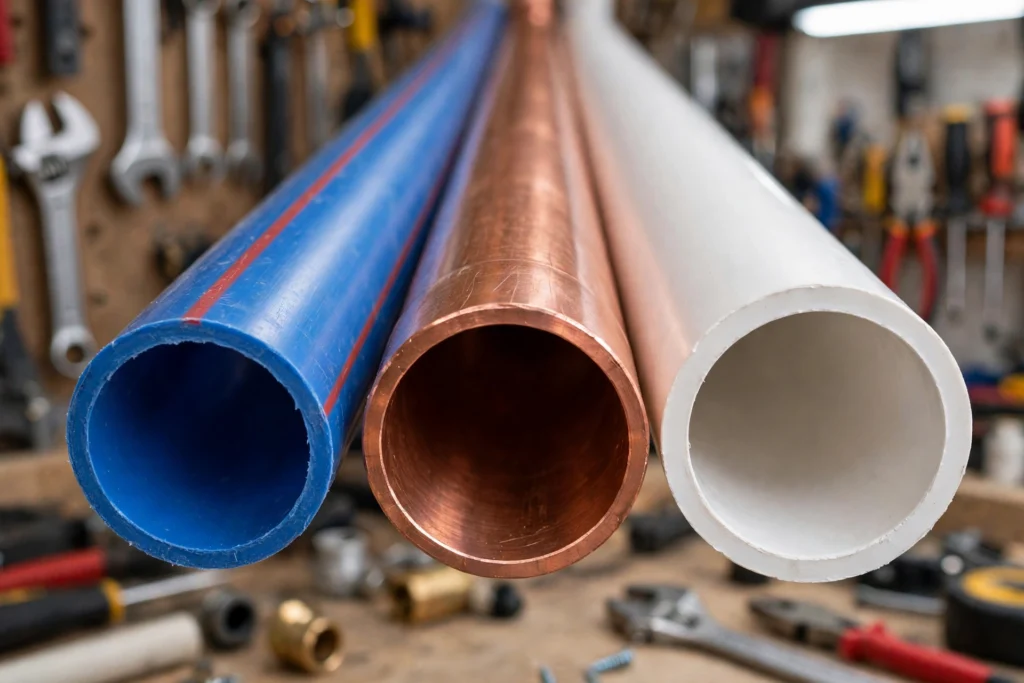
There is no single best pipe material — there is a right material for each job. PEX is the flexible, affordable choice for most water-supply repipes. Copper is the premium, long-life option. PVC is the standard for drains and vents, not for hot supply lines. The tables below compare them side by side.
If your project also involves a new water heater, price that part with the water heater replacement cost calculator:
The right material depends on your water, your budget, and whether you’re repiping a whole house or fixing one run.
Why the material matters more than the brand
Plumbing pipe is one of those products where the material is the product. A PEX pipe from any reputable manufacturer behaves like PEX; a copper pipe behaves like copper. The brand on the box matters far less than the letters on the spec sheet.
What actually differs between materials: how they handle your water chemistry, how they fail, how easy they are to install (which drives labor cost), and how long they last. Get those four right and the brand takes care of itself.
This is also why ‘best pipe’ is the wrong question. The best pipe for a whole-house repipe in a hard-water region isn’t the best pipe for a single bathroom addition. Match the material to the job.
The three materials at a glance
Each material below is rated on relative cost (Low / Moderate / Premium) and general lifespan guidance — not quotes, and not guarantees.
| Material | Relative cost | Lifespan (general guidance) | Best for | Watch out for |
|---|---|---|---|---|
| PEX | Low–Moderate | Several decades | Water-supply repipes, retrofits, freeze-prone runs | UV exposure, rodents; needs proper fittings |
| Copper | Premium | 50+ years | Exposed runs, long-life installs | Higher material cost; acidic water can corrode it |
| PVC | Low | 50+ years in drain service | Drain, waste, vent; irrigation | Not for hot water supply lines |

PEX: the modern default
PEX dominates new residential plumbing for good reasons. It’s flexible — long runs snake through walls with far fewer fittings, and fewer fittings mean fewer potential leak points. It resists scale buildup and freeze damage better than rigid pipe, and it installs fast, which keeps labor costs down.
The trade-offs: PEX can’t go outdoors in sunlight (UV degrades it), and some homeowners simply trust metal more. Fitting systems matter too — expansion and crimp fittings both work well when installed properly, but a bad fitting installation is the most common PEX failure.
For whole-house repipes, PEX is usually the value winner: good longevity, forgiving installation, and reasonable cost. It’s the default recommendation for a reason.
PEX vs copper — the real decision
Most homeowners choosing supply-line material are really choosing between PEX and copper. Here is how they compare.
| Factor | PEX | Copper |
|---|---|---|
| Relative cost | Lower — material and labor | Higher — material cost dominates |
| Installation | Flexible; fewer fittings, faster runs | Rigid; soldered or press fittings |
| Freeze resistance | More forgiving — expands slightly | Can burst if water freezes inside |
| Lifespan | Several decades (general guidance) | 50+ years (general guidance) |
| Best use | Whole-house repipes, retrofits | Exposed piping, premium installs |
Where PVC fits — and where it does not
PVC is the workhorse of drain, waste, and vent (DWV) systems and outdoor irrigation — cheap, corrosion-proof, and easy to join. Standard PVC is rated for cold water only: it must not be used for hot water supply lines. CPVC is the chlorinated variant rated for hot water, but PEX and copper remain the more common choices for supply lines.

PVC and CPVC: where plastic pipe belongs
Plastic pipe earns its place in very specific jobs — and causes trouble when it wanders outside them. Standard PVC (schedule 40 and 80) is the default for drain, waste, and vent systems: it’s immune to the corrosion that kills metal drains, it’s light, and solvent-welded joints are fast and reliable. It’s also the standard for cold-water irrigation and outdoor applications where it stays out of pressurised hot service.
CPVC is PVC’s chlorinated sibling, rated for hot water supply — the extra chlorine in the resin raises its temperature tolerance. It’s a legitimate supply-line material and often shows up in older renovations. But it has its own quirks: CPVC is more brittle than PVC and doesn’t love freezing temperatures, and like all plastic pipe it expands and contracts noticeably with temperature swings, which the installation has to accommodate.
Joining plastic pipe is straightforward: PVC uses solvent cement that chemically welds the joint in seconds, while CPVC uses its own cement formulated for the chlorinated resin — the two cements are not interchangeable. That speed is part of why PVC dominates DWV work: a whole house of drain lines goes together fast. CPVC supply installations use similar solvent joining, though many plumbers still prefer PEX or copper for supply lines because the installed cost and flexibility compare well.
The hard rule: standard PVC never goes on hot water supply, and neither PVC nor CPVC should be used where local code or the application demands metal. For drains, vents, and cold-water outdoor runs, PVC is hard to beat on value and longevity. For hot supply lines, leave PVC on the shelf and choose PEX or copper.
One more practical note: plastic pipe and sunlight don’t mix for long. UV degrades PVC and CPVC left exposed outdoors, so buried or shielded runs last far longer. And because plastic pipe is a poor conductor, it won’t sweat the way cold copper can in humid spaces — a small comfort bonus in basements and crawl spaces.
Which material for your project
- Repiping supply lines on a budget — PEX
- Premium install you want to last decades — copper
- Drains, vents, and outdoor irrigation — PVC
- Hot water supply — PEX or copper, never standard PVC
- Exposed piping where looks matter — copper
Copper: the proven veteran
Copper has plumbed homes for the better part of a century, and there’s a reason it survived every challenger: it’s proven, it’s recyclable, and plumbers everywhere know how to work it. In good water conditions, copper lasts generations.
The weaknesses are water chemistry and cost. Aggressive or acidic water eats copper from the inside, causing pinhole leaks — the classic copper failure. And copper costs more in both material and labor: soldering joints takes skill and time that PEX doesn’t.
Choose copper when your water is kind to it, when local code or your plumber prefers it, or when you simply want the track record. It’s never the wrong answer — just sometimes the expensive one.
Frequently asked questions
What is the best pipe material for home plumbing?
There is no single best material — it depends on the job. PEX is the most common choice for water supply repipes today, copper is the premium long-life option, and PVC is standard for drains and vents. Match the material to the application, not to a trend.
Is PEX as good as copper?
For water supply lines, PEX performs well and costs less to install because it is flexible and needs fewer fittings. Copper lasts longer and handles UV and rodents better. Many plumbers use PEX for most runs and copper where it is exposed.
Can PVC be used for hot water lines?
Standard PVC should not be used for hot water supply — it is rated for cold water, drains, waste, and vents. CPVC is the chlorinated variant rated for hot water, but PEX and copper are the more common choices for supply lines.
How long do PEX, copper, and PVC pipes last?
As general guidance: copper often lasts 50 years or more, PEX is generally expected to last several decades, and PVC used for drains can last 50 years or more. Actual lifespan depends on water quality, installation, and local conditions — not on a single number.
Should I repipe my whole house or just fix the leak?
A single accessible leak is usually worth fixing. Frequent leaks, discolored water, or very old galvanized or polybutylene piping point toward a full repipe. If the project involves a new water heater too, the water heater replacement cost calculator can help you plan that part of the budget.
Can you mix PEX and copper in the same system?
Yes — it’s common and perfectly fine when done with proper transition fittings. Many repipes use PEX for long runs and keep copper where it’s exposed or required. The key is using the right fittings for the transition; a plumber handles this routinely.
Is PEX safe for drinking water?
PEX used for potable water is certified to NSF/ANSI standards, which is the safety benchmark that matters. It has been used in millions of homes for decades. If you have concerns, look for the NSF certification mark on the pipe — that’s your assurance.
Next step
Decide which material fits your job using the tables above, then talk to a plumber about the right scope — a single fix or a full repipe. And if a water heater is part of the project, use the water heater replacement cost calculator linked at the top of this guide to plan that budget before you get quotes. If you’re planning a repipe, get the material decision settled before you collect quotes — it changes every number.
