
How Much Does It Cost to Replace a Faucet?
Direct answer
The cost to replace a faucet depends mainly on the type of faucet, who supplies it, and the condition of the shut-off valves and supply lines underneath. Replacing a basic bathroom faucet costs about $400 at average U.S. labor rates, with a Budget to Premium range of roughly $245 to $645. A standard kitchen faucet is about $480.
A faucet replacement is a small job with a lot of small variables, which is why two quotes for what sounds like the same work can come back hundreds of dollars apart. The faucet itself is only part of the cost to replace a faucet: labor, the trip charge, removal of the old faucet, and disposal all add up, and a corroded valve or a faucet that does not fit the existing sink holes can turn a one-hour swap into a half-day job.
Use the Faucet Replacement Cost Calculator early in your planning. It builds the estimate from separate pieces — materials, labor, removal, and disposal — so you can see exactly what drives the cost to replace a faucet in your own home before you call a plumber.
What “faucet replacement” means
A faucet replacement is the complete job of removing an old faucet and fitting a working new one: the faucet itself, the supply lines that connect it to the shut-off valves, the mounting hardware, and the connections, plus removal and disposal of the old faucet. On a standard job, the sink, the countertop, and the drain stay where they are.
A faucet replacement is not a sink replacement and not a bathroom remodel. If the sink is cracked, the countertop needs cutting for a different faucet style, or the drain assembly is failing, those are separate jobs with their own costs. What usually surprises people is how much of the cost to replace a faucet is labor rather than parts: on a basic bathroom faucet, the plumber’s labor and trip charge together are about as large as the faucet and install kit, so choosing a cheaper faucet does not always make the job much cheaper.
Replacing a faucet is also different from repairing one. A dripping faucet often needs only a new cartridge, washer, or O-ring, and our guide to leaking pipe repair cost covers the repair side of plumbing costs. But when the finish is worn through, the valve body is corroded, parts are no longer made for the model, or the faucet has been repaired more than once, replacement is usually the better call — and the cost to replace a faucet is often not much more than a second or third repair visit.
Types of faucets
The faucet type is the single biggest influence on the cost to replace a faucet. A basic bathroom faucet is the lowest-cost and quickest swap; a touchless kitchen faucet or a wall-mount faucet takes longer and costs more, because there is more to fit and connect.
Bathroom faucets
A single-handle or centerset bathroom faucet is one unit with the handle and spout on a single base, and it fits the standard three-hole sink layout with the holes close together. It is the simplest replacement and the cheapest in the calculator.
A widespread bathroom faucet has three separate pieces — a hot handle, a cold handle, and a spout — spread across the sink, so it takes longer to mount and connect, which raises the cost to replace a faucet of this type. It suits wider sinks and gives a more traditional look. A vessel sink faucet sits on a bowl sink that rises above the counter, and it must be tall enough to clear the rim, which limits the models that fit.
Kitchen faucets
A standard kitchen faucet is a single unit with one handle and a fixed or swiveling spout. A pull-down or pull-out faucet adds a sprayer head on a hose, which costs more and needs room under the sink for the hose and its weight. A touchless or smart kitchen faucet adds a sensor and a solenoid valve under the sink, powered by batteries or a plug-in adapter, which is why it carries the highest cost to replace a faucet in the calculator.
Utility and wall-mount faucets
A laundry or utility sink faucet is a simple, sturdy fitting and the cheapest type to replace. A wall-mount faucet comes out of the wall above the sink rather than sitting on the sink or counter, and a swap takes longer because the new faucet must match the center spacing of the existing wall valve.
| Faucet type (1 faucet) | Budget | Standard | Premium |
|---|---|---|---|
| Bathroom (single-handle / centerset) | $245 | $400 | $645 |
| Widespread bathroom (3-piece) | $350 | $580 | $970 |
| Vessel sink faucet | $400 | $655 | $1,110 |
| Kitchen faucet (standard) | $295 | $480 | $785 |
| Kitchen pull-down / pull-out | $380 | $610 | $970 |
| Touchless / smart kitchen | $520 | $835 | $1,345 |
| Laundry / utility sink | $235 | $370 | $595 |
| Wall-mount faucet (swap) | $465 | $765 | $1,270 |
These figures are for one faucet with default settings in the calculator: the plumber supplies it, it fits the existing holes, the valves work, access is easy, an average U.S. labor market, and no add-ons. They show the cost to replace a faucet at each level. The levels differ in materials, labor rate, and trip charge, not just by a percentage — Budget is an entry-level faucet, basic parts, and independent-plumber rates; Standard is a mid-range faucet and an established plumbing company; Premium is a high-end faucet and components with premium service-company rates.
What Affects the Cost to Replace a Faucet
No two faucet jobs have the same cost to replace a faucet, because the price is built from several moving parts. The calculator prices six of them: the faucet type, who supplies it, whether it fits your existing sink holes, the condition of the shut-off valves, your local labor market, and any extras. These are the ones that matter most.
Faucet type and finish
The faucet you choose sets the materials part of the bill and much of the labor. A basic single-handle bathroom faucet is quick to fit; a widespread faucet has three pieces to mount and connect; a pull-down kitchen faucet needs hose clearance under the sink; a touchless faucet needs a sensor and valve fitted underneath. The finish matters too — chrome is usually the least expensive, while brushed nickel, matte black, and brass finishes tend to cost more, and matching a finish across a bathroom can narrow the choice of models and raise the cost to replace a faucet.
Who supplies the faucet
Whether you buy the faucet yourself or the plumber supplies it changes the cost to replace a faucet in both directions. If you buy the faucet yourself and pay only for labor and parts, a standard kitchen faucet drops to about $300 in the calculator, compared with about $480 when the plumber supplies it. The saving is real, but it comes with a trade-off: if the faucet you bought does not fit, is missing parts, or fails early, the plumber may charge for the extra visit, and the warranty on the faucet is yours to chase, not theirs. When the plumber supplies it, the faucet, the fitting, and the warranty are one person’s responsibility, and that single point of responsibility is part of what the cost to replace a faucet buys.
Sink holes and fit
A faucet must match the holes in your sink or countertop — the number of holes and the distance between them. A centerset faucet needs three holes close together; a widespread faucet needs three holes spread apart; a single-hole faucet needs one. If the new faucet does not fit the existing holes, the job needs a cover plate, new holes drilled, or a different faucet, and drilling a stone countertop is an extra that adds to the cost to replace a faucet. Before you buy, count the holes and measure the spread between the outer ones.
Shut-off valves and supply lines
Every faucet should have shut-off valves underneath that let you turn off the water to that faucet alone. On older homes those valves are often stiff, corroded, or seized, and a plumber who cannot shut the water off cleanly has to replace the valves before the faucet can come out. New supply lines are usually fitted as part of the job, since old braided or copper lines are a common leak point. The condition of the valves is one of the six things the calculator asks about, because it is one of the most common reasons the cost to replace a faucet comes in above the basic estimate.
Labor, access, and who does the work
Labor is priced as plumber hours multiplied by an hourly rate, plus a service-call charge, and it is the largest single line in the cost to replace a faucet on a basic job. Access decides how many hours the job takes: an open vanity cabinet with room to work is quick, while a pedestal sink with almost no space underneath, a kitchen sink backed against a wall, or a faucet reached through a cramped crawl space all slow the work down. Your local labor market scales the labor, disposal, equipment, repair, and permit allowances in the calculator, though it does not change the faucet price itself. Your ZIP code is required so the calculator can match you with local plumbers; it does not change the price.
Extras: drains, drilling, and repairs
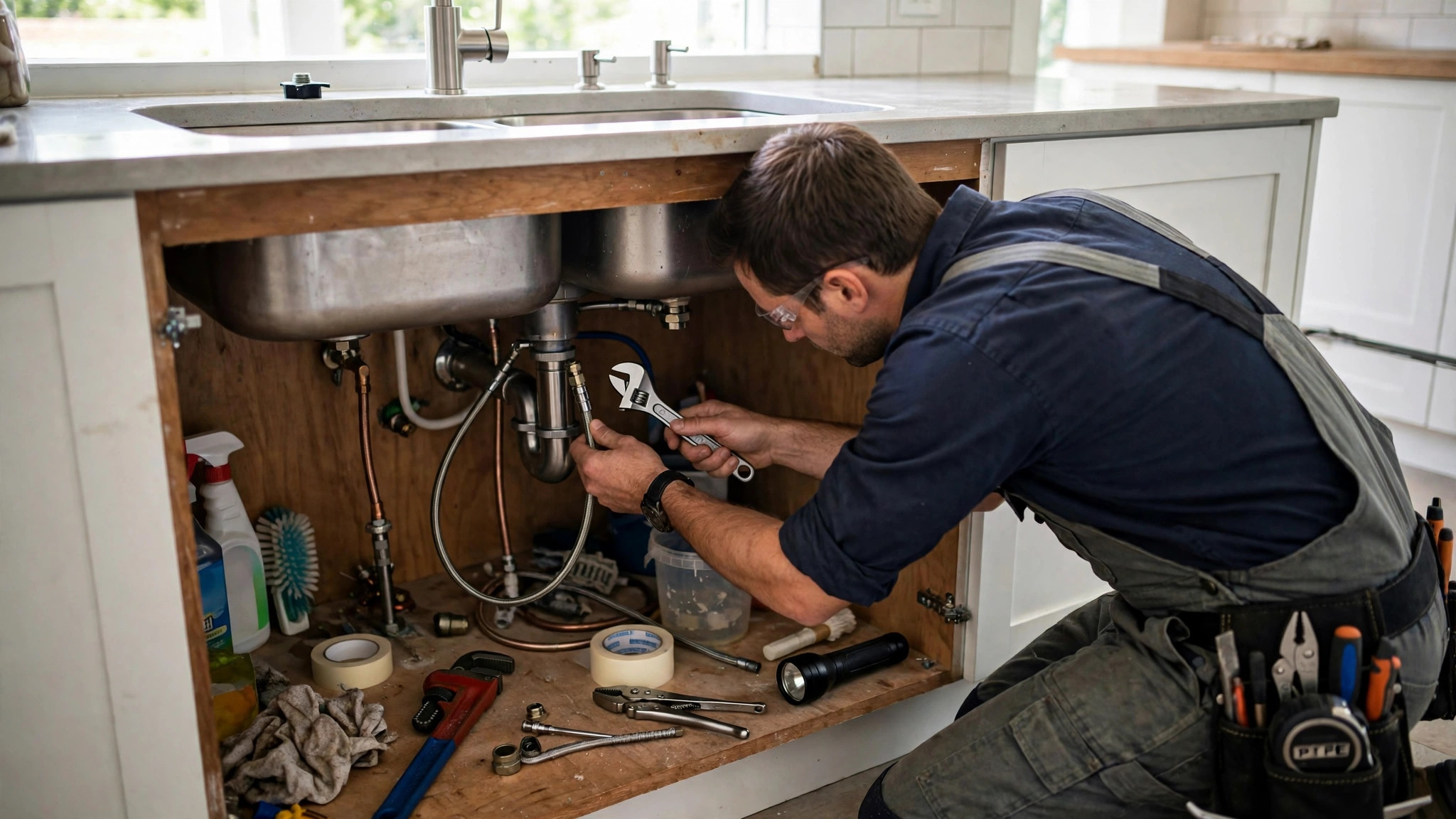
Extras are included in the estimate only when you select them, and they are the part of the cost to replace a faucet most people forget to budget for. A new drain assembly or pop-up drain, drilling a stone or quartz countertop for a new faucet layout, replacing a damaged sink flange, or repairing water damage found under the sink can each add to the bill. If the plumber finds a leak, a corroded trap, or damaged shut-off valves once the old faucet is out, that repair work is priced separately from the cost to replace a faucet itself.
What is included in the estimate
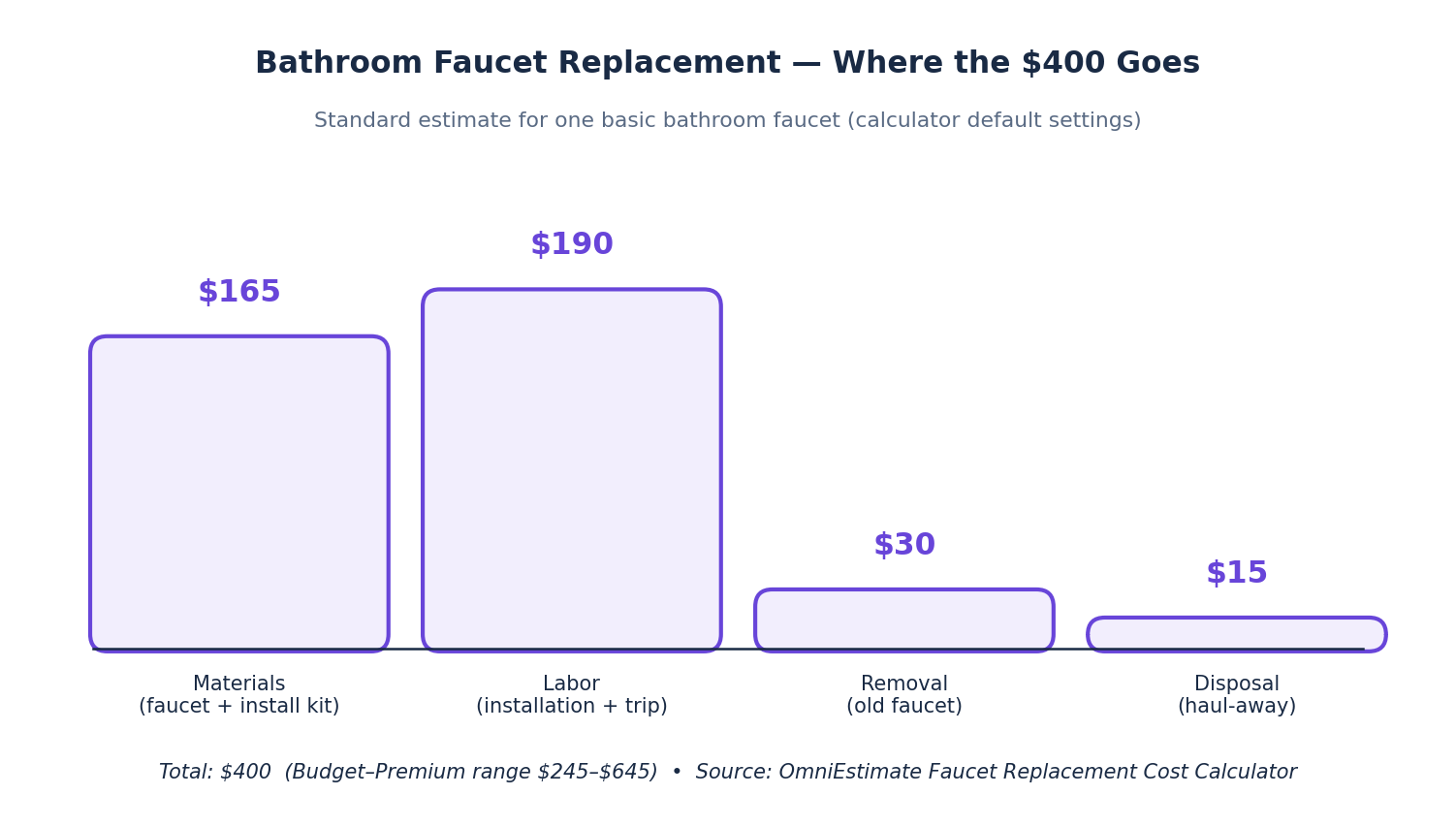
Here is how the default bathroom faucet replacement breaks down in the calculator, so you can see where the cost to replace a faucet goes.
| Cost category | Standard estimate | Budget – Premium range |
|---|---|---|
| Materials (faucet and install kit) | $165 | $80 – $305 |
| Labor (installation and trip charge) | $190 | $135 – $275 |
| Removal of old faucet | $30 | $20 – $40 |
| Disposal / haul-away | $15 | $10 – $25 |
| Total | $400 | $245 – $645 |
Removal and disposal are always included in the calculator’s estimate. Equipment, repairs, and permits are included only when you select them, which keeps the base estimate honest: a straightforward swap has no permit or equipment cost, and you should not pay for them unless your job actually needs them.
The breakdown explains why the cost to replace a faucet does not fall as fast as the faucet price. On the standard bathroom job, labor and the trip charge ($190) are larger than the materials ($165). Dropping from a mid-range faucet to an entry-level one saves on materials, but the plumber still has to travel, shut off the water, remove the old faucet, fit the new one, test it, and haul the old one away. That fixed labor is why the Budget total ($245) is only about 40 percent below the Standard total ($400), even though the faucet itself costs far less.
Repair or replace?
The question behind most faucet calls is whether to fix what is there or start over. A dripping faucet is often a worn cartridge or washer, and a repair can be the right move when the faucet is a good model, parts are available, and the finish and valve body are sound. Our guide to repair or replace for pipes and fixtures walks through the same decision for the rest of your plumbing, and the logic is the same: repair when the part is sound and the fix is simple, replace when the part is failing.
Replace when the finish has worn through to the metal underneath, the valve body is corroded or pitted, the manufacturer no longer makes parts for the model, the faucet has already been repaired more than once, or the handle is stiff and grinding even after a new cartridge. A faucet that leaks from the base or the body, rather than from the spout, usually has a body problem that a cartridge will not fix. In those cases the cost to replace a faucet is money better spent than another repair visit, and the new faucet comes with a warranty the old one no longer has.
There is also a water argument for replacing an old faucet. The U.S. Environmental Protection Agency’s WaterSense program notes that WaterSense labeled bathroom sink faucets use a maximum of 1.5 gallons per minute, cutting a sink’s water flow by 30 percent or more from the standard flow of 2.2 gallons per minute without sacrificing performance. If your old faucet predates modern flow standards, a replacement can cut the water that sink uses every day, which is worth weighing alongside the cost to replace a faucet.
DIY or hire a plumber?
Replacing a faucet is one of the more approachable plumbing jobs for a confident homeowner, and the saving is the labor line of the cost to replace a faucet — about $190 on a standard bathroom job in the calculator. A straightforward swap needs basic tools, new supply lines, and a careful eye for the order the parts come off, so they go back on the same way.
DIY makes sense when the shut-off valves work cleanly, the new faucet fits the existing holes, the supply lines are in good shape, and you have room to work under the sink. It stops making sense when the valves are seized, the old faucet is corroded in place, the sink is a pedestal or wall-mount with almost no access, or the job needs drilling or valve replacement. A stripped fitting or a cross-threaded supply line can turn a saved trip charge into an emergency call, and water damage from a slow leak under a sink costs far more than the labor you saved.
If you hire a plumber, the cost to replace a faucet buys more than the fitting: it buys the warranty on the work, the right tools for seized fittings, and someone who can replace a valve or a supply line on the spot instead of leaving the water off while parts are ordered. For help choosing the right person, see our guide to how to hire a plumber.
How to compare faucet quotes
Because the cost to replace a faucet varies so much with scope, the only way to compare quotes fairly is to make sure each one covers the same work. A lower quote that excludes removal, disposal, or new supply lines is not cheaper — it is incomplete.
Before you call, gather the basics: the faucet type and how many holes your sink has, whether the shut-off valves work, whether you want to supply the faucet yourself or have the plumber supply it, and whether anything else under the sink needs attention. Then check that each quote covers the full cost to replace a faucet: the faucet itself (brand and model, or the allowance if the plumber supplies it), the supply lines, removal and disposal of the old faucet, the trip charge, and any valve or repair work.
Ask each plumber the same questions: Is the faucet included, and what model? Are new supply lines included? What happens if the shut-off valves need replacing — is that in the price or extra? What warranty covers the faucet, and what covers the labor? A plumber who explains the scope is usually a safer choice than a lower quote with no explanation.
Use the Faucet Replacement Cost Calculator to build an estimate for your own home before you compare quotes. It gives you a realistic starting point, so you can spot a quote that is missing major scope — or one that includes work your home does not need.
FAQs
How much does it cost to replace a faucet?
The cost to replace a faucet depends on the faucet type, who supplies it, and the condition of the shut-off valves and supply lines. Replacing a basic bathroom faucet costs about $400 at average U.S. labor rates, with a Budget to Premium range of roughly $245 to $645. A standard kitchen faucet is about $480. Use the Faucet Replacement Cost Calculator for a tailored estimate, and compare detailed quotes from qualified local plumbers.
What is the cheapest faucet to replace?
A laundry or utility sink faucet is the cheapest type in the calculator, at about $370 at the Standard level, followed by a basic single-handle or centerset bathroom faucet at about $400. Both are simple, single-unit fittings that are quick to swap. The highest cost to replace a faucet is a touchless or smart kitchen faucet, at about $835 at the Standard level, because it adds a sensor and a solenoid valve under the sink.
Is it cheaper to buy the faucet yourself?
Usually, yes — if you buy the faucet yourself and pay only for labor and parts, a standard kitchen faucet drops to about $300 in the calculator, compared with about $480 when the plumber supplies it. That is the single biggest saving on the cost to replace a faucet. The trade-off is that fit problems, missing parts, and warranty claims become yours to handle, and a plumber may charge for an extra visit if the faucet you bought does not fit.
How long does it take to replace a faucet?
A straightforward swap, where the new faucet fits the existing holes and the shut-off valves work, is usually a one- to two-hour job. It takes longer when the valves are seized and need replacing, the old faucet is corroded in place, access under the sink is tight, or the job needs a new drain assembly or countertop drilling.
Do I need a plumber to replace a faucet?
Not always. A confident homeowner can replace a faucet when the shut-off valves work, the new faucet fits the existing holes, and there is room to work under the sink. Hire a plumber when the valves are seized, the old faucet is corroded, the sink is a pedestal or wall-mount with poor access, or the job needs valve replacement or drilling.
Should I repair a dripping faucet or replace it?
Repair it when the faucet is a good model, parts are available, and the finish and valve body are sound — a dripping faucet is often just a worn cartridge or washer. Replace it when the finish has worn through, the valve body is corroded, parts are no longer made, or the faucet has already been repaired more than once.
Does replacing a faucet require a permit?
A straightforward faucet swap usually does not need a permit, because it is a like-for-like fixture replacement with no changes to the plumbing system. Permits can apply when the job involves moving supply lines, changing the drain layout, or other alterations to the plumbing. Your plumber or local building department can confirm what applies in your area.
Conclusion
The cost to replace a faucet is shaped by the faucet you choose, who supplies it, and what the plumber finds underneath your sink. A basic bathroom faucet is a small, straightforward job at about $400; a touchless kitchen faucet or a wall-mount swap is a bigger one, and seized valves or a faucet that does not fit the existing holes can add to either. The labor and trip charge are about half the bill on a standard job, which is why the cheapest faucet does not always mean the lowest cost to replace a faucet.
Start with the Faucet Replacement Cost Calculator to build an estimate for your own home, then compare detailed quotes from qualified local plumbers, checking that each one covers the same scope. A faucet is a fitting you touch every day — the time spent getting the type, the fit, and the scope right is time well spent.
