
How Much Does It Cost to Stain a Deck?
Direct answer
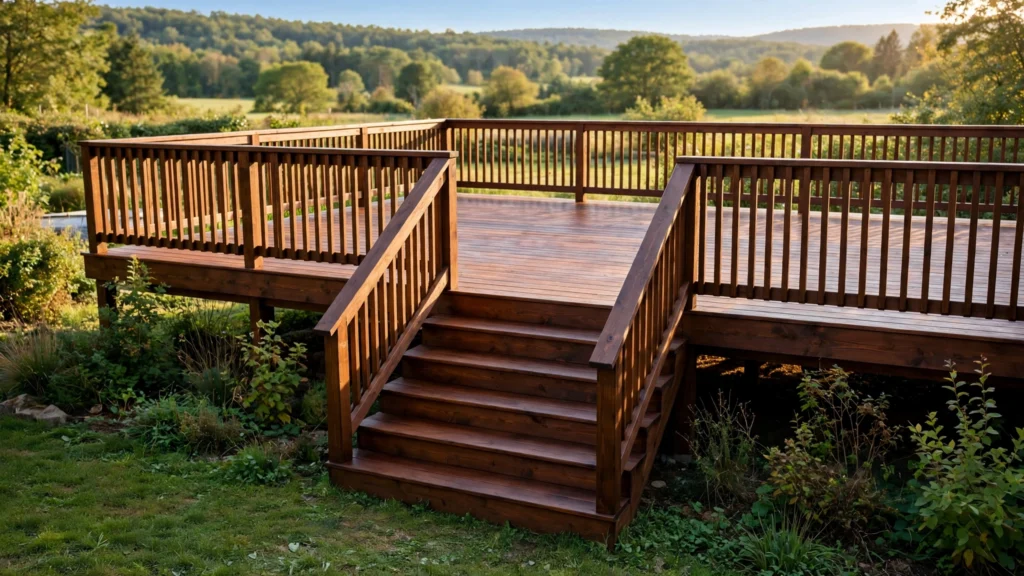
The cost to stain a deck depends mainly on how large the deck is, how much preparation the wood needs, what kind of stain or sealer you choose, and how many coats are applied. A small, well-maintained deck that only needs cleaning and one fresh coat will usually cost far less than a large, weathered deck with railings and stairs that needs stripping, sanding, and board repairs first. Because labor rates, deck condition, and stain products vary so much across the United States, there is no single national price. Work through the cost drivers below, then use the Deck Staining Cost Calculator to build an estimate for your own deck and compare detailed written quotes from local professionals.
Use the Deck Staining Cost Calculator early in your planning to see how deck size, railings, preparation, and stain choices change the estimate before you invite anyone to quote.
Deck size is the starting point
Deck staining is usually priced by the area of the deck surface, so size is the first thing to measure. A small deck takes less stain, less preparation time, and less labor than a large multi-level deck, and the difference grows once railings and stairs are included. Measure the length and width of each section, including separate levels, rather than guessing from the footprint of the house.
Railings and stairs deserve their own count. Every baluster, post, and handrail has to be cleaned and coated on several sides, and stair treads, risers, and railings add the same kind of work. A deck with railings on three sides and two sets of stairs can take considerably longer to stain than a flat deck of the same floor area with no railings. When you compare quotes, check whether railings and stairs are included — a quote that leaves them out is not comparable to one that includes them.
Shape and access also matter. A simple rectangular deck is faster to work on than one with angled corners or built-in benches, and a ground-level deck with clear access is easier than a raised deck that needs ladders.
Preparation: cleaning, stripping, and sanding
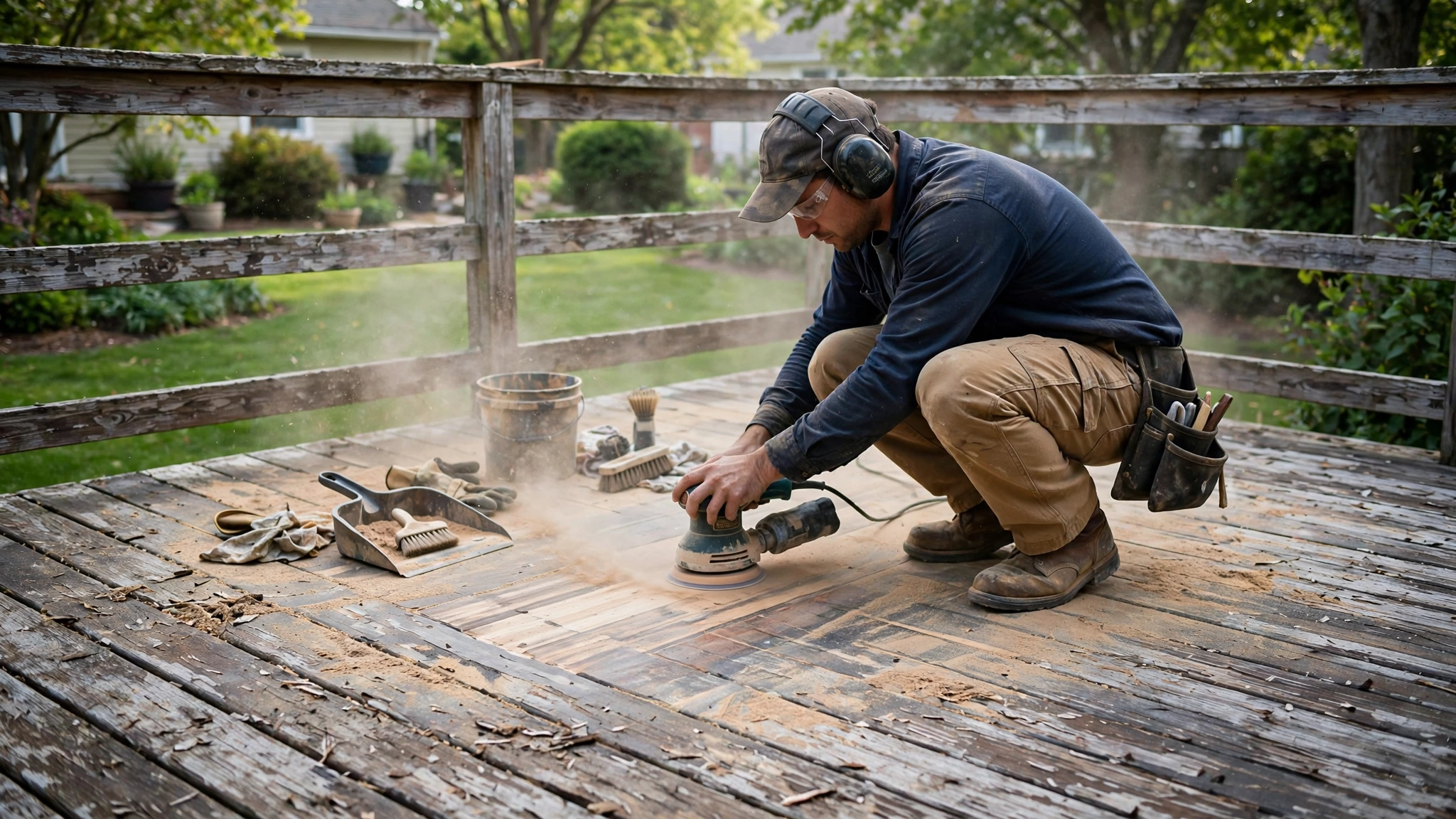
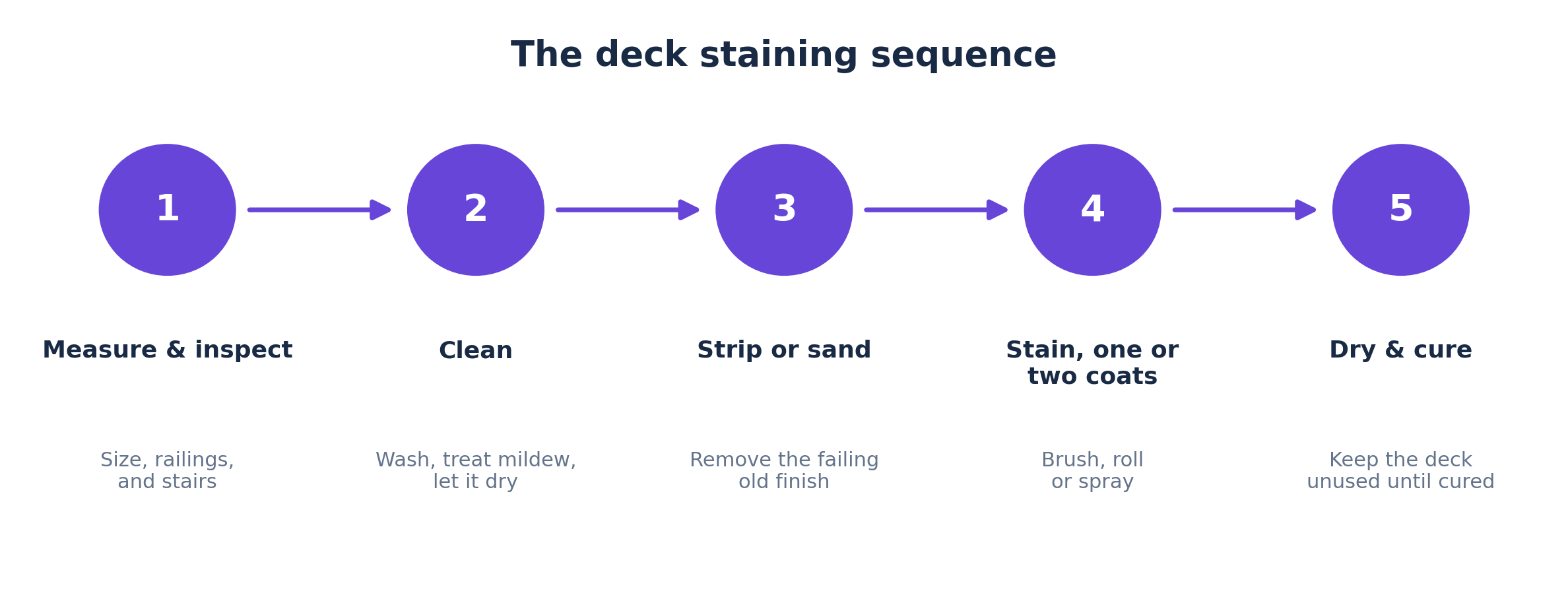
Preparation is where most of the labor goes, and where cutting corners shows up first. Stain applied over dirt, mildew, or a failing old finish will not bond well and will usually peel or wear unevenly. A professional job normally starts with cleaning — sweeping, washing, and treating mildew or algae — and allowing the wood to dry before any stain is applied.
If the old stain or sealer is peeling, a restain will often need stripping or sanding to remove the loose finish. Stripping lifts the old coating with a chemical remover or a careful pressure wash; sanding smooths rough boards and opens the grain so the new stain can penetrate. Not every deck needs full stripping and sanding — one whose finish is still sound may only need cleaning and a light sanding in worn areas. Ask the contractor to explain what preparation your deck actually needs, and why.
Repairs are part of preparation too. Loose, cracked, or soft boards should be fixed before staining, not covered up — a board replaced afterwards will not match, and a soft board stained over will keep deteriorating. Ask whether the quote includes minor repairs, what counts as minor, and how larger repairs would be priced.
Moisture, weather, and timing
Wood has to be dry enough before it is stained, and the weather has to cooperate while the stain dries. Staining damp wood can trap moisture under the finish, so follow the manufacturer’s guidance on wood moisture and temperature, and schedule the work in a dry spell with enough warm, dry days for preparation, staining, and drying between coats.
That is one reason deck staining is seasonal in much of the United States. Ask the contractor how they check the wood is dry enough and what happens if rain is forecast.
Stain and sealer choices
The stain or sealer you choose affects both the cost of the job and how the deck will look and wear. The main choices are about opacity and base.
Transparent and semi-transparent stains let the wood grain show through and tend to look more natural, often chosen for newer or good-quality wood. Solid stains cover the grain more like paint and can give an older or mismatched deck a more uniform appearance, but they usually need more product per coat and are harder to maintain if they start to peel, because the old solid finish has to be removed before a fresh coat will bond well.
Oil-based stains generally penetrate deeper and can be more forgiving on weathered wood, but they take longer to dry and need solvents for cleanup. Water-based stains dry faster, have lower odor, and clean up with water, but may not penetrate as deeply on some woods. Neither type is always better: the right choice depends on the wood, the deck’s condition, the previous finish, and the look you want. Ask the contractor which product they propose and why it suits your deck.
Color also plays a part. A stain close to the wood’s natural color shows wear less obviously than a very dark or light one, and changing from a dark old finish to a light new one may need extra preparation. Ask to see a new color on a small test area first.
How many coats, and what they cost
Most decks need at least one full coat, and many need two, particularly when the wood is weathered, the color is changing, or the first coat soaks in unevenly. A second coat uses more stain and more labor, but usually gives more even color and better protection.
Agree the number of coats before work starts, and make sure the quote says whether it covers one or two coats on the deck surface, railings, and stairs.
Labor and what a professional job includes
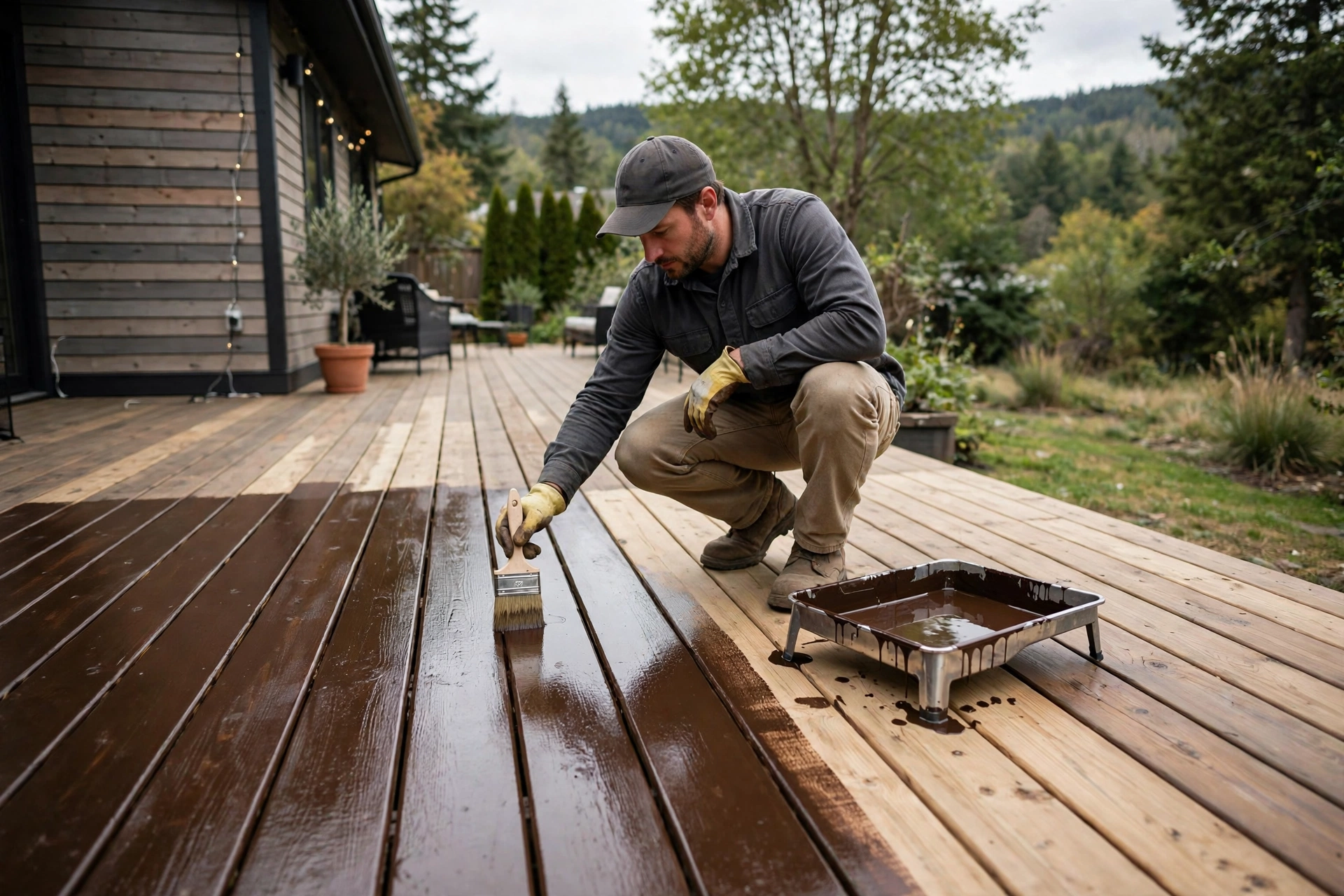
Labor is usually the largest part of a deck staining project, reflecting the time spent on preparation, application, and cleanup. A small, clean deck takes far less time than a large, weathered one needing stripping, sanding, repairs, and two coats on the deck, railings, and stairs. Brushing and rolling give good control and work stain into the wood; spraying is faster on large flat areas but needs careful masking and usually still needs back-brushing.
A complete professional quote should cover cleaning, any stripping or sanding, minor repairs, the stain or sealer, the number of coats, masking, and cleanup. Ask whether it includes moving deck furniture and planters, or whether you need to clear the deck before work starts.
Staining versus other options
Painting gives a solid, uniform color and can cover mismatched boards, but paint sits on the surface rather than penetrating the wood, so it can peel and needs more preparation when it comes time to recoat. Leaving a deck untreated is an option for some hardwoods, but most softwood decks will gray, crack, and wear faster without a protective finish.
If boards are badly rotted, warped, or structurally unsound, staining will not fix the problem — replacing boards, or rebuilding the deck, is the honest answer.
Maintenance intervals and how long a finish lasts
How often a deck needs restaining depends on the wood, the stain type, the number of coats, sun and rain exposure, and foot traffic. A deck in full sun with heavy use will wear faster than a shaded, lightly used one. No one can promise a fixed service life for a finish, and this article does not do so — ask any contractor who guarantees a specific number of years what that guarantee actually covers.
Watch for water soaking in instead of beading, uneven fading, peeling, or a rough, splintery surface.
How to compare quotes
Get itemized written quotes from more than one contractor, all covering the same scope: the deck area, railings and stairs, preparation, repairs, stain product and color, number of coats, and cleanup. If one quote is much lower than the others, look for what it leaves out — often the sanding, the second coat, the railings, or the repairs.
Useful questions to ask every contractor: What preparation does my deck need, and why? How will you check that the wood is dry enough? What stain or sealer do you propose, and how many coats are included? Are railings and stairs included? What repairs are included, and how are larger repairs priced? How long will the deck be out of use, and what happens if it rains?
Planning checklist before you book
- Measure the deck area, including each level, and count the railings and stairs.
- Note the current finish: is it peeling, faded, or still sound?
- Check for loose, cracked, or soft boards and for popped nails or screws.
- Clear the deck of furniture, planters, and grills, or agree who will move them.
- Choose a stain type and color, and ask to see it on a test area first.
- Agree the number of coats, the preparation, and the repairs in writing.
- Plan the timing around dry weather, and keep the deck unused while the finish cures.
- Use the Deck Staining Cost Calculator to build an estimate for your deck before you compare quotes, so you can spot a quote that is missing a major item.
FAQs
Q: How much does it cost to stain a deck?
A: It depends on the deck’s size, railings and stairs, how much cleaning, stripping, and sanding the wood needs, the stain chosen, and the number of coats. There is no single national price. Use the Deck Staining Cost Calculator to build an estimate for your deck, then compare itemized quotes from local professionals.
Q: How much does it cost to stain a deck per square foot?
A: A per-square-foot figure only makes sense if you know what it includes. Some cover only the stain and one coat on the deck surface, while others include cleaning, sanding, railings, stairs, and two coats. Ask the contractor what their figure covers, and use the calculator to build an estimate for your whole deck rather than relying on a single per-square-foot number.
Q: How much does it cost to restain a deck?
A: Restaining often costs more than staining a new deck, because the old finish may need stripping or sanding and worn boards may need repair. If the old finish is still sound, the work may only need cleaning and a fresh coat.
Q: How many coats of stain does a deck need?
A: Most decks need at least one full coat, and many need two, particularly if the wood is weathered, the color is changing, or the first coat soaks in unevenly. The number of coats should be agreed before work starts and written into the quote.
Q: How long should I wait before using my deck after staining?
A: It depends on the product and the weather. The stain needs time to dry and cure as the manufacturer directs, and foot traffic, furniture, and planters should stay off the deck until then. Ask the contractor for the drying and curing time for the product they are using.
Q: Can I stain a deck myself?
A: Some homeowners stain their own decks, but the work is labor-intensive and the preparation — cleaning, stripping, sanding, and repairs — takes most of the time. If you hire a professional, the quote should cover that preparation, not just the staining.
Q: How often should a deck be restained?
A: It depends on the wood, the stain type, the number of coats, sun and rain exposure, and foot traffic. Watch for water soaking in instead of beading, uneven fading, peeling, or a rough, splintery surface. No fixed service life can be promised for a finish.
Conclusion
Deck staining cost is driven by size, preparation, and the finish you choose — not by the stain alone. A small, well-maintained deck that needs only cleaning and a fresh coat is a very different job from a large, weathered deck with railings and stairs that needs stripping, sanding, repairs, and two coats. Work through the cost drivers above, build an estimate with the Deck Staining Cost Calculator, and compare itemized quotes from contractors who can explain in writing what preparation your deck needs, what product they will use, and how many coats are included.
