
Clay vs Concrete Tile Roof: Best 2026 Cost & Lifespan Comparison
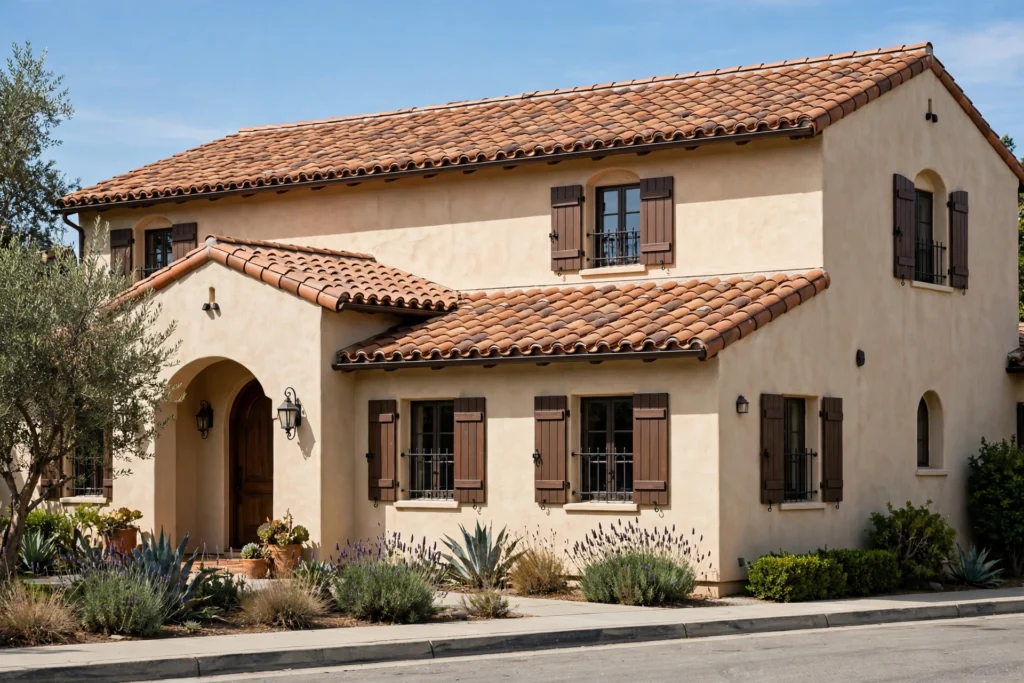
Tile roofs turn heads. Whether it is the warm barrel curves on a Mediterranean villa or the clean lines of flat concrete tile on a modern home, tile says permanence in a way shingles never will. But once you decide on tile, a second decision follows: clay or concrete? The two look similar from the street, they are installed in similar ways, and they both outlast most other roofing materials. Under the surface, though, they differ in price, lifespan, weight, and style — and the right choice depends on your budget, your home, and how long you plan to stay. This guide compares clay vs concrete tile roof on every factor that should drive the decision, with real figures from our calculators, so you can choose with the numbers in front of you.
The short answer: concrete tile usually costs less and clay tile usually lasts longer. Concrete runs $8.70 to $19.80 per square foot for materials and installation ($14 to $22 all-in), while clay runs $12 to $44 ($21 to $42 all-in). Clay’s expected lifespan is 50 to 100 years against concrete’s roughly 40 to 50-plus. In the clay vs concrete tile roof comparison, neither material is wrong — concrete is the value choice, clay is the long-life choice, and the right pick depends on your budget and how long you plan to keep the roof.
What clay tile is
Clay tile is made from natural clay, shaped and fired in a kiln — the same basic material as brick and pottery, and one of the oldest roofing materials in use. It comes in several profiles. Interlocking flat tiles are the simplest and least expensive clay option at $12 to $22 per square foot installed ($16.30 typical). S-tile, with its gentle wave, runs $12.70 to $23.50 ($17.10 typical). Barrel tile — the half-cylinder Mission profile most people picture when they think of a tile roof — runs $13.50 to $25 ($18.50 typical). Glazed clay tile, fired with a colored coating, runs $18.50 to $35.50 ($25.50 typical), and handmade or artisan tile, shaped and finished by hand with an irregular, custom look, runs $21 to $44 ($30 typical). Colors are natural earth tones — terracotta, brown, buff — with glazed tiles offering a wider palette. Clay’s headline strength is lifespan: 50 to 100 years, which means a clay roof can outlast the mortgage and, in some cases, several generations of owners. Keep these properties in mind — they are half of the clay vs concrete tile roof comparison.
What concrete tile is
Concrete tile is made from a mix of sand, cement, and water, molded under pressure and cured — a manufactured tile designed to deliver the tile look at a lower price. Its profiles mirror clay’s at lower prices: flat concrete tile runs $8.70 to $15.50 per square foot ($11.50 typical), Roman tile $9 to $16 ($12 typical), and S-tile or barrel $9.40 to $16.50 ($12.40 typical). Concrete also does something clay does not: it imitates other materials. Shake-look concrete tile, molded to resemble wood shake, runs $9.80 to $17.70 ($13.10 typical), and designer or slate-look tile, molded to resemble natural slate, runs $10.80 to $19.80 ($14.70 typical). Concrete tile is available in more shapes and colors than clay overall. Its expected lifespan is roughly 40 to 50-plus years — shorter than clay’s, but still far longer than most roofing materials. With both materials defined, the clay vs concrete tile roof comparison comes down to five factors: cost, lifespan, weight, style, and climate.
Clay vs concrete tile roof: cost compared
Cost is where most owners start the clay vs concrete tile roof comparison, and the gap is real at every price point. The figures below come from our two calculators, both priced on the same basis — materials and installation, then the all-in project cost.
| Clay tile | Concrete tile | |
|---|---|---|
| Materials + install (per sq ft) | $12–$44 | $8.70–$19.80 ($870–$1,980/square) |
| All-in project cost (per sq ft) | $21–$42 | $14–$22 |
| Flat profile (typical) | Interlocking flat $16.30 | Flat $11.50 |
| Barrel / S-tile (typical) | Barrel $18.50 | S-tile/barrel $12.40 |
| Premium profile (typical) | Handmade/artisan $30 | Designer/slate-look $14.70 |
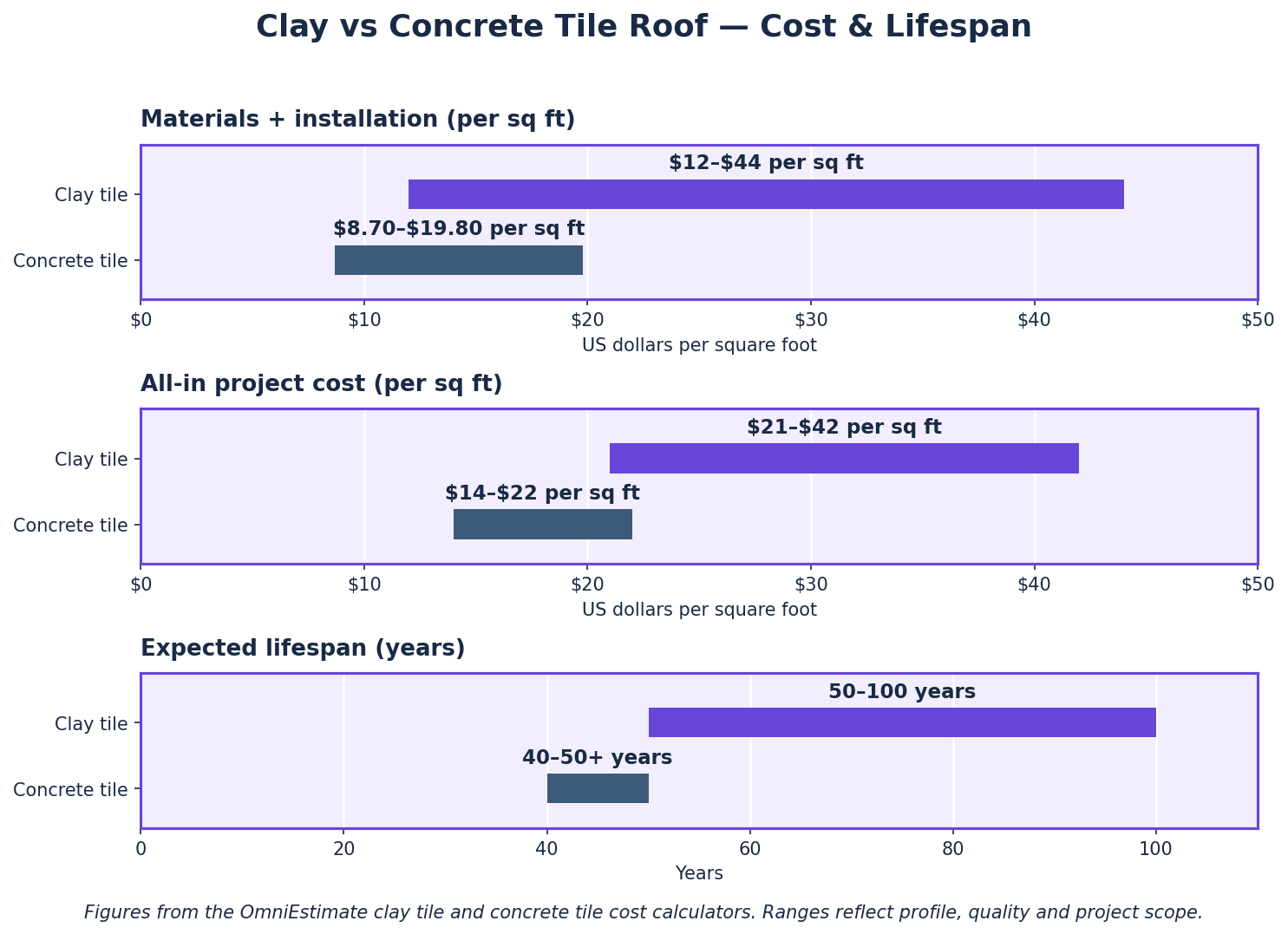
On materials and installation, the clay vs concrete tile roof gap runs from about $3.30 per square foot at the bottom of the ranges ($12 against $8.70) to about $24 at the top ($44 against $19.80) — the top end is where handmade clay separates from everything else. The fairest like-for-like comparisons are the matching profiles: interlocking flat clay at $16.30 typical against flat concrete at $11.50 typical is $4.80 more per square foot, and barrel clay at $18.50 typical against concrete S-tile/barrel at $12.40 typical is $6.10 more. Multiply the per-square-foot ranges by 100 and clay works out to roughly $1,200 to $4,400 per square against concrete’s published $870 to $1,980 per square.
The all-in gap in the clay vs concrete tile roof comparison is wider still: $21 to $42 per square foot for clay against $14 to $22 for concrete, or roughly $7 more at the bottom of the ranges and $20 more at the top. Both calculators price on the same all-in basis, so the comparison is apples to apples — and it shows clay costing roughly half as much again as concrete at the low end and nearly twice as much at the high end.
One more cost belongs in the clay vs concrete tile roof math: framing. Tile is heavy, and the clay calculator prices framing reinforcement at roughly $5,700 to $6,600 where the existing structure needs it. Not every home needs it — the figure applies where reinforcement is required — but it is a real cost that belongs in the budget. Concrete tile is heavy too, and your roofer should assess the structure either way; the published reinforcement figure comes from the clay calculator. To price your own roof, run the numbers through the Clay Tile Roof Cost Calculator and the Concrete Tile Roof Cost Calculator with your profile, roof size, and whether reinforcement is needed.
The per-square-foot gap is only half of the clay vs concrete tile roof cost story, though. Because clay’s expected lifespan runs far longer (see below), its cost per year of service narrows the gap — the dearer roof that lasts decades longer can work out cheaper over the life of the building. Whether it does depends on how long you keep the home: a roof that lasts 100 years only pays for itself if someone is still living under it.
Clay vs concrete tile roof: lifespan
Our calculator pages put clay tile’s expected life at 50 to 100 years and concrete tile’s at roughly 40 to 50-plus years. That longer range is the honest summary of the clay vs concrete tile roof lifespan question: clay can last about twice as long at the top of the range, and even at the bottom of its range it matches concrete’s best. Over a 50-year building life, a concrete tile roof may need replacing once; a clay roof, installed well, may never need replacing at all.
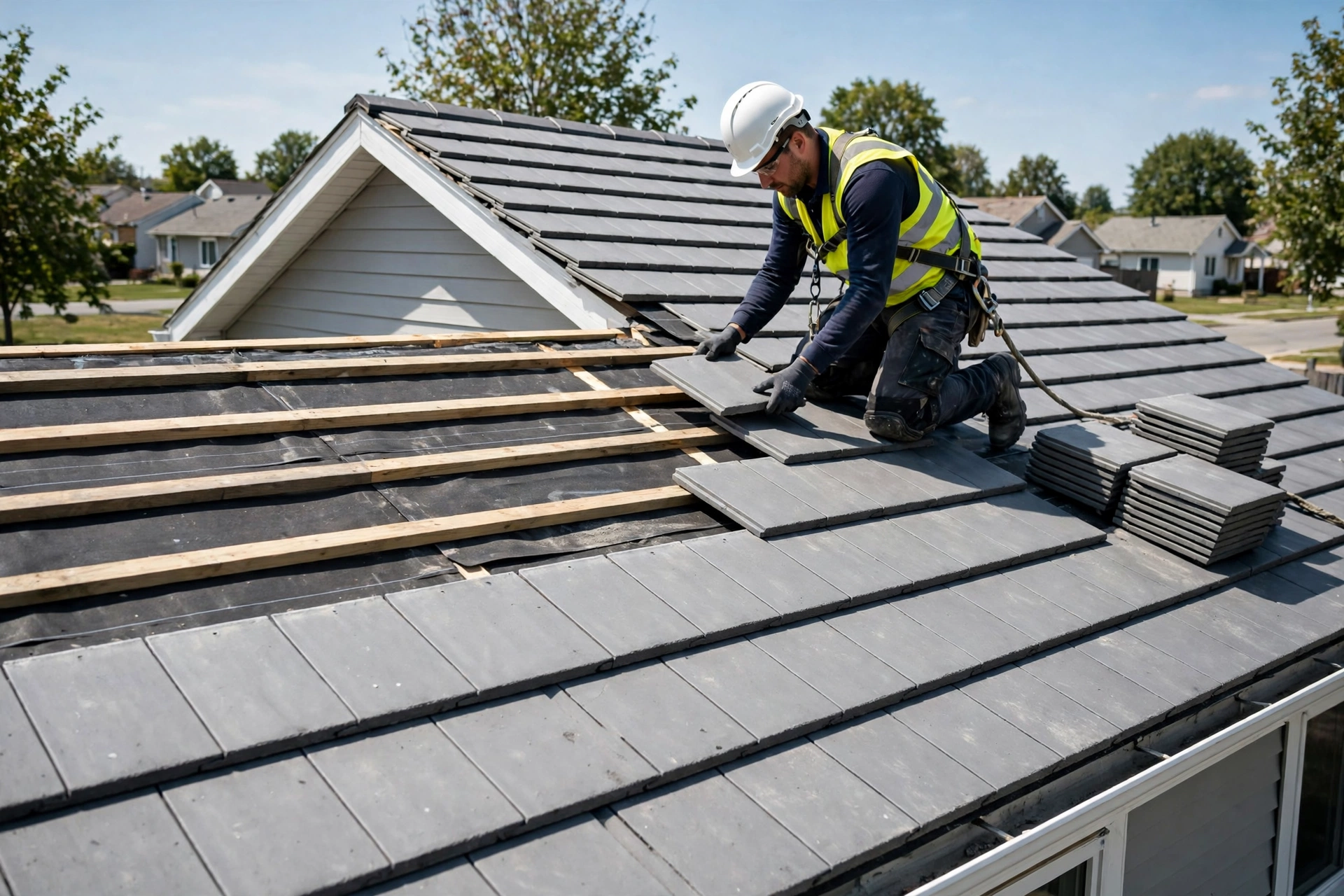
Three things matter more than the headline numbers in any clay vs concrete tile roof comparison. First, the underlayment: tile itself usually outlasts the waterproofing layer beneath it, so the underlayment’s quality and the flashing details decide how the roof actually performs over decades. Second, installation quality: tile roofs are unforgiving of poor installation — broken tiles, bad flashing, and wrong fastening shorten any tile roof’s life, whatever the material. Third, maintenance: regular inspections, replacing cracked tiles promptly, and keeping valleys and gutters clear help both roofs reach the longer end of their range. Whatever you choose, get quotes from licensed local roofers with real tile experience — tile is a specialist job, not a shingle crew’s side project.
Clay has one more lifespan advantage worth knowing: when a clay barrel roof eventually needs its underlayment replaced, the tiles themselves can often be lifted and re-laid. Our clay calculator prices re-laying existing barrel tile at roughly $12,500 to $14,300 less than installing new barrel tile — a saving that only exists because the tiles themselves outlast everything under them.
Clay vs concrete tile roof: weight and structure
Weight is the factor most owners overlook in the clay vs concrete tile roof decision, and it is the one that can add thousands to the bill. Tile — clay and concrete alike — is far heavier than asphalt shingles, and a roof framed for shingles may not be ready for tile. The clay calculator prices framing reinforcement at roughly $5,700 to $6,600 where the structure needs strengthening, and that figure should sit in your budget as a contingency until a structural check says otherwise.
In practice, the clay vs concrete tile roof weight question has one answer for both materials: get the structure checked before you commit. A structural engineer or an experienced tile roofer can tell you whether your framing carries tile as it stands or needs reinforcement, and that answer should come before you sign a contract, not after the tiles arrive. If reinforcement is needed, it is a one-time cost — once the framing is right, it is right for the life of the roof, however many decades that is.
Clay vs concrete tile roof: style and color
Style is where the clay vs concrete tile roof choice gets personal, because the two materials cover different ground. Clay’s look is the classic tile roof: natural earth tones — terracotta, brown, buff — with barrel and S-tile profiles that suit Mediterranean, Spanish, and Southwestern homes. Glazed clay widens the palette, and handmade artisan tile gives a one-of-a-kind surface no manufactured tile copies. Concrete’s strength is range: it comes in flat, Roman, and barrel profiles like clay, and then goes further, with shake-look tile that mimics wood shake and designer tile that mimics natural slate — two looks clay does not offer. That range is why the clay vs concrete tile roof style question has no single winner: clay owns the authentic Mediterranean look, concrete owns variety and mimicry, and the right answer is the one that suits your home’s architecture.
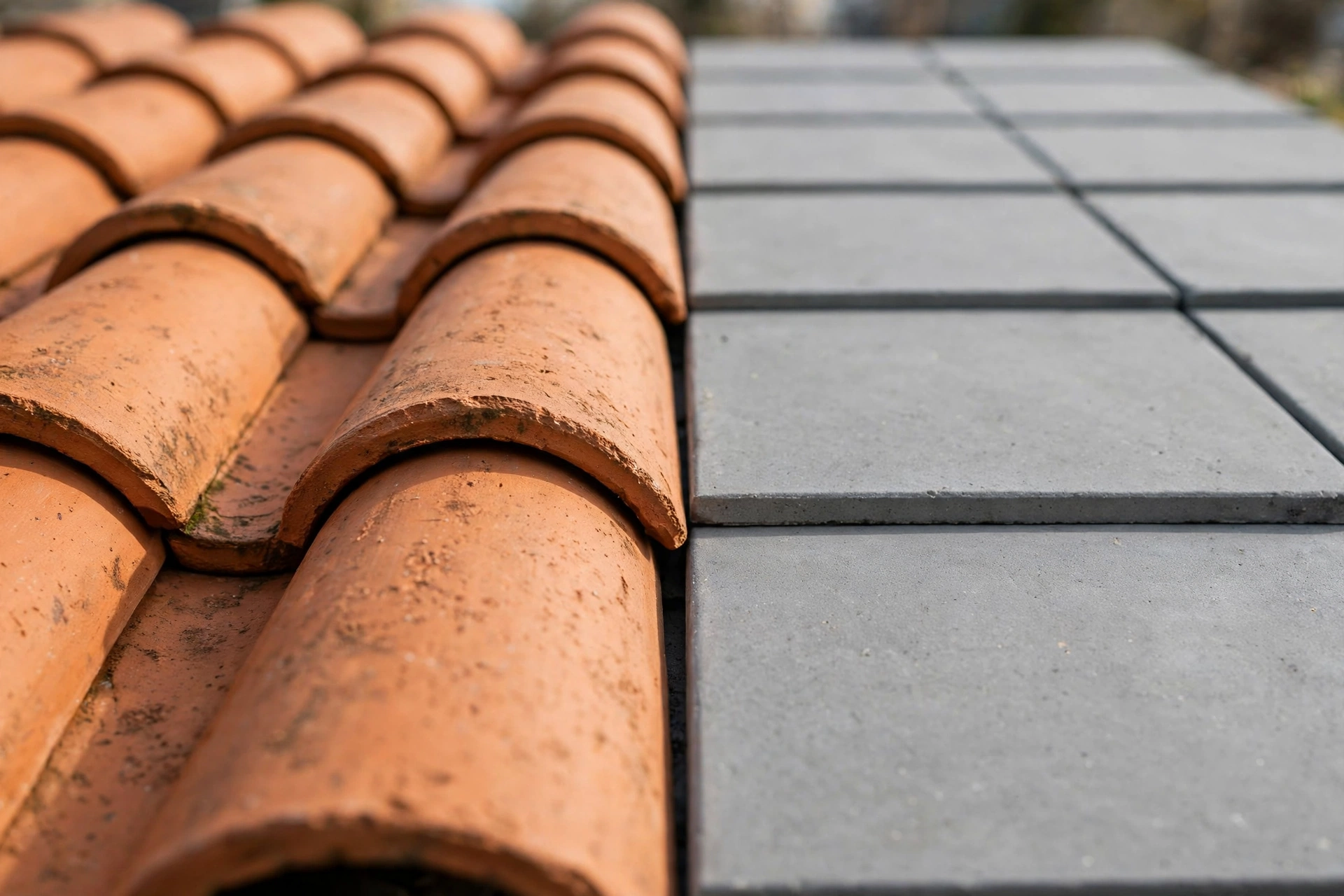
One honest style note: clay holds its color throughout the tile and is fade-resistant, so a clay roof keeps its color for decades. Concrete tile’s surface color can fade over time, unless you choose through-colored tile, which mixes the color through the concrete and resists fading better at a higher price. That difference matters most on premium homes where the roof is part of the architecture, and least where the roof is barely visible from the street.
Clay vs concrete tile roof: climate and durability
This is where the clay vs concrete tile roof comparison genuinely diverges on durability rather than price. Both materials are fire resistant — a real advantage in wildfire-prone areas — and both are heavy, durable roofs. The differences are in the details. Clay’s fade resistance means its color holds for decades in strong sun, while concrete’s surface color can fade unless the tile is through-colored. Both materials share the same weakness: tile breaks if walked on carelessly, so foot traffic — for maintenance, chimney work, or solar installation — needs care and the right technique. In a mild climate, these durability differences shrink and cost and lifespan take over the clay vs concrete tile roof decision; in a hot, sunny climate, clay’s fade resistance earns its keep. In a cold climate, ask your roofer about the tile’s freeze-thaw performance before you commit — the right grade and installation details matter more than the material name.
Which should you choose?
Choose clay if: your budget stretches to it, you want the longest expected life, you love the authentic Mediterranean look, or you plan to keep the home for decades — clay’s 50-to-100-year lifespan and fade-resistant color are the strongest reasons to pick clay in the clay vs concrete tile roof decision, and the re-laying option means the tiles can outlast even the underlayment beneath them.
Choose concrete if: your budget is tight, you want the tile look for less, you like the shake-look or slate-look profiles clay does not offer, or your horizon is 20 to 30 years rather than 50-plus. Concrete is the value side of the clay vs concrete tile roof comparison: the same tile presence, the same fire resistance, at roughly two-thirds of clay’s all-in price at the low end.
Either way: whichever side of the clay vs concrete tile roof comparison you land on, get the structure checked first, get the underlayment and flashing details right, and hire a crew with proven tile experience — tile is specialized, heavy work, and mistakes lead to leaks, cracked tile, and warranty problems. The National Roofing Contractors Association (NRCA) is a good starting point for finding qualified contractors and understanding the standards each system should meet. For the wider picture — how tile compares with shingles, metal, and other materials — see our roofing materials compared guide, and if your project involves a full replacement rather than a material choice, the roof replacement cost guide and the metal roof cost guide cover those options.
Frequently asked questions
Which is cheaper, clay or concrete tile?
Concrete tile is cheaper. Our calculators put concrete at $8.70 to $19.80 per square foot for materials and installation ($14 to $22 all-in) against clay at $12 to $44 ($21 to $42 all-in). On matching profiles, flat concrete runs $11.50 per square foot typical against interlocking flat clay at $16.30, and concrete S-tile/barrel runs $12.40 typical against clay barrel at $18.50.
Which lasts longer, clay or concrete tile?
Clay tile lasts longer. Clay roofs are expected to last 50 to 100 years, while concrete tile roofs are expected to last roughly 40 to 50-plus years. Installation quality, underlayment, flashing, and maintenance affect both — a well-installed tile roof of either material outlasts a poorly installed one.
Is clay tile worth the extra cost over concrete?
It can be, if you keep the home long enough. Clay costs roughly $7 to $20 more per square foot all-in, but it can last about twice as long at the top of the range, holds its color without fading, and its tiles can be re-laid when the underlayment wears out — our clay calculator prices re-laying existing barrel tile at roughly $12,500 to $14,300 less than new barrel tile. If your horizon is 20 to 30 years, concrete is usually the better value.
Do tile roofs need extra framing support?
Sometimes. Tile is far heavier than asphalt shingles, and a roof framed for shingles may need strengthening before it can carry tile. Our clay calculator prices framing reinforcement at roughly $5,700 to $6,600 where the structure needs it. Get the structure checked before you sign a contract — the answer should come before the tiles arrive, not after.
Can you reuse clay tiles when re-roofing?
Often, yes. Clay tiles usually outlast the underlayment beneath them, so when a clay barrel roof needs work, the tiles can be lifted, the underlayment replaced, and the same tiles re-laid. Our clay calculator prices re-laying existing barrel tile at roughly $12,500 to $14,300 less than installing new barrel tile.
What styles do clay and concrete tiles come in?
Clay comes in interlocking flat, S-tile, barrel (Spanish or Mission), glazed, and handmade artisan profiles. Concrete comes in flat, Roman, and S-tile/barrel profiles, plus shake-look tile that mimics wood shake and designer tile that mimics natural slate — two looks clay does not offer. Concrete is available in more shapes and colors overall.
How much does a clay or concrete tile roof cost for my home?
It depends on the profile, roof size, whether framing reinforcement is needed, and local labor. Run your numbers through the Clay Tile Roof Cost Calculator and the Concrete Tile Roof Cost Calculator for budget, standard, and premium estimates, then confirm with written quotes from licensed local roofers with proven tile experience.
The bottom line
Clay vs concrete tile roof comes down to this: concrete costs less, offers more styles, and lasts 40 to 50-plus years, while clay lasts 50 to 100 years, holds its color, and can be re-laid when the underlayment wears out. For most owners on a budget, concrete is the better value; for a forever home where the roof is part of the architecture, clay earns its premium. Either way, check the structure, price both options on the same basis, and hire a crew that has installed tile many times before. The calculators above will give you the numbers to take into that conversation.
