
- Home
-
Plan your next home project
Explore cost calculators by service.
Roofing Calculators
View allRoof Replacement Cost CalculatorArchitectural Shingle Roof Cost CalculatorNew Roof Installation Cost CalculatorRoof Repair Cost CalculatorAsphalt Shingle Roofing Cost CalculatorMetal Roofing Cost CalculatorRoof Coating Cost CalculatorTile Roofing Cost CalculatorSlate Roofing Cost CalculatorFlat/Low-Slope Roofing Cost CalculatorTPO Roofing Cost CalculatorEPDM Roofing Cost CalculatorModified Bitumen Roofing Cost CalculatorSkylight Installation/Replacement Cost CalculatorRoofing Cost Per Square FootClay Tile Roof Cost CalculatorTile Roof Cost CalculatorRoof Inspection Cost CalculatorWood Shake/Shingle Roofing Cost CalculatorRoof Decking/Sheathing Cost CalculatorRoof Underlayment Cost CalculatorFlashing Repair/Replacement Cost CalculatorRoof Vent Installation Cost CalculatorStanding Seam Metal Roof Cost CalculatorRoof Underlayment Replacement Cost CalculatorSkylight Replacement Cost CalculatorChimney Flashing Repair Cost CalculatorConcrete Tile Roof Cost CalculatorSlate Roof Cost CalculatorPlumbing Calculators
View allPipe Installation/Replacement Cost CalculatorPipe Repair Cost CalculatorLeak Repair Cost CalculatorDrain Cleaning Cost CalculatorSewer Line Repair Cost CalculatorSewer Line Replacement Cost CalculatorWater Main Installation/Repair Cost CalculatorWater Heater Installation/Replacement Cost CalculatorTankless Water Heater Cost CalculatorToilet Installation/Replacement Cost CalculatorSink/Faucet Installation Cost CalculatorShower/Tub Plumbing Cost CalculatorGarbage Disposal Installation Cost CalculatorSump Pump Installation Cost CalculatorWater Softener Installation Cost CalculatorRepiping Cost CalculatorGas Line Installation/Repair Cost CalculatorPlumbing Project Cost CalculatorPlumber Cost CalculatorWater Heater Replacement Cost CalculatorTank Water Heater Cost CalculatorWater Heater Repair Cost CalculatorClogged Drain Repair Cost CalculatorTrenchless Sewer Repair Cost CalculatorMain Water Line Replacement Cost CalculatorPipe Leak Repair Cost CalculatorWhole House Repiping Cost CalculatorToilet Installation Cost CalculatorBurst Pipe Repair Cost CalculatorFaucet Replacement Cost CalculatorToilet Replacement Cost CalculatorGarbage Disposal Replacement Cost CalculatorGarbage Disposal Installation Cost CalculatorSink Installation Cost CalculatorSump Pump Replacement Cost CalculatorBathtub Plumbing Cost CalculatorShower Plumbing Cost CalculatorFaucet Installation Cost CalculatorGas Line Installation Cost CalculatorGas Line Repair Cost CalculatorPlumbing Inspection Cost CalculatorPEX Repiping Cost CalculatorHVAC Calculators
View allAC Compressor Replacement Cost CalculatorFurnace Installation Cost CalculatorCentral AC Installation Cost CalculatorAC Replacement Cost CalculatorFurnace Installation/Replacement Cost CalculatorAC Repair Cost CalculatorFurnace Repair Cost CalculatorHeat Pump Installation/Replacement Cost CalculatorHeat Pump Repair Cost CalculatorBoiler Installation/Replacement Cost CalculatorMini-Split Installation Cost CalculatorBoiler Repair Cost CalculatorDuctwork Installation Cost CalculatorDuct Repair Cost CalculatorDuctwork Replacement Cost CalculatorHVAC System Installation Cost CalculatorHVAC Replacement Cost CalculatorThermostat Installation Cost CalculatorVentilation Installation Cost CalculatorHVAC Installation Cost CalculatorFurnace Replacement Cost CalculatorHeat Pump Installation Cost CalculatorHeat Pump Replacement Cost CalculatorDuctless Mini Split Cost CalculatorMini Split Installation Cost CalculatorHVAC Duct Cleaning Cost CalculatorSmart Thermostat Installation Cost CalculatorBoiler Replacement Cost CalculatorBoiler Installation Cost CalculatorAir Handler Replacement Cost CalculatorEvaporator Coil Replacement Cost CalculatorHVAC Maintenance Cost CalculatorHVAC System Size CalculatorElectrical Project Cost CalculatorElectrical Calculators
View allElectrical Panel Upgrade/Replacement Cost CalculatorNew Wiring Cost CalculatorWhole-House Rewiring Cost CalculatorOutlet Installation Cost CalculatorSwitch Installation Cost CalculatorLight Fixture Installation Cost CalculatorCeiling Fan Installation Cost CalculatorElectrical Service Upgrade Cost CalculatorGenerator Installation Cost CalculatorEV Charger Installation Cost CalculatorCircuit Breaker Installation Cost CalculatorDedicated Circuit Installation Cost CalculatorOutdoor/Landscape Lighting Cost CalculatorSmoke/CO Detector Installation Cost CalculatorFlooring Calculators
View allHardwood Flooring Cost CalculatorEngineered Wood Flooring Cost CalculatorLaminate Flooring Cost CalculatorVinyl/LVP Flooring Cost CalculatorTile Flooring Cost CalculatorCarpet Installation Cost CalculatorBamboo Flooring Cost CalculatorCork Flooring Cost CalculatorConcrete Flooring Cost CalculatorEpoxy Flooring Cost CalculatorFlooring Replacement Cost CalculatorFloor Refinishing Cost CalculatorFloor Removal Cost CalculatorSubfloor Repair/Replacement Cost CalculatorPainting Calculators
View allInterior Painting Cost CalculatorWhole-House Painting Cost CalculatorExterior Painting Cost CalculatorCeiling Painting Cost CalculatorRoom Painting Cost CalculatorTrim/Baseboard Painting Cost CalculatorDoor Painting Cost CalculatorCabinet Painting/Refinishing Cost CalculatorDeck Painting/Staining Cost CalculatorFence Painting/Staining Cost CalculatorSiding Painting Cost CalculatorGarage Painting Cost CalculatorCommercial Painting Cost CalculatorHouse Painting Cost CalculatorPainting Cost Per Square Foot CalculatorBedroom Painting Cost CalculatorLiving Room Painting Cost CalculatorKitchen Painting Cost CalculatorBathroom Painting Cost CalculatorTrim Painting Cost CalculatorCabinet Painting Cost CalculatorDeck Painting Cost CalculatorFence Painting Cost CalculatorKitchen Cabinet Painting Cost CalculatorDeck Staining Cost CalculatorExterior Siding Painting Cost CalculatorPopcorn Ceiling Removal and Painting Cost CalculatorWallpaper Removal and Painting Cost CalculatorGeneral Construction Calculators
View allNew Home Construction Cost CalculatorStructural Renovation Cost CalculatorGarage Construction Cost CalculatorDetached Structure Construction Cost CalculatorFraming Cost CalculatorStructural Framing Repair Cost CalculatorBasement Build-Out Cost CalculatorMajor Home Renovation Cost CalculatorCommercial Build-Out Cost CalculatorAccessory Dwelling Unit (ADU) Construction Cost CalculatorConstruction Cost Per Square FootNew Home ConstructionCustom Home BuildingHome Addition ConstructionDetached Garage ConstructionShed ConstructionPole BarnWall FramingLandscaping Calculators
View allLandscape Installation Cost CalculatorSod Installation Cost CalculatorArtificial Turf Cost CalculatorLawn Installation Cost CalculatorIrrigation/Sprinkler Installation Cost CalculatorIrrigation Repair Cost CalculatorLandscape Grading Cost CalculatorYard Leveling Cost CalculatorDrainage Installation Cost CalculatorFrench Drain Installation Cost CalculatorMulching Cost CalculatorGarden Bed Installation Cost CalculatorTree Planting Cost CalculatorLandscape Lighting Cost CalculatorHardscaping Cost CalculatorLandscaping Cost CalculatorLandscape Design Cost CalculatorArtificial Grass Cost CalculatorLawn Seeding Cost CalculatorHydroseeding Cost CalculatorLawn Grading Cost CalculatorMulch Installation Cost CalculatorLandscape Rock Cost CalculatorFlower Bed Installation Cost CalculatorTree Removal Cost CalculatorStump Grinding Cost CalculatorShrub Installation Cost CalculatorIrrigation System Cost CalculatorSprinkler System Installation Cost CalculatorSprinkler Repair Cost CalculatorDrainage System Cost CalculatorFrench Drain Cost CalculatorOutdoor Lighting Installation Cost CalculatorRetaining Wall Landscaping Cost CalculatorConcrete Calculators
View allConcrete Driveway Cost CalculatorConcrete Patio Cost CalculatorConcrete Slab Cost CalculatorConcrete Foundation Cost CalculatorConcrete Walkway/Sidewalk Cost CalculatorConcrete Steps Cost CalculatorConcrete Floor Cost CalculatorConcrete Resurfacing Cost CalculatorConcrete Repair Cost CalculatorStamped Concrete Cost CalculatorColored/Decorative Concrete Cost CalculatorConcrete Removal Cost CalculatorGarage Slab Cost CalculatorFootings Cost CalculatorConcrete Cost CalculatorSiding Calculators
View allWood Siding Cost CalculatorSiding Installation Cost CalculatorEngineered Wood Siding Cost CalculatorSiding Replacement Cost CalculatorMetal/Aluminum Siding Cost CalculatorSiding Repair Cost CalculatorVinyl Siding Cost CalculatorStucco Siding Cost CalculatorBrick Veneer Cost CalculatorFiber Cement Siding Cost CalculatorStone Veneer Cost CalculatorSiding Painting Cost CalculatorSiding Cost Per Square FootJames Hardie SidingAluminum SidingSiding RemovalHouse Wrap InstallationWindows & Doors Calculators
View allWindow Installation Cost CalculatorWindow Replacement Cost CalculatorExterior Door Installation Cost CalculatorWindow Repair Cost CalculatorInterior Door Installation Cost CalculatorEnergy-Efficient Windows Cost CalculatorExterior Door Replacement Cost CalculatorBay/Bow Windows Cost CalculatorPatio Door Installation Cost CalculatorSkylight Installation Cost CalculatorSliding Glass Door Cost CalculatorFrench Door Cost CalculatorStorm Door Cost CalculatorGarage Entry Door Cost CalculatorRemodeling Calculators
View allKitchen Remodel Cost CalculatorBathroom Remodel Cost CalculatorBasement Remodel Cost CalculatorAttic Remodel Cost CalculatorWhole-House Remodel Cost CalculatorBedroom Remodel Cost CalculatorLiving Room Remodel Cost CalculatorGarage Conversion Cost CalculatorHome Office Remodel Cost CalculatorLaundry Room Remodel Cost CalculatorInterior Renovation Cost CalculatorAccessibility Remodel Cost CalculatorHome Remodeling Cost CalculatorWhole House Remodel Cost CalculatorSmall Bathroom Remodel Cost CalculatorPrimary Bathroom Remodel Cost CalculatorBasement Finishing Cost CalculatorAttic Conversion Cost CalculatorMudroom Remodel Cost CalculatorCloset Remodel Cost CalculatorOpen Floor Plan Conversion Cost CalculatorInterior Wall Removal Cost CalculatorHome Addition Cost CalculatorRoom Addition Cost CalculatorFencing Calculators
View allWood Fence Cost CalculatorVinyl Fence Cost CalculatorChain-Link Fence Cost CalculatorAluminum Fence Cost CalculatorSteel Fence Cost CalculatorWrought-Iron Fence Cost CalculatorComposite Fence Cost CalculatorPrivacy Fence Cost CalculatorPicket Fence Cost CalculatorPool Fence Cost CalculatorFence Replacement Cost CalculatorFence Repair Cost CalculatorGate Installation Cost CalculatorDecks, Porches & Patios Calculators
View allComposite Deck Cost CalculatorDeck Replacement Cost CalculatorWood Deck Cost CalculatorDeck Repair Cost CalculatorDeck Resurfacing Cost CalculatorDeck Railing Cost CalculatorCovered Deck Cost CalculatorPorch Construction Cost CalculatorPorch Replacement Cost CalculatorScreened Porch Cost CalculatorPatio Installation Cost CalculatorPaver Patio Cost CalculatorConcrete Patio Cost CalculatorCovered Patio Cost CalculatorGutters Calculators
View allGutter Installation Cost CalculatorGutter Replacement Cost CalculatorGutter Repair Cost CalculatorSeamless Gutters Cost CalculatorSteel Gutters Cost CalculatorAluminum Gutters Cost CalculatorGutter Guards Cost CalculatorCopper Gutters Cost CalculatorDownspout Installation/Replacement Cost CalculatorGutter Cleaning Cost CalculatorInsulation & Drywall Calculators
View allAttic Insulation Cost CalculatorWall Insulation Cost CalculatorBasement/Crawlspace Insulation Cost CalculatorSpray Foam Insulation Cost CalculatorBlown-In Insulation Cost CalculatorFiberglass Insulation Cost CalculatorInsulation Removal Cost CalculatorDrywall Installation Cost CalculatorDrywall Replacement Cost CalculatorDrywall Repair Cost CalculatorCeiling Drywall Cost CalculatorDrywall Finishing/Texturing Cost CalculatorFoundation & Waterproofing Calculators
View allFoundation Repair Cost CalculatorFoundation Replacement Cost CalculatorFoundation Crack Repair Cost CalculatorFoundation Stabilization Cost CalculatorPiering/Underpinning Cost CalculatorBasement Waterproofing Cost CalculatorCrawlspace Waterproofing Cost CalculatorExterior Waterproofing Cost CalculatorInterior Drainage System Cost CalculatorSump Pump System Cost CalculatorFrench Drain Cost CalculatorCrawlspace Encapsulation Cost CalculatorGarage & Garage Doors Calculators
View allAttached Garage Construction Cost CalculatorDetached Garage Construction Cost CalculatorGarage Addition Cost CalculatorGarage Conversion Cost CalculatorGarage Door Installation Cost CalculatorGarage Door Replacement Cost CalculatorGarage Door Repair Cost CalculatorGarage Door Opener Installation Cost CalculatorGarage Renovation Cost CalculatorGarage Flooring/Epoxy Cost CalculatorGarage Insulation Cost CalculatorSolar Calculators
View allResidential Solar Panel Installation Cost CalculatorSolar Panel Replacement Cost CalculatorGround-Mounted Solar Cost CalculatorSolar Inverter Replacement Cost CalculatorSolar System Expansion Cost CalculatorSolar Panel Removal & Reinstallation Cost CalculatorSolar Battery Storage Cost CalculatorRoof-Mounted Solar Cost CalculatorPools & Spas Calculators
View allChoose a project. Explore the costs. Plan with confidence. - Browse by City
- About Us
- Contact Us
Electrical
Home > Calculators > Whole-House Rewiring Cost Calculator
Whole-House Rewiring Cost Calculator
Use this free whole-house rewiring cost calculator to estimate what rewiring your entire home costs, from a small ranch with open walls to a large older house with knob-and-tube wiring behind plaster. Pick your home size and stories, choose your current wiring type and wall access, and tick any extras such as a new panel or drywall patching. You will get a planning estimate split into wiring materials, electrician labor, old-wiring removal and permit costs, with budget, standard and premium levels to compare before you call an electrician.
Estimate My Rewiring CostWhole-House Rewiring Cost Calculator
Rewiring cost depends on how much wire has to move and how hard it is to move it. Square footage sets the length of the runs, but wall access sets the labor: fishing new cable through finished walls costs far more than pulling it through open studs, and plaster is the hardest of all. The wiring you are replacing matters too — knob-and-tube has no ground wire and takes the most care to remove safely.
Set your home size, stories, current wiring type, wall access and home age, choose whether a new panel is included, estimate your outlets and switches, then tick any extras such as a permit allowance, drywall patching, AFCI/GFCI upgrades or surge protection. Then enter your ZIP code so we can match you with local professionals if you want a firm quote. This estimate uses national planning averages, not ZIP-specific pricing.
Get Your Free Estimate
Complete the form below to get matched with local electricians for your rewiring project.
How to Read Your Results
Your result shows one headline planning estimate for a standard project, plus a typical range from the Budget total to the Premium total.
Below that you will see three cards. Budget assumes basic materials and a lower labor rate. Standard assumes quality materials, a licensed electrician and typical access. Premium assumes premium materials, a specialist crew and difficult access. The breakdown shows materials, labor and other costs for the standard project, with a line-item table listing quantity, rate and subtotal for every line. Labor hours grow with home size and stories, and grow fastest when wire must be fished through finished or plaster walls in an older home.
Cost Breakdown Explanation
Materials cover new copper cable priced per square foot of living space, boxes, breakers and fittings, plus every outlet, switch and device you replace or add, and a new electrical panel when you include one. Labor covers the electrician time to pull wire, terminate every device, and test, adjusted for stories, wall access, wiring type and home age. Other costs can include knob-and-tube removal and safe-off, AFCI/GFCI breaker upgrades, whole-house surge protection, drywall or plaster patching, and a permit and inspection allowance. Each extra is priced only when you tick it.
Quick Answers
How much does it cost to rewire a whole house?
Published 2026 US guides put the wiring work itself at about $2 to $4 per square foot (Angi) to $3 to $5 per square foot (HomeAdvisor), before panel, permits and wall repair. All-in old-house rewires run $5 to $17 per square foot on HomeGuide’s data, with most full rewires landing between $6,000 and $22,000. Use the whole-house rewiring cost calculator above for a figure based on your home size and walls.
How much does knob-and-tube replacement cost?
HomeGuide prices knob-and-tube replacement at $12,000 to $35,000 as its own band, because the wiring is ungrounded, often buried in insulation, and takes the most labor to remove safely. Insurers frequently surcharge or decline knob-and-tube, which is why full replacement is usually the answer rather than repair.
Does aluminum wiring need a full rewire?
Not always. Aluminum branch wiring from about 1965 to 1973 usually fails at the connections, not in the wire itself, so CPSC-recognized connector remediation (COPALUM crimps or AlumiConn connectors at every device, roughly $1,500 to $4,000) is a legitimate middle path. A full rewire is the permanent fix and is what this whole-house rewiring cost calculator prices.
Do I need a permit to rewire a house?
Yes, in almost every jurisdiction. A whole-house rewire normally needs an electrical permit, rough-in and final inspections, and the panel work (if any) inspected before power is restored. This calculator includes a permit and inspection allowance only if you tick it.
How Much Does Whole-House Rewiring Cost?
There is no single price for rewiring a house, because the total depends on home size, the wiring being replaced, and above all how the new wire gets through the walls. A 1,200 square foot ranch rewired during a gut remodel and a 2,500 square foot pre-war home with knob-and-tube behind plaster are both called rewires, but they are priced very differently.
Published 2026 US guides put the wiring labor and materials at about $2 to $4 per square foot on Angi’s calculator and $3 to $5 per square foot on HomeAdvisor’s data. HomeGuide’s old-house figures run $5 to $17 per square foot all-in, a $10,000 to $30,000 average project, because they include finished-wall access, wall repair and code upgrades. Most full rewires of a typical 1,500 to 2,500 square foot home land around $6,000 to $22,000, with roughly $12,000 as a common midpoint. That spread is exactly what this whole-house rewiring cost calculator is built to untangle.
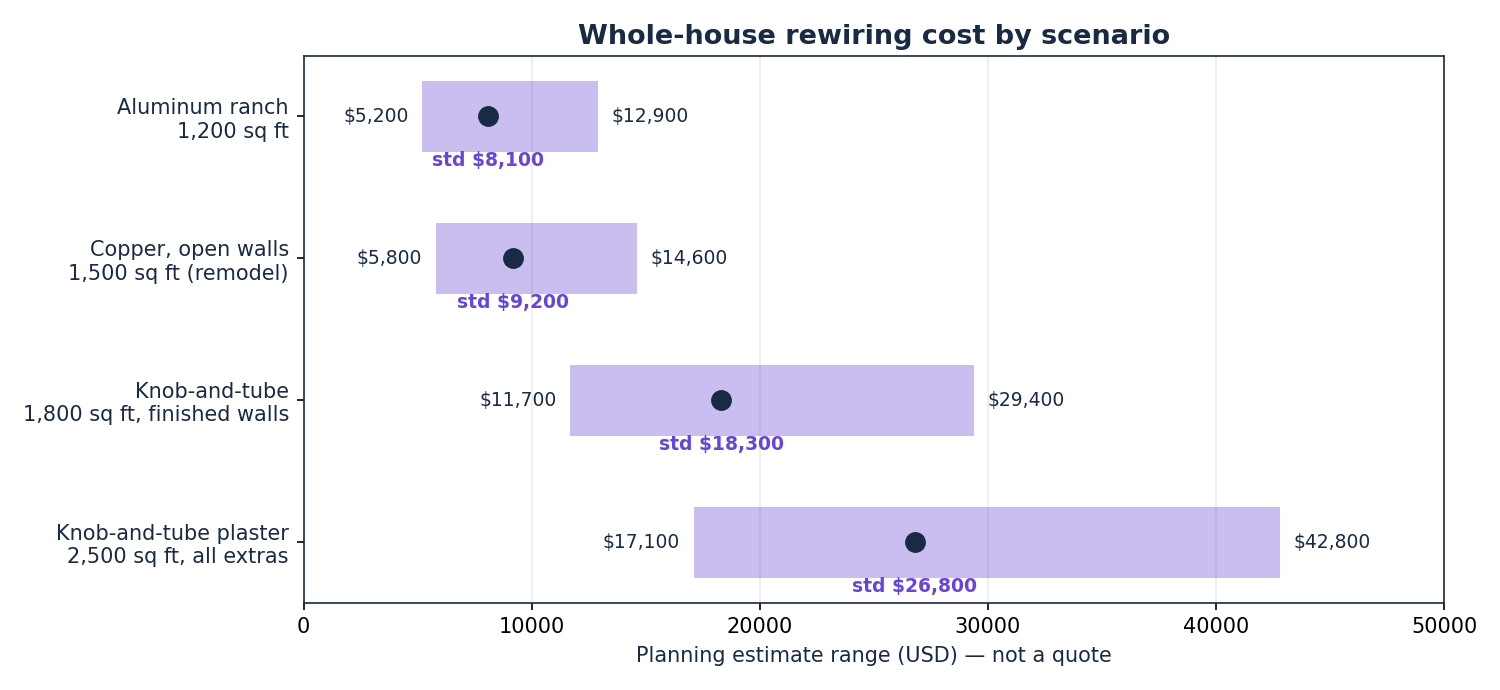
The table at the end of this article shows four example projects calculated by this tool. Use them as reference points, then run your own numbers in the calculator above.
How This Calculator Works
The calculator builds your estimate from the same pieces an electrician would price. It uses planning assumptions rather than live contractor data. Your ZIP code is used only to match you with local professionals and does not change the price.
Home size and stories: cable and boxes are priced per square foot of living space, and labor hours rise with size. Each added story adds vertical runs and slower work, so a two-story home costs more per square foot than a ranch of the same size.
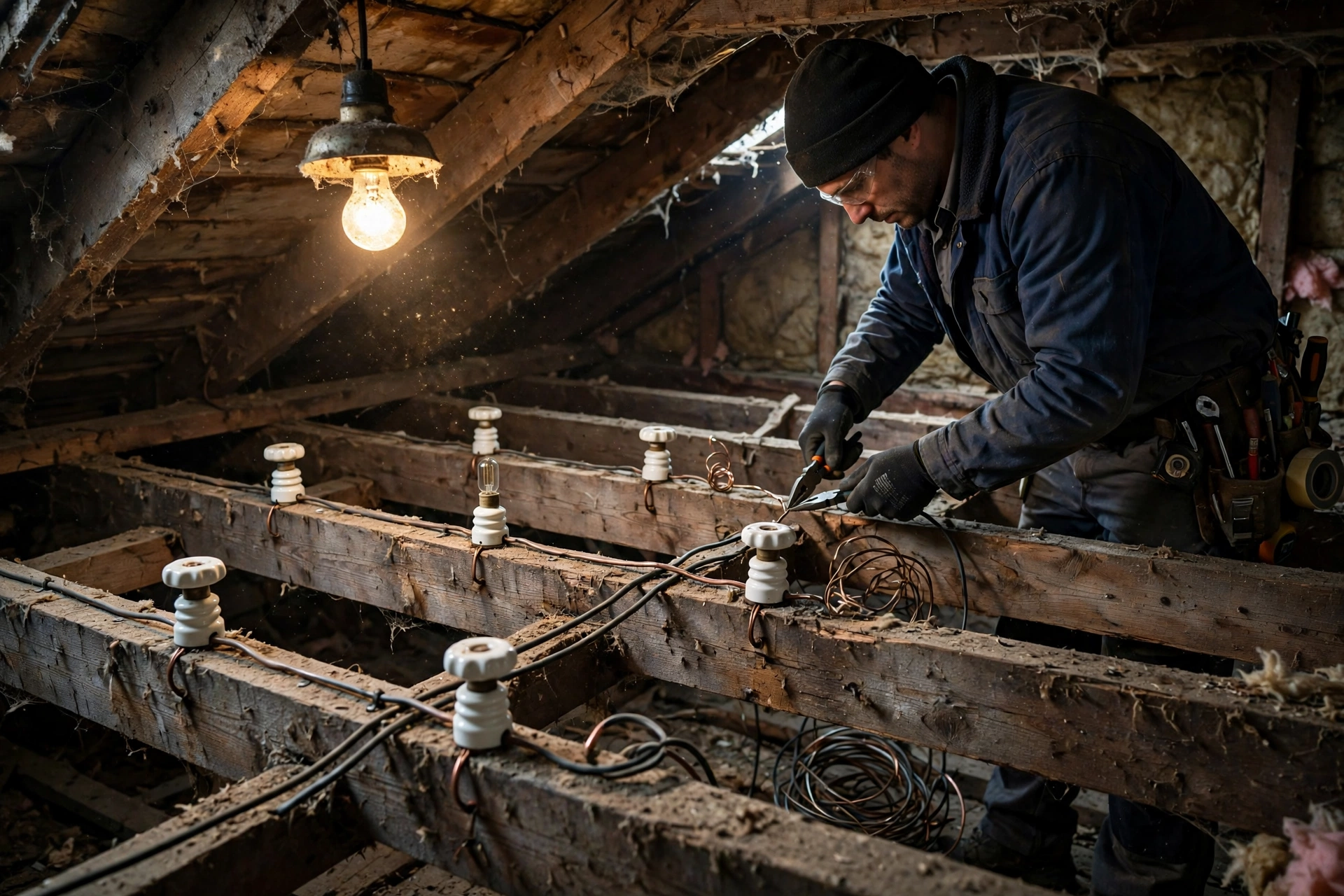
Existing wiring: copper is the baseline. Aluminum adds termination care at every device. Knob-and-tube adds the most labor plus a separate removal and safe-off line, because it has no ground wire and often runs through framing and insulation that must be worked around.
Wall access: open walls during a renovation are the cheapest route. Fishing wire through finished drywall costs more, and plaster costs the most, because every access hole is slower to cut and patch. This whole-house rewiring cost calculator adjusts labor hours for each access type.
Panel and devices: a new panel is priced as its own line when included, and outlets, switches and devices are priced per device, because a rewire that adds circuits and modern devices costs more than a like-for-like swap.
Extras: a permit allowance, drywall or plaster patching, AFCI/GFCI breaker upgrades and surge protection are each added only when selected, with their own materials and labor lines.
Levels: Budget, Standard and Premium use different material grades and labor rates ($85, $110 and $145 per hour in this tool). They are not one number multiplied by a percentage.
What Drives the Cost of Whole-House Rewiring
Home size: more square footage means longer runs, more circuits and more devices, though cost per square foot eases slightly in larger open-plan homes.
Wall access: open walls are cheapest; fishing through finished walls roughly doubles labor, and plaster sits at the top of every published range.
Existing wiring type: knob-and-tube replacement is its own price band ($12,000 to $35,000 on HomeGuide’s data) because removal is slow and must be done safely.
Stories: two- and three-story homes need vertical chases between floors, which adds hours on every circuit.
Panel scope: rewiring almost always pairs with an old panel; adding a new panel adds roughly $950 to $2,500 in this tool, in line with published panel ranges.
Finish work: drywall and plaster patching are separate lines and are often excluded from electrical quotes, so check what any quote includes.
Materials vs Labor
Copper cable, boxes and devices are a real cost, but labor dominates a rewire. Published guides are clear on this: the $2 to $4 per square foot Angi figure is mostly the work of pulling and terminating wire, and the jump to HomeGuide’s $5 to $17 per square foot in old houses is access labor — fishing, cutting, patching and working around framing — not pricier cable. That is why this whole-house rewiring cost calculator prices cable per square foot but lets wall access, stories and wiring type drive the labor hours, instead of quoting one flat rate.
Permits and Inspections
A whole-house rewire almost always needs an electrical permit with rough-in and final inspections, and panel work needs its own inspection before the utility reconnects power. Fees vary widely by city and county — published figures run from about $75 to $150 for the permit plus $100 to $125 per inspection, and more in large metros. Current code also brings AFCI protection for living areas, GFCI protection in wet locations, and proper grounding, which is often the real reason an old home’s rewire grows beyond the wire itself. The calculator includes a permit and inspection allowance only if you tick it.
Common Types of Whole-House Rewiring Jobs
Full knob-and-tube replacement in a pre-1950 home, usually for insurance and safety.
Aluminum branch-wiring rewire in a 1965-1973 home (or connector remediation instead).
Rewire during a gut renovation while walls are open — the cheapest timing.
Partial-to-full rewire when adding a kitchen, EV charger or heat pump overloads old circuits.
Rewire with a new panel and added circuits for a modern all-electric home.
Repair, Replace or Upgrade?
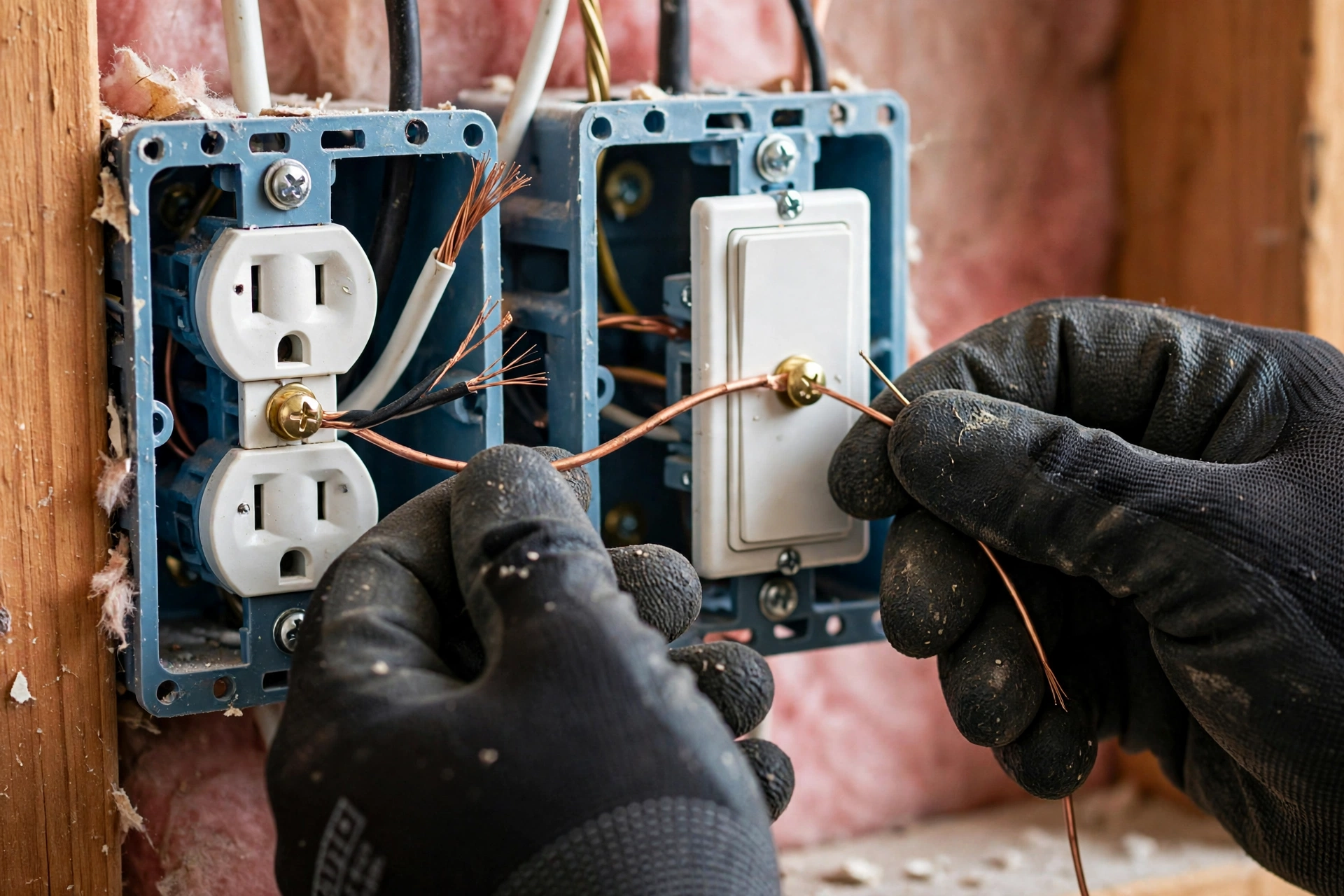
Rewire fully when the wiring itself is the problem: knob-and-tube, damaged or cloth-insulated wire, or aluminum that has already overheated at connections. Consider connector remediation instead when aluminum wiring is otherwise sound, since the fire risk lives at the terminations. Rewire opportunistically when walls are already open for a remodel — the same job through finished walls can cost a third more. And if only one or two circuits are failing, a targeted repair or a new dedicated circuit may solve it for far less than a whole-house job. Ask any electrician quoting you whether the panel, permits, AFCI/GFCI upgrades and wall patching are included, since those lines explain most of the gap between quotes. Running the same job through this whole-house rewiring cost calculator first gives you a checklist to compare those quotes against.
Budget, Standard and Premium Projects
A budget project uses basic materials and a lower labor rate. A standard project uses quality materials, a licensed electrician and typical access. A premium project uses premium materials, a specialist crew and difficult access. The three levels use different material prices and different hourly labor rates. They are not the same number scaled by a percentage. Pick the level that matches the materials and electrician you actually want, not just your budget.
Regional Pricing Differences
Electrician rates vary across the United States. Dense metro areas and regions with high licensing costs generally cost more than smaller markets — some high-cost metros quote $18 to $21 per square foot for a rewire, well above national guide ranges. This whole-house rewiring cost calculator uses national planning averages and does not adjust the price by ZIP code, so treat the result as a starting budget and compare it with local written quotes for your rewire.
Example Projects Calculated by This Tool
Project 1 – Knob-and-tube rewire, 1,800 sq ft two-story, finished walls
1,800 sq ft, 2 stories, knob-and-tube wiring, finished drywall access, built before 1970, new panel included, 45 outlets/switches, permit and drywall patching included. Standard labor about 66 hours. Budget $11,700 – $14,500. Standard $16,500 – $20,500 (headline $18,300). Premium $23,600 – $29,400.
Project 2 – Aluminum rewire, 1,200 sq ft ranch, no panel
1,200 sq ft, 1 story, aluminum wiring, finished drywall access, built 1970-1999, existing panel kept, 35 outlets/switches, permit and AFCI/GFCI upgrades included. Standard labor about 29 hours. Budget $5,200 – $6,500. Standard $7,300 – $9,100 (headline $8,100). Premium $10,400 – $12,900.
Project 3 – Copper rewire during remodel, 1,500 sq ft, open walls
1,500 sq ft, 1 story, copper wiring, open-wall access, built 2000 or later, new panel included, 40 outlets/switches, permit allowance included. Standard labor about 23.1 hours. Budget $5,800 – $7,200. Standard $8,200 – $10,300 (headline $9,200). Premium $11,700 – $14,600.
Project 4 – Knob-and-tube plaster rewire, 2,500 sq ft, all extras
2,500 sq ft, 2 stories, knob-and-tube wiring, plaster wall access, built before 1970, new panel included, 60 outlets/switches, permit, drywall patching, AFCI/GFCI upgrades and surge protection included. Standard labor about 105.7 hours. Budget $17,100 – $21,300. Standard $24,100 – $30,000 (headline $26,800). Premium $34,400 – $42,800.
Whole-House Rewiring Cost FAQs
How much does it cost to rewire a 2,000 square foot house?
At published 2026 rates of $2 to $5 per square foot for the wiring work, a 2,000 square foot home runs about $4,000 to $10,000 before panel, permits and wall repair; old-house all-in figures run higher, toward $10,000 to $30,000. Run this calculator with your wall access and wiring type for a planning range.
How much does knob-and-tube replacement cost?
HomeGuide prices knob-and-tube replacement at $12,000 to $35,000 as its own band. The wiring is ungrounded, its insulation degrades with age, and removal takes the most labor of any wiring type. This calculator adds a separate knob-and-tube removal line and the highest labor factor.
Can I just remediate aluminum wiring instead of rewiring?
Often, yes. Aluminum branch wiring (about 1965 to 1973) usually fails at connections, so CPSC-recognized connector remediation with COPALUM crimps or AlumiConn connectors at every device (roughly $1,500 to $4,000) is a legitimate alternative. A full rewire is the permanent fix and also adds grounding and modern circuits.
How long does a whole-house rewire take?
Most full rewires take one to three weeks depending on size and access, with the home usually livable in sections while work proceeds. Open-wall remodel rewires are fastest; plaster homes with finished ceilings below take longest. The electrician sequences the work circuit by circuit so power is restored room by room.
Do I need a new panel when I rewire?
Not always, but old wiring almost always pairs with an old panel, and a rewire is the cheapest time to replace it. If your panel is a fuse box, a known problem brand, or too small for the new circuits, include it. This calculator prices the panel as its own line only when you select it.
Will rewiring damage my walls?
Some access holes are normal when wire is fished through finished walls, and plaster needs more of them. A good electrician plans routes through attics, basements and closets to minimize cutting. This calculator includes a drywall and plaster patching allowance only if you tick it; full repainting is separate.
Do I need a permit for a whole-house rewire?
In almost every jurisdiction, yes. A rewire normally requires an electrical permit, rough-in and final inspections, and panel inspection before reconnection. Fees vary by city and county, so this calculator includes a permit and inspection allowance only if you select it.
How can I lower the cost of rewiring my house?
Rewire while walls are open for other work — access is the biggest cost driver. Keep device counts realistic, bundle the panel and any new circuits into the same permit and visit, and get at least three itemized quotes that state whether the panel, permits, AFCI/GFCI upgrades and wall patching are included.
Related Calculators
Electrical Panel Upgrade Cost Calculator
Estimate the cost to upgrade or replace your breaker panel.
View calculator
Electrical Service Upgrade Cost Calculator
Estimate the cost to upgrade your electrical service.
View calculator
Electrical Project Cost Calculator
Estimate the cost of outlets, lighting and remodel wiring.
View calculator
EV Charger Installation Cost Calculator
Estimate the cost to install a home EV charger.
View calculator
Generator Installation Cost Calculator
Estimate the cost to install a home generator.
View calculator
Ready to Plan Your Whole-House Rewire?
Compare your planning estimate with written quotes from licensed local electricians before you commit to a budget.
This calculator provides a planning estimate only. It is not a quote, bid or guaranteed price. Actual contractor pricing may vary based on location, conditions, material choice, labor market and project complexity. Always obtain written, itemized quotes from licensed and insured professionals before committing to a budget.