
How Much Does It Cost to Fix a Leaking Pipe?
Direct answer
The cost to fix a leaking pipe depends mainly on where the pipe is, how easy it is to reach, what kind of pipe it is, and how much water has already escaped. A small leak on an exposed pipe in a basement or under a sink is usually a much simpler job than a leak hidden inside a wall, under a floor, or buried underground in the yard. Finding the leak, opening up the area around it, and putting the wall, floor, or yard back afterwards can add considerably to the total. Because labor rates, pipe materials, access, and water damage vary so much across the United States, there is no single national price that fits every leak. Work through the cost drivers below, then use the Pipe Leak Repair Cost Calculator to build an estimate for your own situation, and compare detailed written quotes from qualified local plumbers.
Why active leaks should be addressed promptly
A leaking pipe rarely improves on its own. Even a slow drip can soak insulation, drywall, subflooring, and framing over time, and a pressurized supply leak can release a large volume of water quickly if it worsens. Addressing an active leak promptly limits the spread of water and reduces the area that needs drying and repair. If water is flowing freely, shut off the water at the nearest isolation valve or, if there is no local valve, at the main shut-off for the home, then call a plumber. If you smell gas or suspect a gas leak, leave the home and contact your gas company or emergency services from outside — a gas leak is a different, urgent problem, not a water pipe leak.
Accessible versus concealed leaks
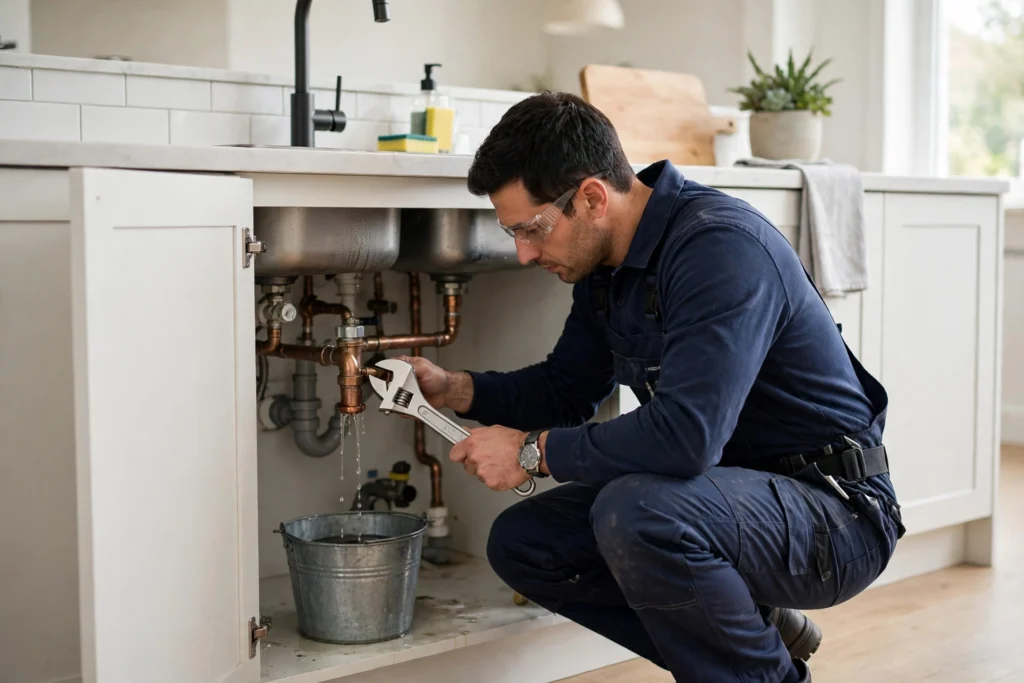
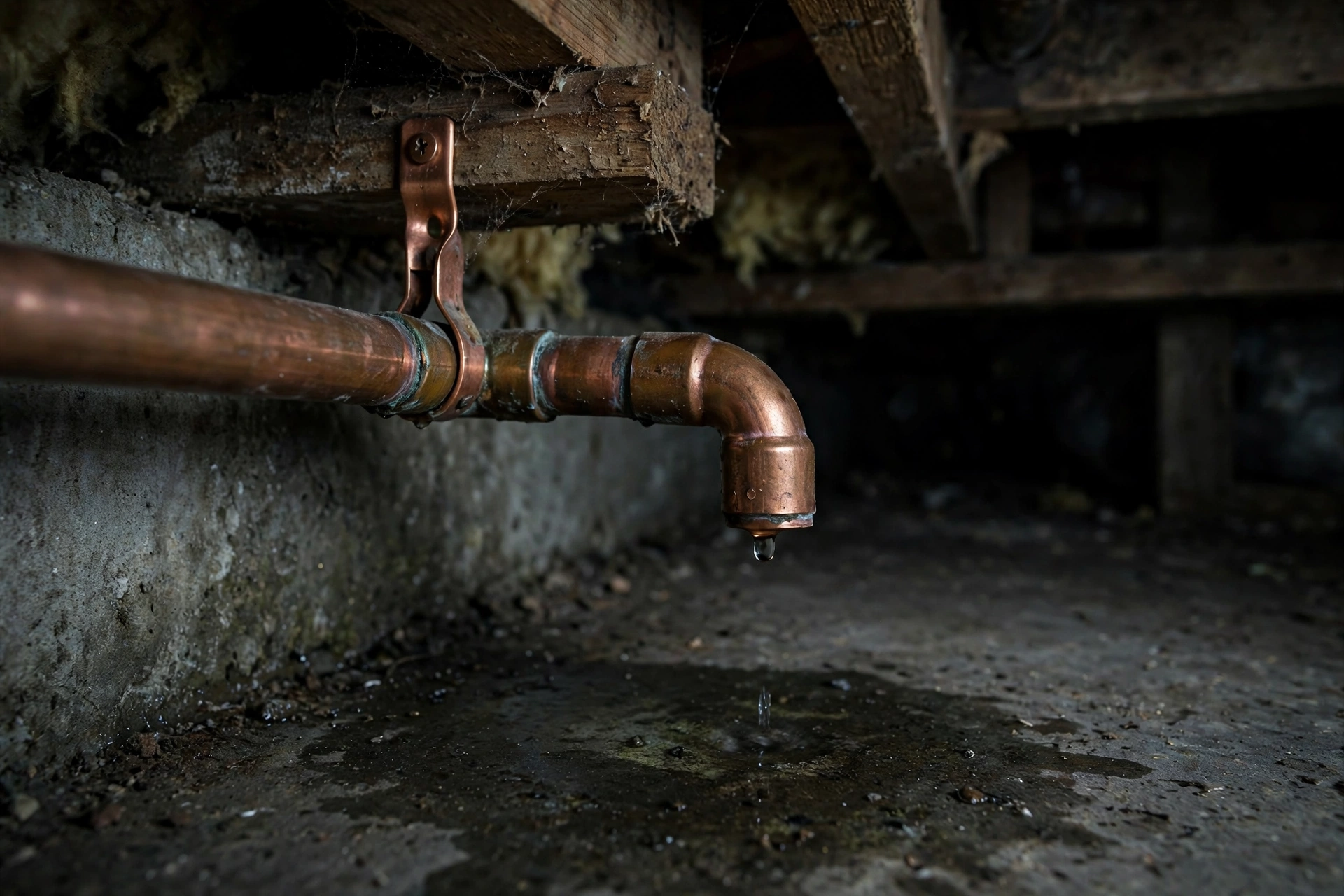
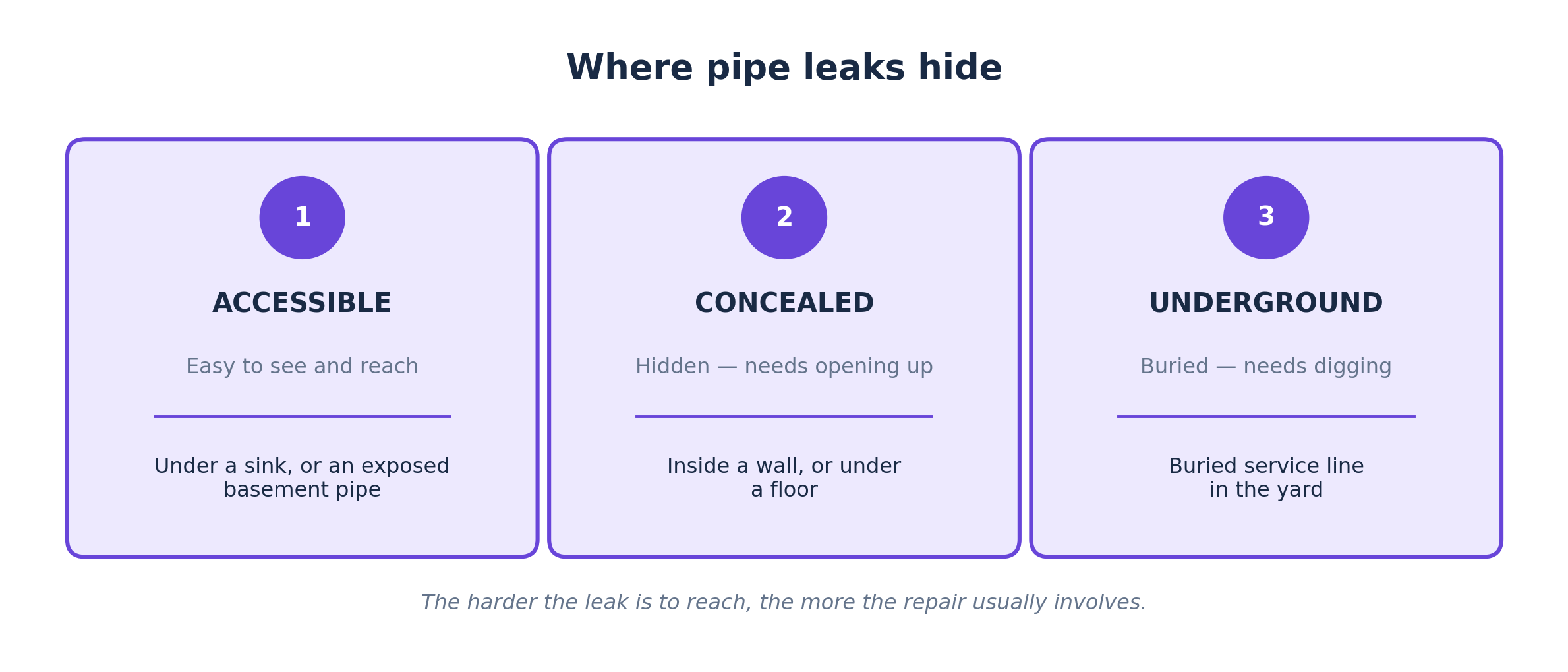
Access is often the biggest single difference between a low-cost pipe repair and an expensive one. An accessible leak is one a plumber can see and reach without removing building fabric: a joint under a kitchen sink, a visible section of pipe in an unfinished basement, a pipe in a utility room, or an exposed outdoor tap connection. The plumber can inspect the pipe, confirm where the water is coming from, and repair or replace the affected section with little preparation and little making good afterwards. A concealed leak is hidden inside a wall, ceiling, or floor, or buried underground. The plumber first has to confirm the location, then open the surface to reach the pipe, and then repair the surface after the pipe work is done.
Supply lines versus drain lines
Whether the leaking pipe carries pressurized supply water or wastewater also affects the repair. Supply lines bring fresh water into the home under pressure, to taps, toilets, showers, and appliances. A leak in a supply line is usually active whenever the water is on, so it needs to be isolated quickly, and the repair must hold under pressure. The work often involves cutting out the damaged section and fitting a new section with sound joints, then testing the repair under pressure before the wall or floor is closed up again. Drain lines carry wastewater away from sinks, baths, showers, toilets, and appliances, usually by gravity rather than under pressure.
Pipe materials and what they mean for repair
The material of the pipe shapes the repair method, the fittings needed, and sometimes the time the job takes. Copper pipe is common in many homes and is usually repaired by cutting out the damaged section and soldering or press-fitting a new section in place, which needs a clean, dry working area and enough space to work around the pipe. Galvanized steel pipe, found in many older homes, can corrode from the inside and may be more difficult to cut and thread; a leak in one section can also be a sign that neighboring sections are in poor condition. PEX pipe is a flexible plastic pipe used widely in newer homes. It can often be repaired with push-fit or crimp fittings, and its flexibility can make it easier to route through tight spaces.
Finding the leak: diagnostic work
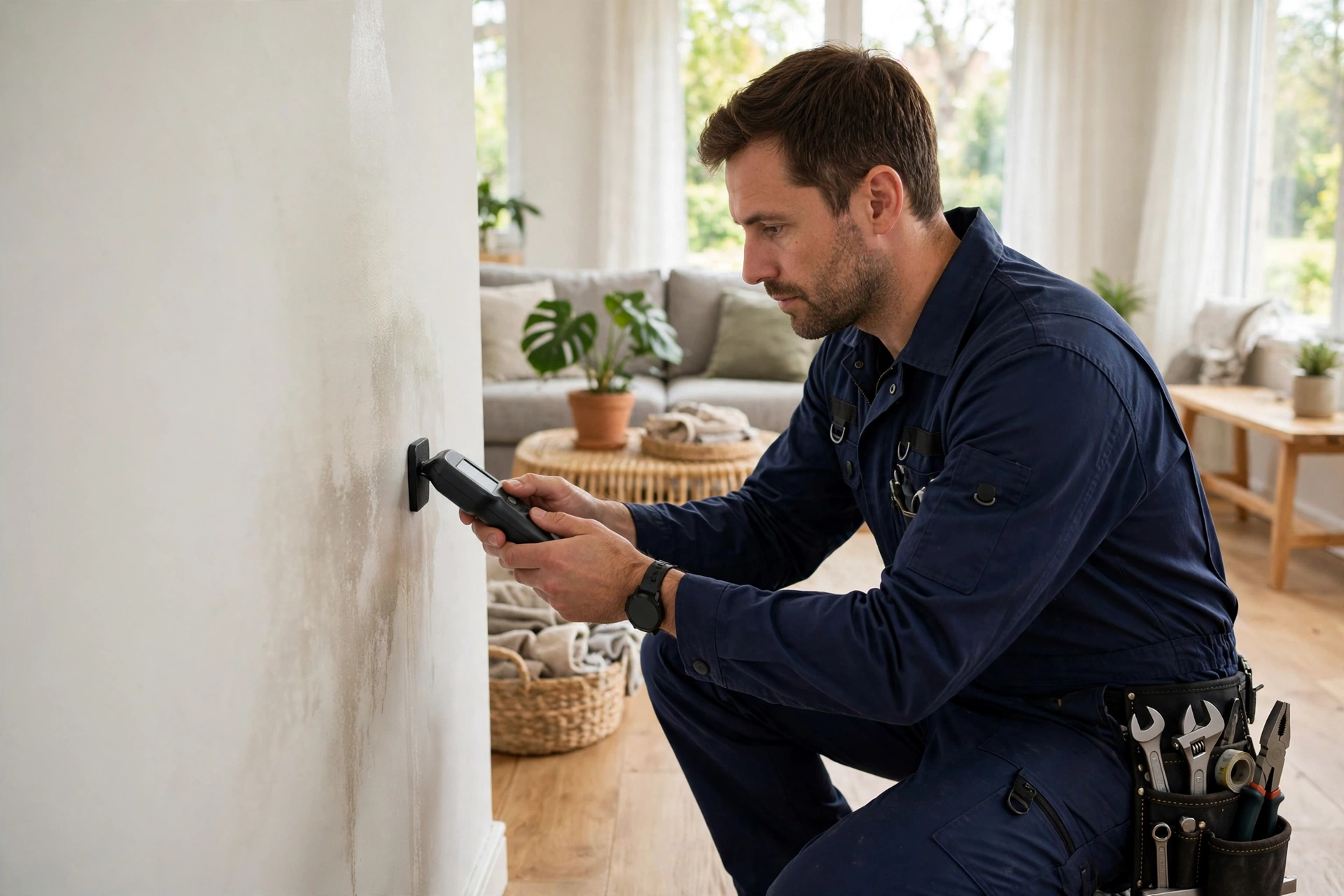
Before any pipe is cut, the leak has to be found accurately. In an accessible case, that may be as simple as watching the pipe while the water is on and tracing the water back to its source. In a concealed case, diagnosis takes longer. A plumber may use a moisture meter to map damp areas, listen for the sound of water escaping from a pressurized line, check the water meter for movement when all taps are off, or use a camera to inspect a drain line from inside. Diagnostic work is a real part of pipe leak repair cost.
How a pipe leak is repaired
The most common approach is to cut out the damaged section and replace it with a new section of the same or a compatible material, joined with fittings suited to that material. For a small pinhole or a failed joint, a plumber may replace just the joint or a short length of pipe. For a longer split, a corroded run, or a pipe damaged by freezing, a longer section may need to go. Ask the plumber whether the proposed repair is intended as a permanent fix or as a temporary hold, and what would make a longer replacement the better choice.
Underground water pipe leaks
An underground leak — for example, in the water service line between the street and the home — is a different kind of job from an indoor repair. The leak may first show as a soggy patch in the yard, a drop in water pressure, an unusually high water bill, or the sound of running water when no tap is on. Reaching the pipe means digging, which may involve a lawn, a driveway, a path, or planting, and the surface then needs to be restored. Underground work can also raise questions about responsibility: in many areas, the homeowner is responsible for the service line from the property boundary or the meter into the home, while the water supplier is responsible for the main in the street.
Opening up, drying, and putting things back
Restoration is the part of a pipe leak repair that homeowners most often underestimate. Cutting a neat opening in drywall is only the start: the area has to dry out, the pipe has to be repaired and tested, the opening has to be patched, and the surface has to be finished to match the surrounding wall, ceiling, or floor. That may involve new drywall, sanding, priming, and painting, and in a bathroom or kitchen it may involve tiles or grout. Wet insulation, drywall, and timber need to dry thoroughly before they are closed up again, or damp and mold problems can follow.
Emergency call-outs, and what can push the cost up
An emergency call-out is usually more expensive than a scheduled visit, because the plumber is attending outside normal hours or at short notice. That does not mean every leak needs an emergency visit: a slow drip from a visible pipe that can be isolated with a local valve may be safe to leave until a normal appointment, provided the water is off to that section and the area is kept dry. A leak that cannot be isolated or is flooding a room is more urgent and should be dealt with promptly. Ask whether the call-out fee is separate from the repair.
Repair versus replacing a longer run
A single leak does not always mean the whole pipe needs replacing. The decision usually turns on the condition of the pipe around the leak. If the pipe is otherwise sound, the leak is at a single joint or a small damaged spot, and the material is in good condition, a short section replacement is often the sensible repair. If the pipe is corroded along its length, has had several leaks, is made of a material that is failing, or has been damaged by freezing along a run, replacing a longer section — or, in an older home, discussing a repipe — may be more reliable in the long run than patching one spot after another. Ask the plumber to explain why a short repair or a longer replacement was chosen.
How to compare plumber quotes
Do not compare quotes on the headline total alone. Ask each plumber for a written quote that names the location of the leak, the pipe material and size, the length of pipe to be replaced, the fittings and method, the diagnostic work included, the opening up and restoration included, any drying time allowed for, and any permit or call-out fees. Useful questions to ask every plumber: Where exactly is the leak, and how did you confirm it? Will you replace a short section or a longer run, and why? How will you test the repair before closing up the wall or floor, and what making good is included? What warranty covers the repair and your work? A good plumber will answer these directly and in writing.
Planning checklist before you book
- Shut off the water to the affected section if you safely can, and note where the water is appearing and when.
- Check whether the leak is constant or only happens when a particular fixture is used.
- Clear access to the area so the plumber can work without moving furniture or stored items first.
- Ask whether diagnosis, repair, testing, and restoration are all included in the quote.
- Use the Pipe Leak Repair Cost Calculator to build an estimate for your situation before you compare quotes, so you can spot a quote that is missing a major item.
FAQs
How much does it cost to fix a leaking pipe?
It depends on the pipe location, how easy it is to reach, the pipe material, the leak severity, and how much opening up and restoration is needed. An accessible leak on an exposed pipe is usually simpler than a concealed or underground leak.
How much does it cost to fix a leaking pipe under a sink?
A leak under a sink is often accessible, because the pipe and joints can be seen and reached without opening a wall. The cost still depends on the pipe material, whether the leak is in a supply line or a drain, and what needs replacing.
What is a leaking pipe repair cost estimate?
A leaking pipe repair cost estimate is a written quote for a specific leak, based on its location, access, pipe material, and the restoration needed. It should list diagnosis, the repair method, testing, and making good, so different quotes can be compared on the same scope.
How much to fix a leaking pipe in a wall?
A leak inside a wall usually costs more than an accessible leak, because the plumber has to find it, open the wall, repair and test the pipe, allow the area to dry, and then patch and finish the surface.
What does an underground water pipe leak repair cost?
An underground water pipe leak repair involves finding the buried line, digging to reach it, repairing or replacing the affected section, and restoring the surface. The cost depends on the depth and length of the line and the surface above it.
Can a leaking pipe be repaired without replacing the whole pipe?
Often, yes. A short damaged section can be cut out and replaced with a new section of the same or a compatible material, provided the neighboring pipe is sound.
Should I call a plumber straight away for a leaking pipe?
Yes, if water is flowing freely, the leak cannot be isolated, or water is reaching electrical fittings. Shut off the water to the affected section if you safely can, and call a qualified plumber.
Conclusion
Fixing a leaking pipe is rarely just about the pipe. The location, the access, the pipe material, the diagnosis, and the restoration afterwards all shape the final cost, and the cheapest quote is only good value if it covers the whole job. Work through the cost drivers above, build an estimate with the Pipe Leak Repair Cost Calculator, and compare itemized quotes from qualified plumbers who can explain where the leak is, how they will repair and test it, and what making good is included.
