
2000 Sq Ft Roof Replacement Cost: Best 2026 Breakdown
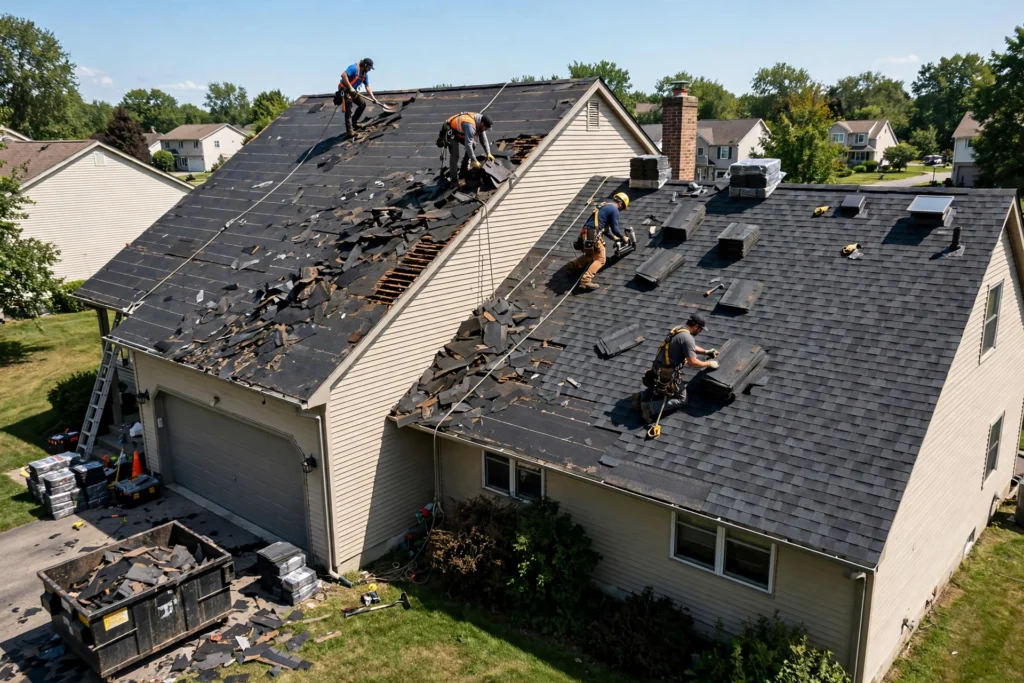
A 2,000-square-foot house is the most common size in American suburbs — and the size most homeowners ask about first when the roof needs replacing. The good news is that the 2000 sq ft roof replacement cost is well documented: our calculator prices this exact house, and the 2000 sq ft roof replacement cost is more specific than the vague ranges you will find elsewhere. This guide gives you the real numbers for a 2,000 sq ft home, explains why your roof is bigger than your house, and shows what moves the price up or down.
The short answer: for a standard single-story 2,000 sq ft footprint home, the 2000 sq ft roof replacement cost runs $9,800 to $12,200 at standard pricing, $7,800 to $9,500 on a budget build, and $12,800 to $16,500 premium. Those figures cover a 2,400-square-foot roof surface — 24 roofing squares — including tear-off of one layer, synthetic underlayment, ice and water shield, new pipe boots, drip edge, ventilation, labor, and cleanup. Asphalt shingles on the same house average $6,500 to $11,500.
Why a 2,000 sq ft house has a 2,400 sq ft roof
The first surprise in any 2000 sq ft roof replacement cost estimate is that you are not paying for 2,000 square feet of roof. You are paying for about 2,400. Two things add the extra 400 square feet. First, pitch: a sloped roof has more surface than the flat footprint beneath it, and the steeper the pitch, the bigger the difference. Second, waste: hips, valleys, ridges, and starter courses need extra material, and the calculator allows a standard 15 percent for it. Together, pitch and waste turn a 2,000 sq ft footprint into a 2,400 sq ft roof surface — 24 roofing squares, where one square covers 100 square feet.
This is the single most important concept in the whole 2000 sq ft roof replacement cost question, because every price you see is priced per square foot of roof surface or per roofing square, not per square foot of house. A quote that looks cheap per square foot of house may be expensive per square of roof, and the only way to compare 2000 sq ft roof replacement cost quotes fairly is to compare them on roof surface. If you want to understand how pitch changes the math, our roof gradient guide explains rise, run, and the area multiplier for every common pitch.
2000 sq ft roof replacement cost: the breakdown
The table below is the calculator’s own 2000 sq ft roof replacement cost breakdown for a standard single-story 2,000 sq ft footprint home with a 2,400 sq ft roof surface. All three scenarios include the same scope — the difference is the grade of materials, the experience of the crew, and the allowances for repairs and upgrades.
| Scenario | Total cost | Per roofing square (24 sqs) | Per sq ft of roof surface |
|---|---|---|---|
| Budget | $7,800–$9,500 | ~$325–$396 | ~$3.25–$3.96 |
| Standard | $9,800–$12,200 | ~$408–$508 | ~$4.08–$5.08 |
| Premium | $12,800–$16,500 | ~$533–$688 | ~$5.33–$6.88 |
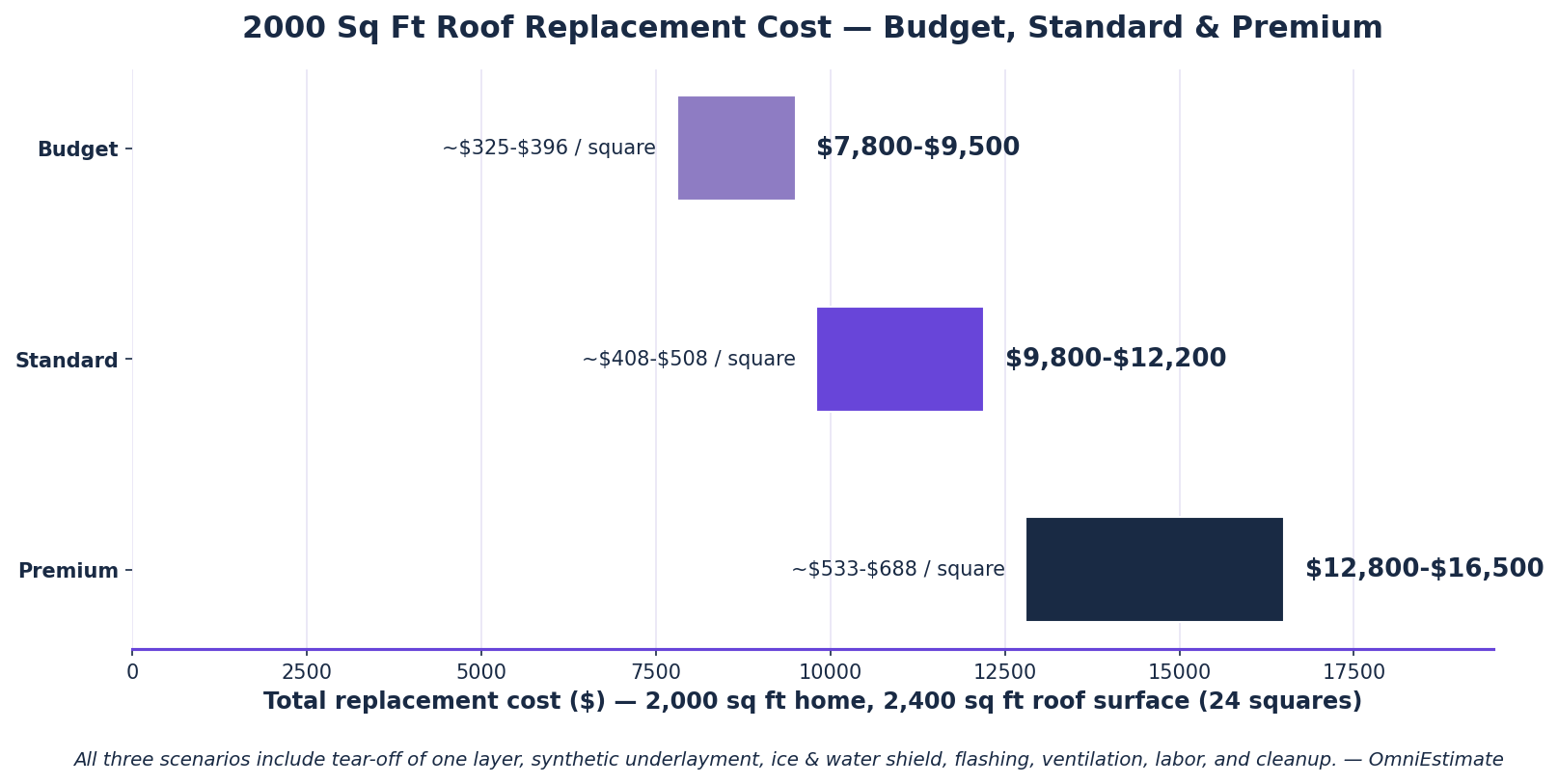
The per-square and per-square-foot columns of this 2000 sq ft roof replacement cost table are simple division of the published totals by 24 squares and 2,400 square feet — they are shown so you can compare these figures with any quote that prices by the square. The standard range is the one most homeowners should plan around: mid-grade materials, an experienced crew, and typical details. Budget means entry-grade materials and minimal extras; premium means top-tier materials, a specialist crew, and larger allowances for deck repair and upgrades.
What the price includes
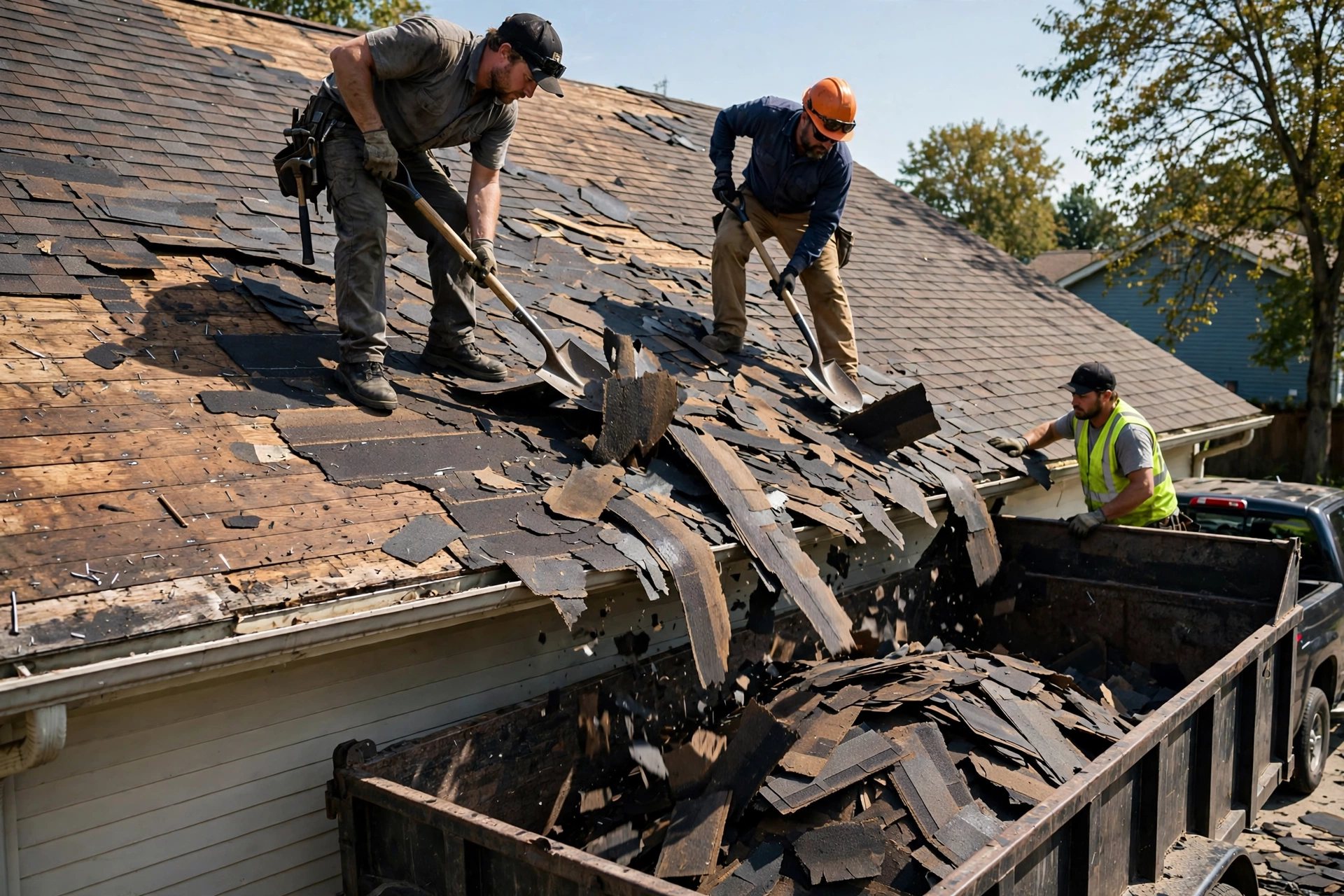
A roof replacement is not just shingles. The 2000 sq ft roof replacement cost above covers the full scope of a standard job: tear-off and disposal of one layer of existing shingles; synthetic high-performance underlayment (an upgrade from felt); ice and water shield installed in all valleys and eaves; new lifetime pipe boots; aluminum drip edge; ventilation; local labor; manufacturer warranties; and complete cleanup. If your roof has two or more layers of old shingles, the tear-off costs more — and if the deck underneath is damaged, repair adds to the bill. Those are the two most common reasons a final invoice exceeds the estimate, and a good contractor will flag both possibilities before work starts.
2000 sq ft roof replacement cost by material
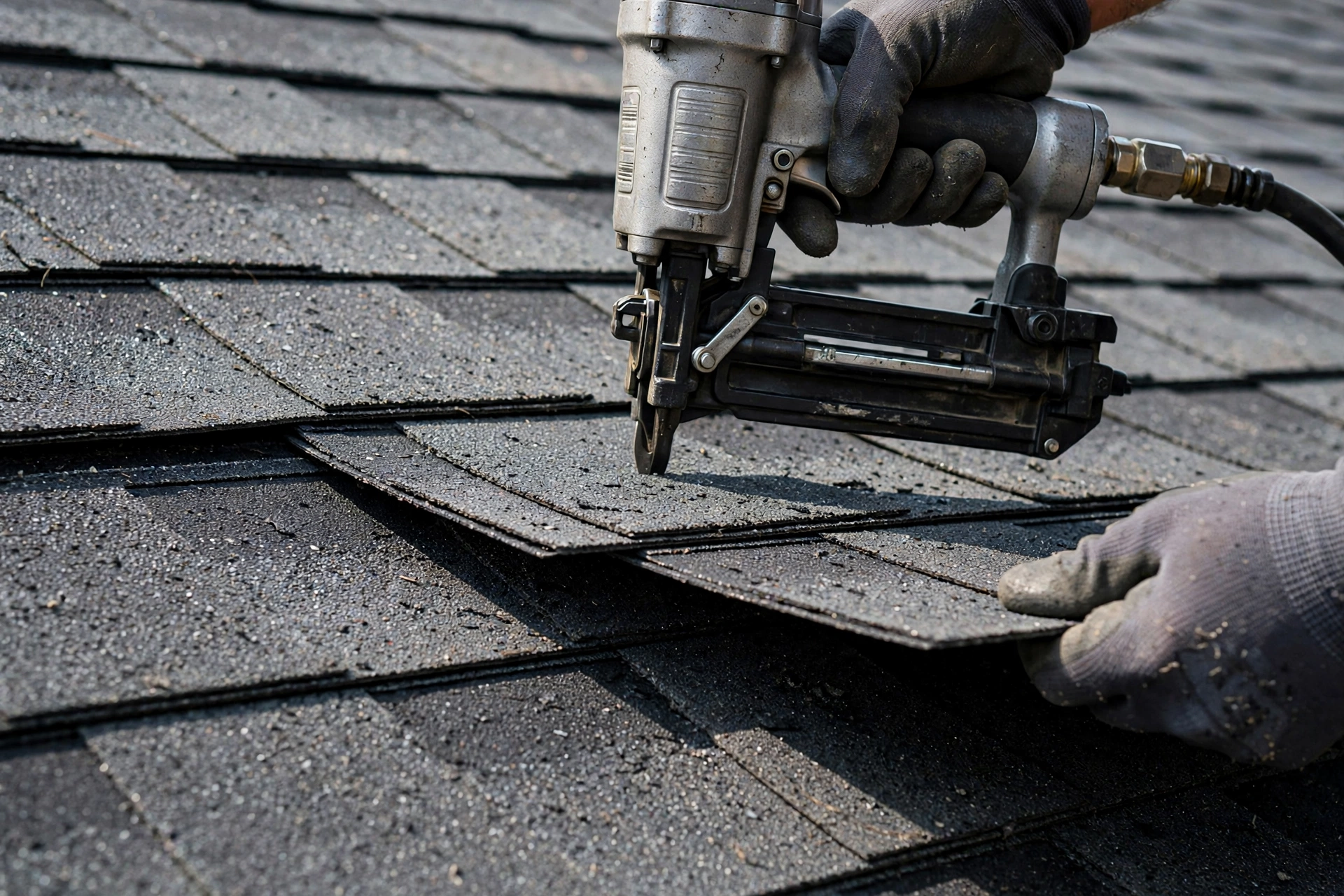
Material is the biggest single lever on the 2000 sq ft roof replacement cost. The figures above assume asphalt shingles, which cover most American homes. Within shingles, there are two main classes. Standard 3-tab asphalt shingles are the cheapest option, running roughly $1.50 to $2.50 per square foot for materials. They are economical upfront, but they offer lower wind resistance and a shorter lifespan of 15 to 20 years compared with architectural upgrades. Architectural (dimensional) shingles cost more per square foot but last longer, resist wind better, and look substantially better — most contractors recommend them as the default for a full replacement, and the standard scenario above assumes them.
Metal roofing sits above shingles in the 2000 sq ft roof replacement cost range and well above on lifespan. Standing seam metal and metal shingles cost more upfront but can last decades longer than asphalt, which changes the lifetime math even when the sticker price is higher. Our metal roof cost guide breaks down metal pricing in detail. Premium materials — slate, clay or concrete tile — scale upward from there and may need structural assessment, because they are far heavier than shingles. For a side-by-side view of every option, see our roofing materials compared guide.
What moves the price up or down
Five factors move the 2000 sq ft roof replacement cost more than anything else:
Pitch. A steep roof raises the 2000 sq ft roof replacement cost above a shallow one at the same footprint, for two reasons: more surface area per square foot of house, and slower, more safety-intensive labor. A 12/12 roof has about 41 percent more surface than a flat roof over the same footprint. The 2,400 sq ft figure above assumes a typical residential pitch; a steep or complex roof will be larger.
Complexity. Hips, valleys, dormers, skylights, and chimneys all add flashing work and waste. A simple gable roof is the cheapest shape to replace; a cut-up roof with multiple planes and penetrations costs more per square foot. Each penetration — a vent, a skylight, a chimney — needs flashing, and flashing is skilled, time-consuming work.
Tear-off layers. The standard estimate assumes one layer of old shingles coming off. A second layer adds tear-off and disposal cost, and some jurisdictions limit how many layers a roof may carry. A recover — new shingles over old — avoids tear-off but is only suitable if the existing roof and deck are dry and sound, and it must comply with local code.
Location. Labor rates, permit fees, and disposal costs vary widely by region, and some areas require specific underlayment or wind ratings that add cost. The 2000 sq ft roof replacement cost figures here are national planning estimates; your local quotes are the final word. The National Roofing Contractors Association (NRCA) can help you find qualified local contractors and understand the standards a replacement should meet.
Timing. Roofing demand peaks in late spring and summer. Booking in the shoulder seasons can sometimes mean faster scheduling and keener pricing, though weather windows matter more than the calendar — a good crew will not install shingles in rain or extreme cold regardless of the season.
How to get an accurate quote for your house
The 2000 sq ft roof replacement cost figures above are planning estimates, and the honest next step is to get written quotes from licensed local roofers. Three quotes is the standard advice, and it is good advice — but only if you compare them on the same basis. Ask every contractor for the same scope: tear-off layers, underlayment type, ice and water shield coverage, flashing details, ventilation, warranty terms, and cleanup. A quote that omits underlayment or flashing is not cheaper; it is incomplete. Before you call anyone, run your own numbers through the Roof Replacement Cost Calculator with your roof size, material, and ZIP code — you will walk into every conversation knowing what the job should cost, and you will spot an inflated quote immediately.
Frequently asked questions
How much does it cost to replace a roof on a 2000 sq ft house?
For a standard single-story 2,000 sq ft footprint home, the 2000 sq ft roof replacement cost is $9,800 to $12,200 at standard pricing, $7,800 to $9,500 budget, and $12,800 to $16,500 premium. Those figures cover a 2,400 sq ft roof surface (24 squares), including tear-off, underlayment, flashing, ventilation, labor, and cleanup.
How many squares is a 2000 sq ft roof?
A 2,000 sq ft footprint home typically has about 2,400 sq ft of roof surface once pitch and waste are accounted for — 24 roofing squares, where one square covers 100 square feet. Steeper pitches and more complex rooflines push the number higher.
What is the cheapest way to replace a roof on a 2000 sq ft house?
The cheapest legitimate option is 3-tab asphalt shingles, with materials around $1.50 to $2.50 per square foot, on a simple roof with a single tear-off layer. That is the budget end of the range at $7,800 to $9,500. Be wary of quotes far below that — they usually omit underlayment, flashing, or proper ventilation.
Does a 2000 sq ft roof replacement cost include tear-off?
Yes — the figures in this guide include tear-off and disposal of one layer of existing shingles. A second layer, or deck repair found after tear-off, adds cost. Always confirm with your contractor how many layers the quote covers.
How long does a roof replacement take on a 2000 sq ft house?
Most straightforward replacements on a 2,000 sq ft home take one to three days of work, depending on crew size, weather, roof complexity, and whether deck repair is needed. Your contractor should give a schedule in writing before work starts.
Is metal roofing worth it on a 2000 sq ft house?
Metal costs more upfront than asphalt shingles but lasts far longer, which can make it cheaper over the life of the roof — especially if you plan to stay in the house for decades. See our metal roof cost guide for the full breakdown.
How do I get an exact price for my roof?
Use the Roof Replacement Cost Calculator with your roof size, material, and ZIP code for a planning estimate, then get written quotes from at least three licensed local roofers on the same scope. The calculator tells you what the job should cost; the quotes tell you what it will cost where you live.
The bottom line
The 2000 sq ft roof replacement cost is one of the best-documented numbers in home improvement: $9,800 to $12,200 standard for a 2,400 sq ft roof surface, with budget and premium options on either side. The keys are knowing that your roof is bigger than your house, comparing quotes on roof surface rather than footprint, and checking that every quote covers the full scope — tear-off, underlayment, flashing, ventilation, and cleanup. Get those three things right and the number stops being a mystery. Run your roof through the Roof Replacement Cost Calculator to see your own estimate, then get your quotes.
