
Slate vs Tile Roof: Best 2026 Cost & Lifespan Comparison
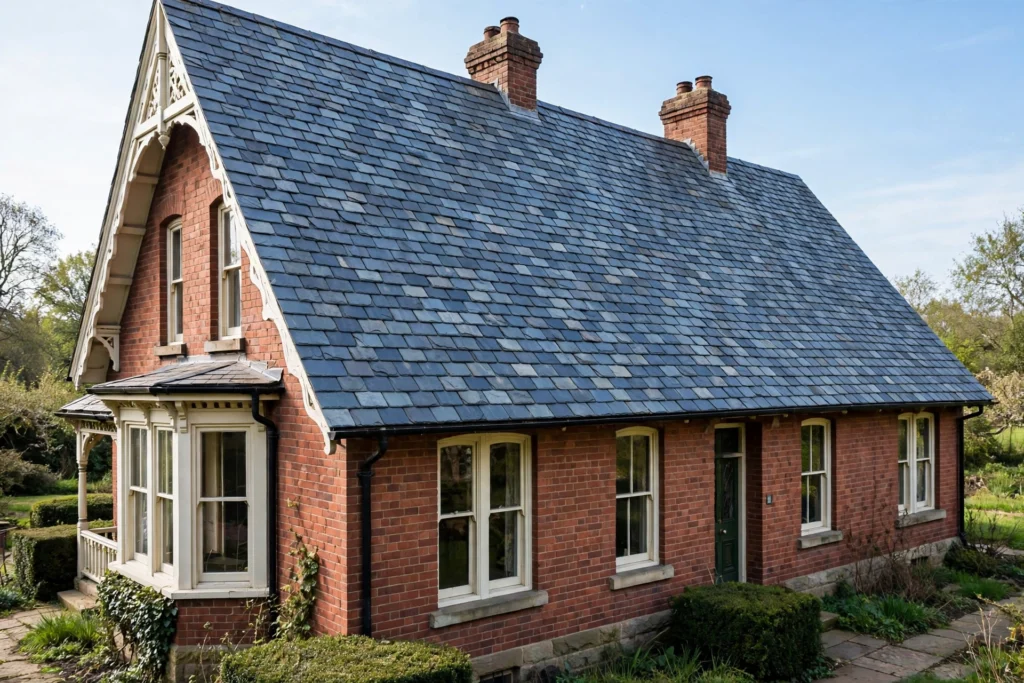
If you are choosing between slate and tile, you are already shopping at the top of the roofing market. Both materials outlast shingles by decades, both give a house a look that nothing else imitates, and both cost far more than a standard asphalt roof. But they are not interchangeable: slate is natural stone cut from a quarry, tile is fired clay or cast concrete, and the differences in cost, lifespan, and weight are big enough to decide the question for most homeowners. This guide compares slate vs tile roof on every factor that matters, with real figures from our calculators, so you can choose with the numbers in front of you.
The short answer: natural slate lasts longer — a premium S1-grade slate roof frequently lasts 75 to 150+ years — and costs more, at $10 to $30 per square foot installed. Tile costs less, at $7 to $25 per square foot for materials and installation, and still lasts a long time: clay tile 50 to 100 years, concrete tile roughly 40 to 50+ years. Slate is the longer-lived, heavier, pricier roof; tile is the more affordable way to get a premium look with a long life. The slate vs tile roof decision comes down to how much you want to spend, how long you plan to keep the house, and whether your framing can carry the weight.
What slate roofing is
Natural slate is stone — thin sheets split from quarried rock, each piece with its own color and texture. It is graded under ASTM standards into S1, S2, and S3, and the grade matters: S1 grade provides the longest operational life, 75+ years, with superior resistance to micro-cracks, freeze-thaw cycles, and water absorption. A premium S1-grade natural slate roof is a generational investment, frequently lasting between 75 and 150+ years, and with proper design, high-quality copper fasteners, and routine maintenance, it easily outlives traditional shingles by several decades. Slate needs very little recurring maintenance, but you should schedule bi-annual visual inspections to locate and replace cracked slates, and keep an eye on the metal flashing. Keep these properties in mind — lifespan and weight are half of the slate vs tile roof comparison.
Synthetic slate is the lighter alternative: tiles molded from durable composites, plastic, or recycled rubber, with authentic textures and edge-chisel detail that imitate natural stone. It is much lighter and easier to install than natural slate, needs no structural reinforcement, and costs roughly half the total investment of a natural slate roof — though its lifespan is shorter, at around 50 years, backed by a 50-year warranty. Synthetic slate is the option for owners who want the slate look without the slate weight or the slate price, and it sits near the bottom of the slate vs tile roof price range rather than at the top of it.
What tile roofing is
Tile roofing comes in three materials, and the price range is wide because the materials are so different. Clay tile is fired clay in interlocking flat, S-tile, and barrel profiles: interlocking flat runs $12 to $22 per square foot ($16.30 typical) and barrel $13.50 to $25 ($18.50 typical), with a lifespan of 50 to 100 years. Concrete tile is cast concrete in flat and S-tile profiles: flat runs $8.70 to $15.50 ($11.50 typical) and S-tile $9.40 to $16.50 ($12.40 typical), with a lifespan of roughly 40 to 50+ years. Composite or synthetic tile is the budget end of the family at $7 to $12.60 per square foot ($9.30 typical). Across the whole tile family, materials and installation run $7 to $25 per square foot, and the all-in project cost runs $13 to $26 per square foot. Both ranges are wide, which is one reason the slate vs tile roof cost comparison spans so widely: the cheapest tile undercuts the cheapest natural slate by $3 per square foot, while the most expensive clay tile overlaps slate’s mid-range.
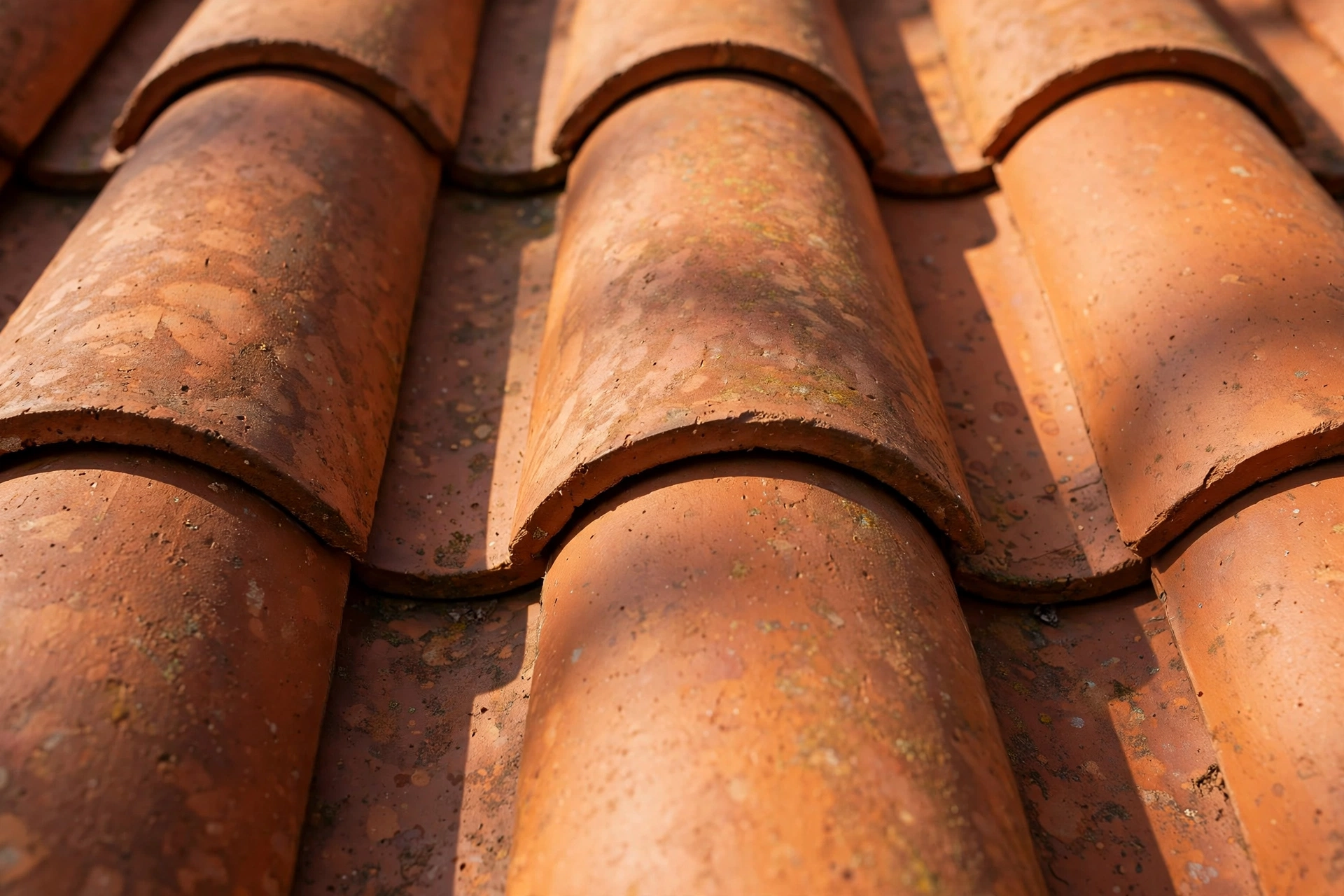
With both materials defined, the slate vs tile roof comparison comes down to four factors: cost, lifespan, weight, and installation.
Slate vs tile roof: cost compared
Cost is where most owners start the slate vs tile roof comparison, and the gap is real. The figures below come from our two calculators. Note what each page publishes: the slate page prices installed cost per square foot and per square, while the tile page prices materials plus installation and the all-in project cost — so the cleanest head-to-head is the per-square-foot row, and the all-in row shows what a tile project costs once everything is included.
| Natural slate | Synthetic slate | Tile | |
|---|---|---|---|
| Materials + install (per sq ft) | $10–$30 | $8–$14 | $7–$25 |
| Per square | $1,100–$2,000 | $700–$1,100 | — |
| All-in project cost (per sq ft) | — | — | $13–$26 |
| Typical replacement, 2,000 sq ft home | $20,000–$60,000 | — | — |
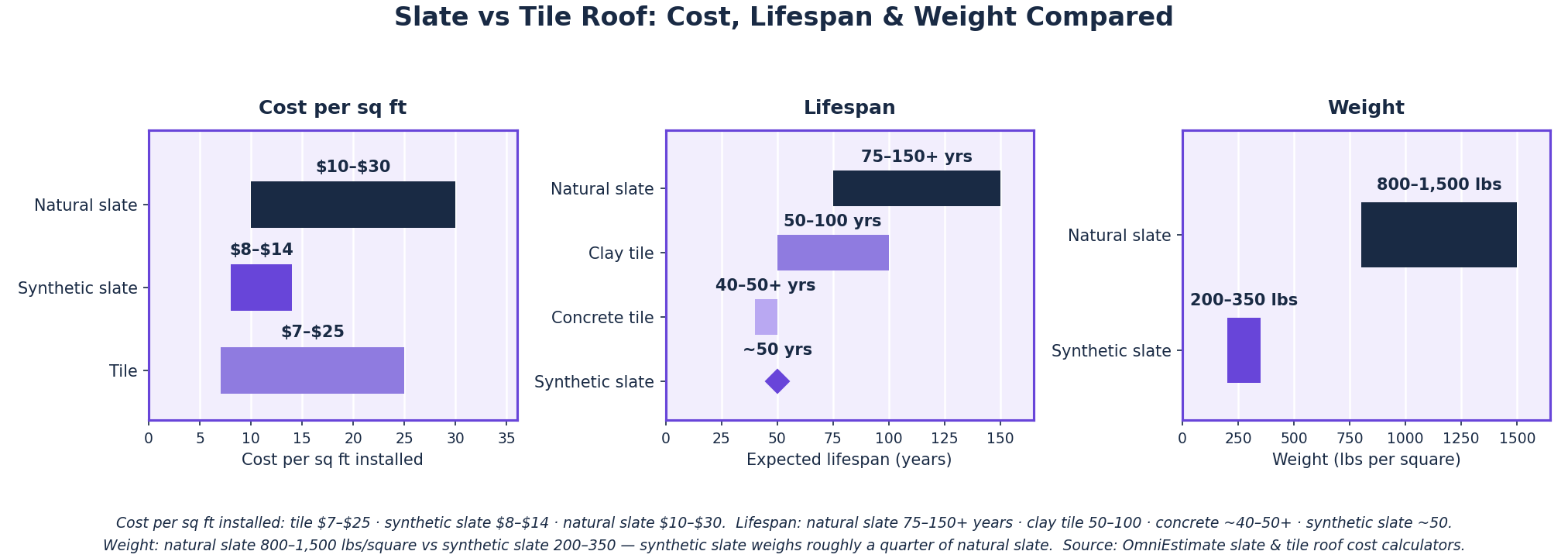
On the installed cost itself, the slate vs tile roof gap is about $3 more per square foot for natural slate at the low end of the ranges and about $5 more at the high end. On a standard 2,000-square-foot home, a complete natural slate roof replacement typically ranges from $20,000 to $60,000 — the wide range reflects slate quality, quarry, roof complexity, steep pitches, and custom color blending. Synthetic slate sits inside tile’s price range at $8 to $14 per square foot, and at roughly half the total investment of natural slate it is the way to get the slate look at a tile-like price. To price your own roof, run the numbers through the Slate Roof Cost Calculator and the Tile Roof Cost Calculator with your material, profile, and roof size.
The per-square-foot gap is only half of the slate vs tile roof cost story, though. Because a premium slate roof lasts 75 to 150+ years, its cost per year of service can work out lower than a shorter-lived roof that must be replaced — a concrete tile roof at roughly 40 to 50+ years may need replacing once during the same span that a single slate roof covers. Clay tile narrows that argument, since its 50-to-100-year lifespan overlaps slate’s lower range. The honest way to read the slate vs tile roof numbers is to price both options for your roof, then divide by the years you expect each to last: slate usually wins on cost per year, tile usually wins on the check you write today.
Slate vs tile roof: lifespan
Our calculator pages put a premium S1-grade natural slate roof at 75 to 150+ years — a generational investment that, with proper design, high-quality copper fasteners, and routine maintenance, easily outlives traditional shingles by several decades. Synthetic slate is shorter-lived, at around 50 years. Clay tile runs 50 to 100 years and concrete tile roughly 40 to 50+ years. That is the honest summary of the slate vs tile roof lifespan question: natural slate has the longest expected life by a clear margin, clay tile is the only tile that approaches it, and concrete tile and synthetic slate sit a rung below.
Three things matter more than the headline numbers in any slate vs tile roof comparison. First, grade: natural slate’s lifespan depends on the ASTM grade — S1 gives the longest operational life at 75+ years, with superior resistance to micro-cracks, freeze-thaw cycles, and water absorption, so a lower grade will not deliver the generational numbers. Second, installation quality: slate’s performance depends on correct fastening and flashing, and a badly installed premium roof will fail before a well-installed basic one. Third, maintenance: slate needs very little recurring maintenance, but bi-annual visual inspections to find and replace cracked slates are what keep a slate roof at the long end of its range. Whatever you choose, get quotes from licensed local roofers with experience in that specific material — slate and tile are both specialist jobs, and the crew matters as much as the material.
Slate vs tile roof: weight and structure
Weight is the factor most owners overlook in the slate vs tile roof comparison, and it is the one that can decide the question before cost even enters it. Natural slate weighs 800 to 1,500 pounds per square — 8 to 15 pounds per square foot. Standard framing is usually designed to hold about 10 to 15 pounds per square foot, which means a natural slate roof can sit right at the limit of what an ordinary frame was built to carry. A structural engineer must assess the framing before installation, and rafters typically need reinforcement. That assessment and reinforcement is a real line item in a slate project, on top of the material and labor cost.
Synthetic slate removes the problem: at 200 to 350 pounds per square, it weighs roughly a quarter of natural slate and needs no structural reinforcement. Tile sits in between in a way the numbers only partly capture — the clay tile calculator notes that framing reinforcement adds about $5,700 to $6,600, so tile can also need structural work, and that cost belongs in any honest slate vs tile roof budget. The practical point is the same for both materials: get the structural question answered before you fall in love with a material. The slate vs tile roof weight question is really a question about your framing — if an engineer says your roof cannot carry natural slate, synthetic slate or tile gives you the premium look without the structural bill.
Slate vs tile roof: installation and repair
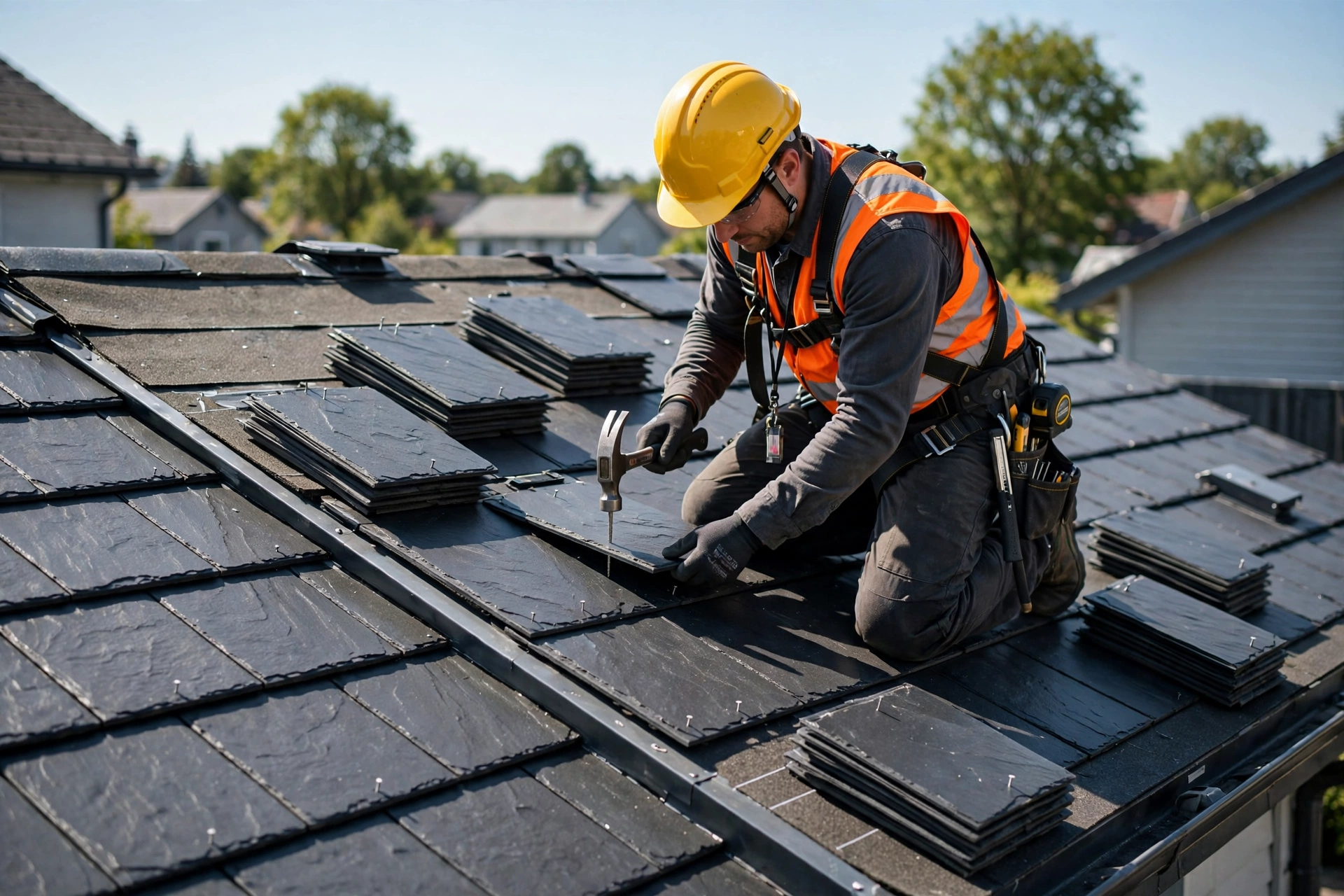
In the slate vs tile roof installation comparison, synthetic slate has the easiest path: it is much lighter and easier to install than natural slate, needs no reinforcement, and goes on with standard labor. Natural slate is the hardest of the three to install well — heavy pieces, a structural assessment first, copper fasteners, and a crew that knows slate specifically. Tile falls between the two on difficulty, and like slate it rewards a crew with experience in the exact material and profile you have chosen. Both slate and tile are specialist installations, and the cheapest bid from a crew that has never laid your material is rarely the bargain it looks like.
On repairs, the slate vs tile roof comparison is straightforward on the slate side: slate requires very little recurring maintenance, and the main job is the bi-annual visual inspection to locate and replace cracked slates, plus watching the metal flashing. A single cracked slate can be replaced without disturbing the rest of the roof, which is one of the quiet advantages of a roof made of individual pieces rather than a continuous membrane. For tile, ask any contractor how repairs work for the profile you are considering — how individual tiles are replaced, what matching tile costs, and whether the profile you want will still be made in twenty years. Neither material is hard to live with, but both punish neglect: a small crack left alone becomes a leak, and a leak left alone becomes rot.
Which should you choose?
The slate vs tile roof decision is not really about which material is better in the abstract — it is about which one fits your house, your budget, and your plans.
Choose natural slate if: you want the longest-lived roof available, you plan to keep the house for decades, your framing can carry the weight (or you are willing to pay for reinforcement), and the budget stretches to $10 to $30 per square foot installed. Slate is the generational choice — a roof you install once and your grandchildren inherit. The S1 grade is the one to ask for, and the crew’s slate experience matters as much as the stone itself.
Choose synthetic slate if: you want the slate look without the slate weight or price. At $8 to $14 per square foot and roughly half the total investment of natural slate, with no structural reinforcement needed and a 50-year warranty, it is the pragmatic pick in the slate vs tile roof range — and at around 50 years of life, it outlasts most roofs you will ever own.
Choose tile if: your budget is tighter, you want a premium look at $7 to $25 per square foot, or you prefer clay or concrete over stone. Clay tile is the strongest tile choice on lifespan at 50 to 100 years; concrete tile costs less but lasts roughly 40 to 50+ years. Either way, budget for the possibility of framing reinforcement — the clay tile calculator puts it at about $5,700 to $6,600.
Either way: whichever side of the slate vs tile roof comparison you land on, get the material grade right (S1 for natural slate), get the structural question answered before you sign, and get a crew with proven experience in the material you pick. The National Roofing Contractors Association (NRCA) is a good starting point for finding qualified contractors and understanding the standards each system should meet. For the wider picture — how slate and tile compare with shingles, metal, and membrane — see our roofing materials compared guide, and if your project involves a standard-size home rather than a premium material, the 2000 sq ft roof replacement cost guide and the metal roof vs shingles comparison cover those options.
Frequently asked questions
Which is cheaper, slate or tile?
Tile is cheaper. Our calculators put tile at $7 to $25 per square foot for materials and installation, with an all-in project cost of $13 to $26 per square foot, against natural slate at $10 to $30 per square foot installed. Synthetic slate sits between the two at $8 to $14 per square foot, at roughly half the total investment of natural slate.
Which lasts longer, slate or tile?
Natural slate lasts longer. A premium S1-grade natural slate roof frequently lasts between 75 and 150+ years, while clay tile lasts 50 to 100 years and concrete tile roughly 40 to 50+ years. Synthetic slate lasts around 50 years. Clay tile is the only tile that approaches slate’s lifespan.
Can my roof support slate?
It depends on your framing. Natural slate weighs 800 to 1,500 pounds per square (8 to 15 pounds per square foot), and standard framing is usually designed to hold about 10 to 15 pounds per square foot. A structural engineer must assess your framing before installation, and rafters typically need reinforcement. Synthetic slate, at 200 to 350 pounds per square, needs no structural reinforcement.
What is synthetic slate, and is it worth it?
Synthetic slate is tile molded from durable composites, plastic, or recycled rubber, with authentic textures and edge-chisel detail that imitate natural stone. It costs $8 to $14 per square foot, about half the total investment of natural slate, needs no structural reinforcement, and carries a 50-year warranty with a lifespan of around 50 years. It is worth it if you want the slate look without the weight or the price.
Is clay tile better than concrete tile?
Clay tile lasts longer and costs more. Clay tile runs $12 to $22 per square foot for interlocking flat and $13.50 to $25 for barrel, with a lifespan of 50 to 100 years. Concrete tile runs $8.70 to $15.50 for flat and $9.40 to $16.50 for S-tile, with a lifespan of roughly 40 to 50+ years. Choose clay for longevity, concrete for budget.
How much does a slate roof cost for a 2,000 sq ft home?
For a standard 2,000-square-foot home, a complete natural slate roof replacement typically ranges from $20,000 to $60,000. The wide range reflects slate quality, quarry, roof complexity, steep pitches, and custom color blending. Synthetic slate costs roughly half the total investment of natural slate.
How much does a slate or tile roof cost for my home?
It depends on material, profile, grade, roof size, and whether your framing needs reinforcement. Run your numbers through the Slate Roof Cost Calculator and the Tile Roof Cost Calculator for budget, standard, and premium estimates, then confirm with written quotes from licensed local roofers.
The bottom line
Slate vs tile roof comes down to this: natural slate lasts longest, costs most, and weighs most; tile costs less, lasts a long time — especially clay — and asks less of your framing. Synthetic slate splits the difference, with the slate look at a tile-like price and no structural work. Either way, measure your roof, price both options on the same basis, answer the structural question first, and hire a crew that has installed your chosen material many times before. The calculators above will give you the numbers to take into that conversation.
